
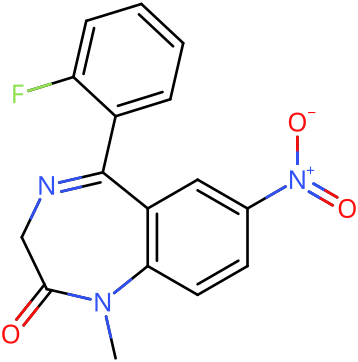
Flunitrazepam Stats & Data
PPTYJKAXVCCBDU-UHFFFAOYSA-NPharmacology
DrugBankDescription
Flunitrazepam is a benzodiazepine with pharmacologic actions similar to those of diazepam that can cause anterograde amnesia. Some reports indicate that it is used as a date rape drug and suggest that it may precipitate violent behavior. The United States Government has banned the importation of this drug.
Mechanism of Action
Benzodiazepines bind nonspecifically to benzodiazepine receptors BNZ1, which mediates sleep, and BNZ2, which affects affects muscle relaxation, anticonvulsant activity, motor coordination, and memory. As benzodiazepine receptors are thought to be coupled to gamma-aminobutyric acid-A (GABAA) receptors, this enhances the effects of GABA by increasing GABA affinity for the GABA receptor. Binding of the inhibitory neurotransmitter GABA to the site opens the chloride channel, resulting in a hyperpolarized cell membrane that prevents further excitation of the cell.
Pharmacodynamics
Flunitrazepam is a powerful hypnotic drug that is a benzodiazepine derivative. It has powerful hypnotic, sedative, anxiolytic, and skeletal muscle relaxant properties. The drug is sometimes used as a date rape drug. In the United States, the drug has not been approved by the Food and Drug Administration for medical use, and is considered to be an illegal drug. It has however been approved in the United Kingdom and other countries.
Absorption
50% (suppository) and 64-77% (oral)
Indication
For short-term treatment of severe insomnias, that are not responsive to other hypnotics.
Receptor Profile
Receptor Actions
Receptor Binding
Measured Affinities
Guide to PHARMACOLOGYMeasured binding and functional data for flunitrazepam, curated by the IUPHAR/BPS Guide to PHARMACOLOGY. Each row cites the paper it came from. Lower concentrations mean tighter binding — a value in the sub-nanomolar range indicates a very potent interaction.
| Target | Action | Measure | Value | Concentration | Species | Source |
|---|---|---|---|---|---|---|
| GABAA receptor α1 subunit GABRA1 | Positive | pKi | 8.28 | 5.25 nM | Human | PMID 8632757 |
| GABAA receptor α2 subunit GABRA2 | Positive | pKi | 8.28 | 5.25 nM | Human | PMID 8632757 |
| GABAA receptor α5 subunit GABRA5 | Positive | pKi | 8.26 | 5.5 nM | Human | PMID 8632757 |
| GABAA receptor α3 subunit GABRA3 | Positive | pKi | 7.8 | 15.85 nM | Human | PMID 8632757 |
Reading this. pKi, pEC50 and pIC50 are negative log molar values, so a higher number means a tighter interaction; the concentration column converts them for you. Values from non-human species are laboratory measurements and do not translate directly to human effect. Receptor affinity is not a dose — it describes what a molecule binds, not how much of it is safe to take.
Receptor data from the IUPHAR/BPS Guide to PHARMACOLOGY (v2026.2), licensed CC BY-SA 4.0. Matched to this substance by InChIKey.
History & Culture
1960–1975
Flunitrazepam was discovered at Hoffmann-La Roche as part of the benzodiazepine research program led by Leo Sternbach. The patent application was filed in 1960 and granted in 1962. Research during this period demonstrated that the specific molecular combination of an N-methyl group and 2-fluoro substitution produced particularly pronounced hypnotic effects compared to other benzodiazepine variants being investigated. The drug came into medical use in the early 1970s and entered the European commercial market in 1975 under the brand name Rohypnol. It was introduced as a treatment for severe insomnia and as a pre-anesthetic medication in hospital settings requiring deep sedation. Originally available in both 1 mg and 2 mg tablet formulations, it gradually expanded to additional international markets during the 1980s. The drug was never approved for medical use or marketed in the United States.
1996–2016
Growing concerns over recreational abuse and use in drug-facilitated crimes prompted the manufacturer Roche to implement several modifications throughout the 1990s. The 2 mg tablets were phased out between 1996 and 1999, and most European countries revised their regulations to limit the maximum available dose to 1 mg. In 1998, Roche introduced redesigned tablets intended to deter covert administration in beverages. The new formulation was made less soluble in cold liquids and incorporated a blue dye that would visibly color drinks when dissolved, while leaving green residue at the bottom of the container. These modifications were specifically designed to make detection easier in the cold beverages commonly served at social gatherings. By 2016, flunitrazepam had been withdrawn from commercial markets in Spain, France, Norway, Germany, and the United Kingdom. The drug remains available by prescription in some countries but faces significant regulatory restrictions across most jurisdictions.
Flunitrazepam gained widespread notoriety during the 1990s as a "date rape drug," acquiring street names including "roofies" and "floonies." Its potent capacity to cause anterograde amnesia made it particularly alarming in the context of drug-facilitated sexual assault. However, harm reduction documentation notes that while this association became well-known in popular culture, such use represents a relatively small proportion of the drug's overall misuse patterns. In the United Kingdom, evidence suggests that flunitrazepam and similar sedatives have been more commonly connected to drug-assisted robbery than sexual assault, with activist estimates suggesting up to two thousand individuals may be robbed annually after consuming spiked drinks. Swedish epidemiological research found flunitrazepam to be the second most common drug detected in suicide cases, identified in approximately 16% of analyzed deaths. The substance has also circulated as a recreational sedative within rave and club scenes.
Flunitrazepam likely has a low toxicity relative to dose. However, it is potentially lethal when mixed with depressants like alcohol or opioids. It is strongly recommended that one use harm reduction practices when using this drug.
Carcinogenicity
No indication of carcinogenicity to humans (not listed by IARC).
Overdose
Benzodiazepine overdose may occur when a benzodiazepine is taken in large quantities or concurrently with other depressants. This is particularly dangerous with other GABAergic depressants such as barbiturates and alcohol since they work similarly, but bind to distinct allosteric sites on the GABAA receptor. Thus their effects potentiate one another.
Toxicity (DrugBank)
Symptoms of overdose include confusion, coma, impaired coordination, sleepiness, and slowed reaction time.
Effect Profile
Curated + 12 ReportsStrong anxiolysis and euphoria with strong cognitive impairment, mild sedation
Tolerance & Pharmacokinetics
drugs.wikiNo tolerance chart. Our decay curves for these drugs were estimates, and a curve can make tolerance look longer-lasting than it is, which is the dangerous direction.
How fast tolerance to these drugs fades after a break has not been measured well enough to draw, so don't count on a dose you used to take still being safe: after time off, start with a much smaller amount and don't use alone. Mixing sedatives with each other, with alcohol or with opioids sharply raises the risk of a fatal overdose. If you've been using regularly, don't stop suddenly: withdrawal from benzodiazepines, alcohol or GHB/GBL can cause seizures or delirium, so get medical help to cut down gradually.
Sources: FRANK: benzodiazepines · Alcohol and Drug Foundation: GHB · FDA 2020: benzodiazepine boxed warning · FDA 2019: gabapentinoids and breathing · NHS: alcohol use disorder
Cross-Tolerances
Experience Report Analysis
ErowidDemographics
Gender Distribution
Too few reports for a chart: gender is known from 14 reports, and a split is drawn only from 20 reports or more. Counts are shown instead. Why 20?
- Male 13 of 14
- Female 1 of 14
Age Distribution
Reports Over Time
Effect Analysis
ErowidEffects aggregated from 12 experience reports (12 single-substance Erowid)
Effect Sentiment Distribution
Confidence Distribution
Each bar is the share of reports mentioning the effect; its whisker, and the band on the rows below, is the 95% interval: where the share could plausibly be with other reports of the same kind.
Too few reports for bars: these effects come from 12 single-substance Erowid reports, and a bar is drawn only from 20 reports or more. With fewer, a percentage cannot tell a common effect from a rare one. Counts are shown instead. Why 20?
Positive Effects 3
Adverse Effects 1
Real-World Dose Distribution
ErowidFrom 13 of 18 recorded dose entries: those that state a weight (mg, g or µg), in routes with at least five of them. Values above Q3 + 3×IQR, far above what people typically take, are left out; they can include real heavy doses and overdoses, not only mistakes.
Oral (n=12)
Form / Preparation
Most common forms and preparations, as a share of the 5 reports that give one
Too few reports for bars: these forms come from 5 reports, and a bar is drawn only from 20 reports or more. With fewer, a percentage cannot tell a common effect from a rare one. Counts are shown instead. Why 20?
- Pill / Tablet 5 of 5
Benzodiazepine Equivalence
Flunitrazepam - 1mg ~=10mg Diazepam.
Legal Status
| Country | Status | Notes |
|---|---|---|
| Australia | Schedule 8 | Classified as a controlled drug requiring a valid prescription or license. Unauthorized possession may result in charges of trafficking in a drug of dependence. Only available in 1 mg tablets marketed under the brand name Hypnodorm. |
| Austria | Prescription required | Legal for medical use under the Arzneimittelgesetz (AMG). Possession or sale without a valid prescription is prohibited under the Suchtmittelgesetz (SMG). |
| Canada | Schedule I CDSA | Reclassified from Schedule III to Schedule I in 2012 under the Controlled Drugs and Substances Act. Production, distribution, and possession without authorization carry criminal penalties. |
| Germany | Anlage III BtMG | Since November 2011, regulated under Anlage III of the Betäubungsmittelgesetz, requiring a special narcotic prescription form. Available in 1 mg tablets; 2 mg injectable ampoules are handled similarly to controlled narcotics like morphine. |
| Netherlands | Prescription medication | Available by prescription in both 1 mg and 2 mg tablet formulations. Generic alternatives exist for the higher dosage form. |
| Norway | Controlled substance | Classified as a controlled substance available only by prescription. Marketed under the brand name Flunipam. |
| Sweden | Class 2 | Classified more strictly than most other benzodiazepines, which fall under Class 4. Available as a prescription medication in 0.5 mg and 1.0 mg tablet strengths. |
| Switzerland | Controlled narcotic | Listed as a controlled narcotic substance. Occasionally prescribed as a sleep aid for severe insomnia. Tablets are dyed green and blue to deter covert administration in beverages. |
| United Kingdom | Class C, Schedule 4 | Controlled under the Misuse of Drugs Act 1971 as a Class C substance and Schedule 4 under the Misuse of Drugs Regulations 2001. Approved for medical use and available by prescription. |
| United States | Schedule IV (federal); Schedule I (some states) | Federally classified as Schedule IV under the Controlled Substances Act, but the FDA has not approved it for medical use, effectively making possession without a valid foreign prescription illegal. Importation is banned even for individuals holding valid prescriptions from other countries. Several states including Idaho, Minnesota, and Oklahoma have independently classified it as Schedule I, carrying stricter penalties. |
Harm Reduction
drugs.wikiHarm-reduction essentials: (1) Potency and amnesia: flunitrazepam is a powerful hypnotic; small dose increments can cause profound sedation and anterograde amnesia, especially above ~1–2 mg. Avoid redosing during the first several hours because the peak may be delayed and effects accumulate with its long half-life. Evidence: HR organizations and pharmacology summaries report rapid onset, strong amnesia and long duration. (2) Mixing with depressants: combining benzodiazepines with alcohol, opioids, or GHB/GBL greatly increases the risk of respiratory depression, loss of consciousness, aspiration, and death. Treat these combinations as high-risk and avoid. If opioids may be present, keep naloxone accessible, but note that naloxone will not reverse benzodiazepine sedation. (3) Gabapentinoids and other sedatives: pregabalin/gabapentin and sedative-hypnotics (Z-drugs, antihistamines, carisoprodol) additively increase sedation and overdose risk; co-use features prominently in European overdose monitoring. (4) Grapefruit/CYP3A4: avoid grapefruit products and strong CYP3A4 inhibitors; they can raise flunitrazepam levels and prolong sedation. (5) Counterfeit risk and adulteration: tablets sold as “Rohypnol” on unregulated markets may contain other benzodiazepines or even potent synthetic opioids (e.g., nitazenes). Use trusted sources and, where available, drug checking to verify contents. (6) Overdose response: prioritize airway, breathing, and circulation; place an unconscious person in the recovery position and call emergency services. Flumazenil is not an at‑home antidote—it can precipitate dangerous seizures and withdrawal in benzodiazepine-tolerant individuals or mixed overdoses (e.g., with TCAs) and should only be considered in carefully selected medical settings. (7) Dependence and withdrawal: daily or prolonged use increases dependence risk; abrupt cessation after regular use can cause severe withdrawal and seizures. Any taper should be medically supervised; the FDA’s 2020 boxed warning for benzodiazepines underscores misuse, addiction, and withdrawal risks, especially with concurrent CNS depressants. (8) Next‑day impairment: due to an 18–26 h half-life and active metabolites, psychomotor impairment can persist into the next day—avoid driving or hazardous tasks until fully alert. (9) Sexual assault prevention and consent: never dose another person; be aware that flunitrazepam can cause hours of amnesia. Reduce victimization risk by not leaving drinks unattended, refusing unknown/open beverages, and looking out for peers. Seek immediate medical and legal assistance if drink‑tampering is suspected. (10) Populations at higher risk: older adults, people with respiratory disease or sleep apnea, and those on multiple sedatives are at heightened risk for respiratory events and falls; use extra caution or avoid.
References
Data Sources
Cited References
Additional references
- DrugBank: Flunitrazepam (DB01544) – metabolism, half-life, grapefruit interaction
- Saferparty (Stadt Zürich): Flunitrazepam HR sheet – dosing, duration, mixing risks
- TripSit Combination Chart – alcohol/GHB/opioids with benzodiazepines marked Dangerous
- NCBI/StatPearls: Benzodiazepine Toxicity – supportive care; flumazenil cautions
- NCBI/StatPearls: Flumazenil – contraindications and seizure risk in benzo dependence and TCA co-ingestion
- Erowid: Flunitrazepam Vault – effects, amnesia, duration; DFSA background
- Erowid: Investigating Drug‑facilitated Sexual Assault – timelines and amnesia
- NCBI/StatPearls: Benzodiazepines – adverse effects and high‑risk populations
- EUDA (EMCDDA): European Drug Report 2025 – polysubstance deaths; benzos with opioids; fake medicines/nitazenes