
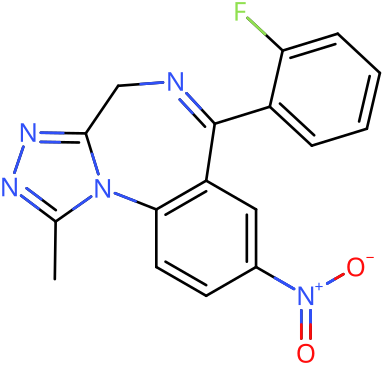
Flunitrazolam Stats & Data
O=N(=O)c1ccc2n3c(C)nnc3CN=C(c3ccccc3F)c2c1RDLAGIOILLWVTM-UHFFFAOYSA-NReceptor Profile
Receptor Actions
History & Culture
Flunitrazolam is a novel designer benzodiazepine with no documented history prior to its emergence on the online research chemical market. Unlike many benzodiazepines which were first developed by pharmaceutical companies and later diverted to recreational use, flunitrazolam appears to have been synthesized specifically for the grey market without any preceding scientific or patent literature. The compound was first definitively identified in October 2016, when an analytical laboratory in Germany detected and reported it to the European Monitoring Centre for Drugs and Drug Addiction (EMCDDA) Early Warning System. It subsequently became available for purchase through online vendors, typically sold as pressed pellets alongside other novel triazolobenzodiazepines such as clonazolam and flubromazolam. As the triazole analogue of flunitrazepam (marketed pharmaceutically as Rohypnol), flunitrazolam represents part of a broader trend of designer benzodiazepines appearing on research chemical markets during the mid-2010s, with vendors systematically exploring structural modifications to existing benzodiazepine scaffolds.
Toxicity
PsychonautWikiFlunitrazolam likely has a low toxicity relative to dose. However, it is potentially lethal when mixed with depressants like alcohol or opioids. It is strongly recommended that one use harm reduction practices when using this substance.
Overdose
Benzodiazepine overdose may occur when a benzodiazepine is taken in extremely heavy quantities or concurrently with other depressants. This is particularly dangerous with other GABAergic depressants such as barbiturates and alcohol since they work in a similar fashion, but bind to distinct allosteric sites on the GABAA receptor. Thus, their effects potentiate one another.
Addiction & dependence
Flunitrazolam is extremely physically and psychologically addictive. Tolerance will develop to the sedative-hypnotic effects within a couple of days of continuous use.
Effect Profile
Curated + 3 ReportsStrong anxiolysis with strong cognitive impairment, moderate euphoria, mild sedation
Tolerance & Pharmacokinetics
drugs.wikiNo tolerance chart. Our decay curves for these drugs were estimates, and a curve can make tolerance look longer-lasting than it is, which is the dangerous direction.
How fast tolerance to these drugs fades after a break has not been measured well enough to draw, so don't count on a dose you used to take still being safe: after time off, start with a much smaller amount and don't use alone. Mixing sedatives with each other, with alcohol or with opioids sharply raises the risk of a fatal overdose. If you've been using regularly, don't stop suddenly: withdrawal from benzodiazepines, alcohol or GHB/GBL can cause seizures or delirium, so get medical help to cut down gradually.
Sources: FRANK: benzodiazepines · Alcohol and Drug Foundation: GHB · FDA 2020: benzodiazepine boxed warning · FDA 2019: gabapentinoids and breathing · NHS: alcohol use disorder
Cross-Tolerances
Experience Report Analysis
ErowidDemographics
Gender Distribution
Too few reports for a chart: gender is known from 4 reports, and a split is drawn only from 20 reports or more. Counts are shown instead. Why 20?
- Male 3 of 4
- Female 1 of 4
Age Distribution
Reports Over Time
Legal Status
| Country | Status | Notes |
|---|---|---|
| Switzerland | Legal | Legal as of September 2021. Not a scheduled or controlled substance under Swiss narcotics law. |
Harm Reduction
drugs.wiki• Microgram potency: active oral doses commonly fall between 0.1–0.25 mg. Equipment or cutting errors have caused blackouts and unintentional overdoses; volumetric dosing and a calibrated scale (0.001 g readability) are harm‑reduction best practices.
• Strong amnesia/blackout risk: many reports describe anterograde amnesia with disinhibition. Avoid redosing during the first 2 hours; set timers and keep a written log of each dose to reduce binge/blackout risk.
• Combining with depressants greatly increases overdose risk via additive respiratory/CNS depression. The highest‑risk mixes are with opioids, alcohol, GHB/GBL, gabapentinoids, and dissociatives.
• Counterfeit/unknown tablets are common: many “benzo” pills contain unexpected substances (other potent benzos, antihistamines, or even opioids). Whenever possible, use a trusted drug‑checking service; assume mislabeling risk in unregulated markets.
• Next‑day impairment is possible even at low doses; do not drive or operate machinery until fully sober. Residual effects may last into the next day.
• Dependence and withdrawal: benzodiazepine withdrawal can be severe and potentially life‑threatening (seizures). Do not stop abruptly after repeated use; medical supervision and gradual tapering are advised.
• Avoid injecting or snorting: most benzos and tablet fillers have poor aqueous solubility; crushing tablets for solutions risks vein damage and emboli.
• Overdose management: flumazenil is a hospital‑use antidote; unsupervised use can precipitate acute withdrawal and seizures in dependent polydrug users—seek emergency care instead of attempting layperson reversal.
• High variability across batches/vendors has been noted for designer benzos; treat each new batch cautiously and test a low dose first (“allergy test”), waiting full onset.
• Keep access to additional doses limited (pre‑measured only), secure sharp objects/valuables, and avoid online shopping or driving while under the influence to mitigate blackout‑related harms. (Harm‑reduction practice based on common benzo blackout behaviors described in user reports.)
References
Cited References
- Ameline et al. 2018 - Characterization of Flunitrazolam in Oral Fluid
- Ameline et al. 2019 - Detection and Metabolism of Flunitrazolam in Urine
- Bluelight: Flunitrazolam Experiences and Dosage Discussion
- EMCDDA: 2016 Annual Report
- Erowid Experience Report: Flunitrazolam
- TripSit Factsheet: Flunitrazolam
- Tripsitter: Flunitrazolam Fact Sheet
- van Vrancken et al. 2021 - Designer Benzodiazepine Toxicity in Netherlands
- TripSit Factsheet: Flunitrazolam
Additional references
- TripSit Drug combinations overview (benzos + depressants flagged)
- Bluelight: RCs – Flunitrazolam thread (microgram dosing, high potency)
- Hi‑Ground: Benzos – harm reduction advice (dependence, combinations)
- EUDA/EMCDDA: New benzodiazepines—distribution and supply; fake medicines risk
- Saferparty drug checking alerts—counterfeit alprazolam (flualprazolam substitution)
- DrugWise: Benzodiazepines (withdrawal risks, mixing dangers)
- Bluelight Medication FAQ (flumazenil note; clinical-only use implied)
- Erowid/DrugsData: drug checking program overview (adulteration context)