
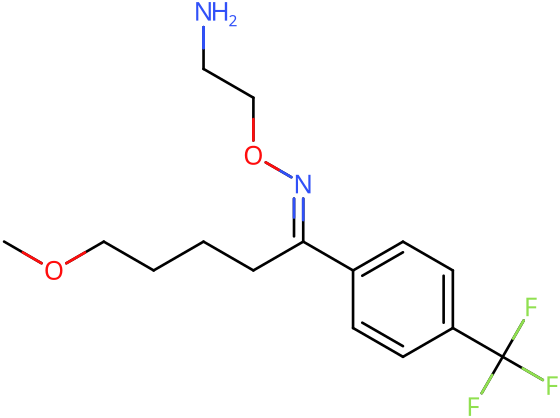
Fluvoxamine Stats & Data
COCCCCC(=NOCCN)c1ccc(cc1)C(F)(F)FCJOFXWAVKWHTFT-XSFVSMFZSA-NPharmacology
DrugBankDescription
Fluvoxamine is an antidepressant which functions pharmacologically as a selective serotonin reuptake inhibitor. Though it is in the same class as other SSRI drugs, it is most often used to treat obsessive-compulsive disorder. Fluvoxamine has been in use in clinical practice since 1983 and has a clinical trial database comprised of approximately 35,000 patients. It was launched in the US in December 1994 and in Japan in June 1999. As of the end of 1995, more than 10 million patients worldwide have been treated with fluvoxamine.
Mechanism of Action
The exact mechanism of action of fluvoxamine has not been fully determined, but appears to be linked to its inhibition of CNS neuronal uptake of serotonin FDA Label, A249, A250. Fluvoxamine blocks the reuptake of serotonin at the serotonin reuptake pump of the neuronal membrane, enhancing the actions of serotonin on 5HT1A autoreceptors FDA Label, A249, A250. Studies have also demonstrated that fluvoxamine has virtually no affinity for α1- or α2-adrenergic, β-adrenergic, muscarinic, dopamine D2, histamine H1, GABA-benzodiazepine, opiate, 5-HT1, or 5-HT2 receptors, despite having an affinity for binding to σ1 receptors .
Pharmacodynamics
Fluvoxamine, an aralkylketone-derivative agent , is one of a class of antidepressants known as selective serotonin reuptake inhibitors (SSRIs) that differs structurally from other SSRIs . It is used to treat the depression associated with mood disorders. It is also used on occassion in the treatment of body dysmorphic disorder and anxiety . The antidepressant, antiobsessive-compulsive, and antibulimic actions of Fluvoxamine are presumed to be linked to its inhibition of CNS neuronal uptake of serotonin FDA Label, A249, A250. <i>In vitro</i> studies show that Fluvoxamine is a potent and selective inhibitor of neuronal serotonin reuptake and has only very weak effects on norepinephrine and dopamine neuronal reuptake . Moreover, apart from binding to σ1 receptors , fluvoxamine has no significant affinity for adrenergic (alpha1, alpha2, beta), cholinergic, GABA, dopaminergic, histaminergic, serotonergic (5HT1A, 5HT1B, 5HT2), or benzodiazepine receptors; antagonism of such receptors has been hypothesized to be associated with various anticholinergic, sedative, and cardiovascular effects for other psychotropic drugs . Furthermore, some studies have demonstrated that the chronic administration of Fluvoxamine was found to downregulate brain norepinephrine receptors (as has been observed with other drugs effective in the treatment of major depressive disorder), while others suggest the opposite .
Metabolism
Fluvoxamine is metabolized extensively by the liver .
Absorption
Well absorbed, bioavailability of fluvoxamine maleate is 53% .
Indication
Indicated predominantly for the management of depression and for Obsessive Compulsive Disorder (OCD) . Has also been used in the management of bulimia nervosa .
Elimination
Nine metabolites were identified following a 5 mg radio labelled dose of fluvoxamine maleate, constituting approximately 85% of the urinary excretion products of fluvoxamine . The main human metabolite was fluvoxamine acid which, together with its N-acetylated analog, accounted for about 60% of the urinary excretion products . Approximately 2% of fluvoxamine was excreted in urine unchanged . Following a 14C-labelled oral dose of fluvoxamine maleate (5 mg), an average of 94% of drug-related products was recovered in the urine within 71 hours .
Measured Affinities
Guide to PHARMACOLOGYMeasured binding and functional data for fluvoxamine, curated by the IUPHAR/BPS Guide to PHARMACOLOGY. Each row cites the paper it came from. Lower concentrations mean tighter binding — a value in the sub-nanomolar range indicates a very potent interaction.
| Target | Action | Measure | Value | Concentration | Species | Source |
|---|---|---|---|---|---|---|
| SERT SLC6A4 | Inhibition | pKd | 8.66 | 2.19 nM | Human | PMID 9537821 |
| SERT Slc6a4 | Inhibition | pKi | 8.19 | 6.46 nM | Rat | PMID 11311448 |
| sigma non-opioid intracellular receptor 1 SIGMAR1 | Binding | pKi | 7.44 | 36.31 nM | Human | — |
Reading this. pKi, pEC50 and pIC50 are negative log molar values, so a higher number means a tighter interaction; the concentration column converts them for you. Values from non-human species are laboratory measurements and do not translate directly to human effect. Receptor affinity is not a dose — it describes what a molecule binds, not how much of it is safe to take.
Receptor data from the IUPHAR/BPS Guide to PHARMACOLOGY (v2026.2), licensed CC BY-SA 4.0. Matched to this substance by InChIKey.
The exact mechanism of action of fluvoxamine has not been fully determined, but appears to be linked to its inhibition of CNS neuronal uptake of serotonin. Fluvoxamine blocks the reuptake of serotonin at the serotonin reuptake pump of the neuronal membrane, enhancing the actions of serotonin on 5HT<sub>1A</sub> autoreceptors.
Carcinogenicity
No indication of carcinogenicity to humans (not listed by IARC).
Toxicity (DrugBank)
Fluvoxamine is a member of antidepressants that possess an increased risk compared to placebo of suicidal thinking and behaviour (suicidality) in children, adolescents, and young adults (ages including and and below 24) in short-term studies of major depressive disorder and other psychiatric disorders . Fluvoxamine maleate tablets are not approved for use in pediatric patients except for patients with obsessive compulsive disorder (OCD) . Side effects include anorexia, constipation, dry mouth, headache, nausea, nervousness, skin rash, sleep problems, somnolence, liver toxicity, mania, increase urination, seizures, sweating increase, tremors, or Tourette's syndrome .
Tolerance & Pharmacokinetics
drugs.wikiTolerance Decay
Experience Report Analysis
ErowidDemographics
Gender Distribution
Too few reports for a chart: gender is known from 6 reports, and a split is drawn only from 20 reports or more. Counts are shown instead. Why 20?
- Male 6 of 6
Age Distribution
Reports Over Time
Real-World Dose Distribution
ErowidFrom 10 of 10 recorded dose entries: those that state a weight (mg, g or µg), in routes with at least five of them. Values above Q3 + 3×IQR, far above what people typically take, are left out; they can include real heavy doses and overdoses, not only mistakes.