
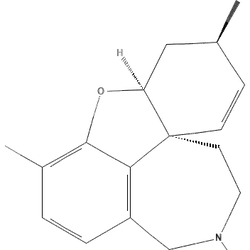
Galantamine Stats & Data
COc1ccc2CN(C)CCC34C=CC(O)CC4Oc1c23ASUTZQLVASHGKV-JDFRZJQESA-NPharmacology
DrugBankDescription
Galantamine is a tertiary alkaloid and reversible, competitive inhibitor of the acetylcholinesterase (AChE) enzyme, which is a widely studied therapeutic target used in the treatment of Alzheimer's disease. First characterized in the early 1950s, galantamine is a tertiary alkaloid that was extracted from botanical sources, such as _Galanthus nivalis_. Galantamine was first studied in paralytic and neuropathic conditions, such as myopathies and postpolio paralytic conditions, and for reversal of neuromuscular blockade. Following the discovery of its AChE-inhibiting properties, the cognitive effects of galantamine were studied in a wide variety of psychiatric disorders such as mild cognitive impairment, cognitive impairment in schizophrenia and bipolar disorder, and autism; however, re-development of the drug for Alzheimer’s disease did not commence until the early 1990s due to difficulties in extraction and synthesis. Galantamine blocks the breakdown of acetylcholine in the synaptic cleft, thereby increasing acetylcholine neurotransmission. It also acts as an allosteric modulator of the nicotinic receptor, giving its dual mechanism of action clinical significance. The drug was approved by the FDA in 2001 for the treatment of mild to moderate dementia of the Alzheimer's type. As Alzheimer's disease is a progressive neurodegenerative disorder, galantamine is not known to alter the course of the underlying dementing process.
Mechanism of Action
Alzheimer’s disease is characterized by progressive, irreversible degeneration of acetylcholine-producing neurons, cognitive impairment, and the accumulation of neurofibrillary tangles and amyloid plaques. The cholinergic system plays a critical role in memory, alongside other important neural functions such as attention, learning, stress response, wakefulness and sleep, and sensory information. Studies show that acetylcholine (ACh) is involved in the modulation of acquisition, encoding, consolidation, reconsolidation, extinction, and retrieval of memory. The gradual loss of cholinergic neurons in Alzheimer’s disease (AD) may, therefore, contribute to the memory loss exhibited by AD patients. Acetylcholinesterase is secreted by cholinergic neurons to rapidly hydrolyze ACh at the synaptic cleft to release acetate and choline. Choline is later recycled back into the presynaptic cholinergic neuron via reuptake by the high-affinity choline transporter. There is some evidence demonstrating the potential involvement of the acetylcholinesterase enzyme in the formation of amyloid fibrils. Galantamine competitively and reversibly inhibits the anticholinesterase enzyme in the CNS (namely in the frontal cortex and hippocampal regions) by binding to the choline-binding site and acyl-binding pocket of the enzyme active site. By blocking the breakdown of ACh, galantamine enhances ACh levels in the synaptic cleft.
Pharmacodynamics
Galantamine is a competitive and reversible inhibitor of acetylcholinesterase that works to increase acetylcholine levels. Galantamine acts both centrally and peripherally to inhibit both muscle and brain acetylcholinesterase, thereby increasing cholinergic tone. Galantamine is also a positive allosteric modulator of neuronal nicotinic acetylcholine receptors. As dementia is a progressive neurodegenerative disease, galatamine has a negligible effect in altering the course of the underlying process of dementia and may exert its therapeutic effectiveness for a short period of time. However, galantamine promoted improvements in cognition, global function, activities of daily living, and behavioural symptoms in clinical studies of Alzheimer’s disease. Galantamine exhibited therapeutic efficacy in studies of vascular dementia and Alzheimer’s disease with cerebrovascular disease. In one study, galantamine reversed scopolamine-induced acute anticholinergic syndrome that was characterized by drowsiness, disorientation, and delirium.
Metabolism
_In vitro_ study findings suggest that about 75% of the drug is metabolized by CYP2D6 and CYP3A4. CYP2D6 promotes O-demethylation of the drug to form O-desmethyl-galantamine and the CYP3A4-mediated pathway forms the galantamine-N-oxide. Important metabolic pathways also include N-demethylation, epimerization, and sulfate conjugation. Other metabolites include norgalantamine, O-desmethyl-galantamine, O-desmethyl-norgalantamine, epigalantamine and galantaminone, which do not retain clinically significant pharmacology activities. Galantamine can also undergo glucuronidation: in one oral radiolabeled drug study in poor and extensive CYP2D6 metabolizers, about 14-24% of the total radioactivity was identified as galantamine glucuronide 8 hours post-dose. O-demethylation by CYP2D6 becomes prominent in patients with who are extensive metabolizers of CYP2D6, but unchanged galatamine (39-77%) and its glucuronide metabolite (14-24%) predominated in the plasma of both poor and extensive metabolizers of CYP2D6 in a radiolabelled drug study. The total plasma clearance, or nonrenal clearnace, accounts for 20–25% of drug elimination.
Absorption
Over a dose range of 8-32 mg/day, galantamine exhibits a dose-linear pharmacokinetic profile. The oral bioavailability of galantamine ranges from 90-100%. Following oral administration, the Tmax is about 1 hour. Following 10 hours of administration, the mean galantamine plasma concentrations were 82–97 µg/L for the 24 mg/day dose and 114–126 µg/L for the 32 mg/day dose.
Indication
Galantamine is indicated for the treatment of mild to moderate dementia of the Alzheimer’s type.
Half-life
Galantamine has a terminal half-life of about 7 hours.
Protein Binding
The plasma protein binding of galantamine is 18% at therapeutically relevant concentrations.
Elimination
Renal clearance accounts for about 20–25% of total plasma clearance of the drug in healthy individuals: the elimination of galantamine has been shown to be decreased in subjects with renal impairment. Following oral or intravenous administration, approximately 20% of the dose is excreted as unchanged in the urine within 24 h. In a radiolabelled drug study, about 95% and 5% of the total radioactivity was recovered in the urine and feces, respectively. Of the dose recovered in the urine, about 32% was in the unchanged parent compound, and 12% was in the glucuronide form.
Volume of Distribution
The mean volume of distribution is 175 L. About 52.7% of galantamine is distributed to blood cells, the blood to plasma concentration ratio of galantamine is 1.2. Galantamine penetrates the blood–brain barrier.
Clearance
The renal clearance is 65 mL/min and the total plasma clearance is about 300 mL/min.
Measured Affinities
Guide to PHARMACOLOGYMeasured binding and functional data for galantamine, curated by the IUPHAR/BPS Guide to PHARMACOLOGY. Each row cites the paper it came from. Lower concentrations mean tighter binding — a value in the sub-nanomolar range indicates a very potent interaction.
| Target | Action | Measure | Value | Concentration | Species | Source |
|---|---|---|---|---|---|---|
| acetylcholinesterase (Yt blood group) ACHE | Inhibition | pIC50 | 6.3 | 501.19 nM | Human | PMID 12182861 |
Reading this. pKi, pEC50 and pIC50 are negative log molar values, so a higher number means a tighter interaction; the concentration column converts them for you. Values from non-human species are laboratory measurements and do not translate directly to human effect. Receptor affinity is not a dose — it describes what a molecule binds, not how much of it is safe to take.
Receptor data from the IUPHAR/BPS Guide to PHARMACOLOGY (v2026.2), licensed CC BY-SA 4.0. Matched to this substance by InChIKey.
Galantamine is non-addictive, is not known to cause harm in reasonable doses, and has an extremely low toxicity relative to dose. Various studies have shown that in reasonable doses in a careful context, it presents few negative cognitive, psychiatric or toxic physical consequences, though some exist. It is strongly recommended that one be familiar with harm reduction practices when using this drug.
LD50
LD50: 75 mg/kg (Rat) (A308)
Carcinogenicity
No indication of carcinogenicity to humans (not listed by IARC).
Effect Profile
Curated + 2 ReportsMild stimulation with low euphoria, anxiety/jitters, and focus
Tolerance & Pharmacokinetics
drugs.wikiTolerance Decay
Robust pharmacologic tolerance is not well documented for therapeutic use; however, community oneirogenic users often perceive reduced effect with frequent dosing and report better outcomes when spacing by 3–7 days. Data are anecdotal and confounded by sleep protocol adherence.
Cross-Tolerances
Experience Report Analysis
ErowidDemographics
Gender Distribution
Too few reports for a chart: gender is known from 4 reports, and a split is drawn only from 20 reports or more. Counts are shown instead. Why 20?
- Male 2 of 4
- Not Specified 1 of 4
- Female 1 of 4
Age Distribution
Reports Over Time
Real-World Dose Distribution
ErowidFrom 7 of 7 recorded dose entries: those that state a weight (mg, g or µg), in routes with at least five of them. Values above Q3 + 3×IQR, far above what people typically take, are left out; they can include real heavy doses and overdoses, not only mistakes.
Oral (n=7)
Harm Reduction
drugs.wikiGalantamine is an acetylcholinesterase inhibitor with additional positive allosteric modulation at nicotinic acetylcholine receptors; together these actions raise central acetylcholine and can intensify REM dream vividness, recall, and lucid dreaming probability. The oral Tmax is about 1 hour and terminal half-life ~7 hours; taking it at standard bedtime often misses late-night REM, so oneirogenic protocols typically use a ‘wake-back-to-bed’ dose 4–6 hours after sleep onset to align the peak with REM-rich sleep. Vagotonic effects can cause bradycardia and AV block even in people without known conduction disease; anyone with cardiac conditions or taking rate-slowing drugs should consult a clinician and avoid unsupervised use. Common cholinergic side effects include nausea, vomiting, diarrhea, abdominal cramps, sweating, hypersalivation, dizziness, and appetite/weight loss; taking with food and adequate fluids and titrating slowly can reduce GI effects. Galantamine increases gastric acid secretion; individuals with active peptic ulcer disease or using gastric-irritant NSAIDs should be cautious and consider gastroprotection. Cholinesterase inhibitors can prolong the effect of succinylcholine and similar neuromuscular blockers; disclose recent galantamine use to anesthesia providers to prevent prolonged paralysis/apnea. Bronchospasm can occur due to cholinergic activity; people with asthma or COPD should avoid unsupervised use and monitor for wheeze or dyspnea. Rare but serious skin reactions (e.g., Stevens–Johnson syndrome) have been reported; stop immediately and seek care if rash or mucosal lesions appear. Urinary outflow obstruction may worsen due to increased detrusor activity; those with BPH or urinary retention should be cautious. Combining with other cholinergics (e.g., donepezil, rivastigmine, huperzine A, large choline donors) increases cholinergic adverse effects; avoid stacking. Strong CYP2D6 or CYP3A4 inhibitors (e.g., paroxetine, ketoconazole, erythromycin) can raise levels and side effects; inducers (rifampin, carbamazepine, phenytoin, St. John’s wort) may reduce effectiveness. Seizures have been reported; people with seizure disorders should consult a clinician and avoid sleep deprivation or concurrent pro-convulsant substances. For lucid dreamers, space doses by several days and avoid frequent redosing to limit side effects and reduce anecdotal tolerance; pharmacologic tolerance is not well characterized. Keep single doses modest (e.g., 4–8 mg WBTB) and avoid combining with sedating antihistamines or alcohol, which can disturb sleep architecture and mask adverse symptoms.
References
Cited references
- DrugBank: Galantamine (DB00674) – PK, metabolism, MoA
- DrugBank article: Clinical pharmacokinetics of galantamine
- DrugBank article: Galantamine—dual mode of action; half-life; dosing
- DrugBank article: Clinically significant interactions with cholinesterase inhibitors (CYP interactions)
- NCBI StatPearls: Galantamine – warnings, cardiac, GI, respiratory, seizures, anesthesia interactions
- NCBI StatPearls: Succinylcholine – contraindications and interactions with cholinesterase inhibitors
- NCBI StatPearls: Depolarizing neuromuscular blocking drugs – interactions
- Erowid: Dreaming Vault – Dream Tripping article (LaBerge protocol; WBTB timing and 6–8 mg suggestion)
- Drug Metab Dispos 2002: Metabolism and excretion of galantamine in humans
- PubChem: Galantamine Hydrobromide (compound identity)
- Reddit r/LucidDreaming threads – usage spacing and community protocols (anecdotal)