
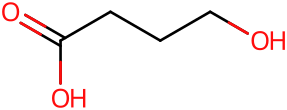
GHB Stats & Data
SJZRECIVHVDYJC-UHFFFAOYSA-NInteraction Warnings
This combination can result in an increased risk of vomiting during unconsciousness and death from the resulting suffocation. If this occurs, users should attempt to fall asleep in the recovery position or have a friend move them into it.
It is dangerous to combine GHB, a depressant, with stimulants due to the risk of excessive intoxication. Stimulants decrease the sedative effect of GHB, which is the main factor most people consider when determining their level of intoxication. Once the stimulant wears off, the effects of GHB will be significantly increased, leading to intensified disinhibition as well as other effects. If combined, one should strictly limit themselves to only dosing a certain amount of GHB per hour.
Pharmacology
DrugBankDescription
Gamma hydroxybutyric acid, commonly abbreviated GHB, is a therapeutic drug which is illegal in multiple countries. It is currently regulated in the US and sold by Jazz Pharmaceuticals under the name Xyrem. However, it is important to note that GHB is a designated Orphan drug (in 1985). Today Xyrem is a Schedule III drug; however GHB remains a Schedule I drug and the illicit use of Xyrem falls under penalties of Schedule I. GHB is a naturally occurring substance found in the central nervous system, wine, beef, small citrus fruits and almost all other living creatures in small amounts. It is used illegally under the street names Juice, Liquid Ecstasy or simply G, either as an intoxicant, or as a date rape drug. Xyrem is a central nervous system depressant that reduces excessive daytime sleepiness and cataplexy in patients with narcolepsy.
Mechanism of Action
GHB is present at much higher concentrations in the brain, where it activates GABA-B receptors to exert its sedative effects. With high affinity, GHB binds to excitatory GHB receptors that are densely expressed throughout the brain, including the cotex and hippocampus. There is some evidence in research that upon activation of GHB receptors in some brain areas, the excitatory neurotransmitter glutamate is released. GHB stimulates dopamin release at low concentrations by acting on the GHB receptor, and the release of dopamine occurs in a biphasic manner. At higher concentrations, GHB inhibits dopamine release by acting on the GABA-B receptors, which is followed by GHB receptor signaling and increased release of dopamine. This explains the paradoxical mix of sedative and stimulatory properties of GHB, as well as the so-called "rebound" effect, experienced by individuals using GHB as a sleeping agent, wherein they awake suddenly after several hours of GHB-induced deep sleep. It is proposed that overtime, the level of GHB in the brain decreases below the threshold for significant GABA-B receptor activation, leading to preferential activation of GHB receptor over GABA-B receptors and enhanced wakefulness.
Pharmacodynamics
GHB predominantly works at two distinct binding sites in the central nervous system: it works as an agonist at the newly-characterized excitatory GHB receptor, while acting as a weak agonist at the inhibitory GABAB receptor. Since it is a naturally occurring substance, its physiological action is similar to that of some endogenous neurotransmitters in mammalian brain. GHB is probably synthesized from GABA in GABAergic neurons, and released when the neurons fire.
Indication
Used as a general anesthetic, to treat conditions such as insomnia, clinical depression, narcolepsy, and alcoholism, and to improve athletic performance.
Elimination
Animal studies indicate that metabolism is the major elimination pathway for sodium oxybate, producing carbon dioxide and water via the tricarboxylic acid (Krebs) cycle and secondarily by beta-oxidation. Succinic acid enters the Krebs cycle where it is metabolized to carbon dioxide and water. Fecal and renal excretion is negligible. 5% renal elimination.
Clearance
* apparent oral cl=9.1 mL/min/kg healthy adults receiving a single oral dose of 25 mg/kg * 4.5 mL/min/kg cirrhotic patients without ascites receiving a single oral dose of 25 mg/kg * 4.1 mL/min/kg cirrhotic patients with ascites receiving a single oral dose of 25 mg/kg
Measured Affinities
Guide to PHARMACOLOGYMeasured binding and functional data for γ-hydroxybutyrate, curated by the IUPHAR/BPS Guide to PHARMACOLOGY. Each row cites the paper it came from. Lower concentrations mean tighter binding — a value in the sub-nanomolar range indicates a very potent interaction.
| Target | Action | Measure | Value | Concentration | Species | Source |
|---|---|---|---|---|---|---|
| HCA1 receptor HCAR1 | Full agonist | pEC50 | 1.82 | 15,135,612 nM | Human | PMID 19047060 |
| GABAB receptor GABBR1|GABBR2|KCTD8|KCTD12|KCTD16 | Partial agonist | - | — | — | Human | PMID 40449125 |
Reading this. pKi, pEC50 and pIC50 are negative log molar values, so a higher number means a tighter interaction; the concentration column converts them for you. Values from non-human species are laboratory measurements and do not translate directly to human effect. Receptor affinity is not a dose — it describes what a molecule binds, not how much of it is safe to take.
Receptor data from the IUPHAR/BPS Guide to PHARMACOLOGY (v2026.2), licensed CC BY-SA 4.0. Matched to this substance by InChIKey.
History & Culture
1874–1960s
The chemical family to which GHB belongs was first explored by Russian chemist Alexander Zaytsev, who published work on related compounds in 1874. The compound itself was first synthesized in the 1920s, though it would remain largely unexamined for several decades. Extended research into GHB and its applications in humans began in the early 1960s when French researcher Henri Laborit investigated the compound as part of his studies on the neurotransmitter GABA. During this period, GHB was examined for numerous potential medical applications including use during obstetric surgery, childbirth, and as an anxiolytic agent. Researchers also noted anecdotal reports suggesting antidepressant and aphrodisiac properties. The compound was studied as an intravenous anesthetic and began being marketed for this purpose in Europe starting in 1964. However, this application never achieved widespread adoption due to the compound's propensity to induce seizures. GHB and its pharmaceutical form, sodium oxybate, were also investigated for treating narcolepsy and alcohol addiction from the 1960s onward.
1980s–1990
Throughout the 1980s, GHB was sold openly as a weight loss and muscle development aid, gaining particular popularity within the bodybuilding community due to its reputed positive effects on growth hormone levels. In May 1990, the compound was formally introduced as a dietary supplement and marketed to bodybuilders as a sleep aid and as a replacement for L-tryptophan, which had been removed from the market in November 1989 following contamination concerns. The unregulated availability of GHB soon led to health concerns. Dozens of illness cases were reported to the Centers for Disease Control and Prevention, with users having consumed up to three teaspoons of the substance. While no deaths occurred during this period, several individuals required intensive care. The FDA issued a warning in November 1990 declaring the sale of GHB to be illegal, though the compound continued to be manufactured and distributed through illicit channels.
1990s–present
Following its removal from the dietary supplement market, GHB transitioned into recreational use and was adopted as a club drug during the 1990s. Users sought the substance for its disinhibiting, pro-social, and sedative properties at lower doses, as well as its reputation for enhancing libido. The drug became a fixture in nightclub and rave scenes throughout this period, appealing to users seeking an alternative to alcohol with a shorter duration of effects.
late 1990s–present
By the late 1990s, GHB had gained significant public notoriety as a date-rape drug following sustained media coverage. The compound's colorless and odorless properties made it particularly concerning, as it was described as very easy to add to drinks without detection. Several high-profile cases brought national attention to this issue. In early 1999, fifteen-year-old Samantha Reid of Rockwood, Michigan, died from GHB poisoning after unknowingly consuming the drug. Her death, along with that of Hillory J. Farias, directly inspired federal legislation—the Hillory J. Farias and Samantha Reid Date-Rape Drug Prohibition Act of 2000—which led to GHB being placed on Schedule I of the Controlled Substances Act. In the United Kingdom, serial killer Stephen Port administered GHB to victims by adding it to their drinks, committing sexual assaults and murdering four individuals in his flat in Barking, East London.
2007–present
In November 2007, an unusual public health incident brought renewed attention to GHB and its precursors. A popular children's toy marketed as Bindeez in Australia and Aqua Dots in the United States was discovered to contain 1,4-butanediol, a compound that metabolizes into GHB when ingested. The toxic chemical had been substituted for the intended non-toxic plasticizer 1,5-pentanediol during the bead manufacturing process. Three young children were hospitalized after consuming large quantities of the beads, prompting a product recall by Melbourne-based manufacturer Moose and a nationwide ban in Australia.
Subjective Effects
Physical
The physical effects of GHB can be broken down into several components which progressively intensify proportional to dosage.
- Stimulation and Sedation: At lower doses, GHB is physically stimulating, encouraging movement and wakefulness. At higher doses, however, it becomes physically sedating, encouraging sleep and lethargy.
- Respiratory depression: In cases of GHB overdoses, many reportedly experience an abnormal pattern of breathing characterized by progressively deeper and sometimes faster breathing followed by a gradual decrease that results in a temporary stop in breathing called an apnea.
- Euphoria
- Nausea
- Motor control loss
- Dizziness
- Dehydration
Cognitive
The cognitive effects of GHB can be broken down into several components which progressively intensify proportional to dosage.
- Empathy, love and sociability enhancement: Unlike alcohol which merely increases sociability through disinhibition, GHB presents strong entactogenic effects which, although weaker than that of MDMA, are still prominent and well defined.
- Disinhibition
- Information processing suppression
- Thought deceleration
- Amnesia
- Euphoria
- Anxiety suppression
Forked from Subjective Effect Documentation by Josie Kins, September 2015. Via dose.wiki (CC0).
study ranking various drugs (legal and illegal) based on statements by drug-harm experts. GHB was found to be the ninth overall most dangerous drug.]] GHB is considered to be a safe and non-toxic substance when used responsibly or medically. The LD50 is above the active dosage, and there is no danger of acute toxicity. However, it can become dangerous when used as a recreational drug or abused. There have been many negative reports from recreational users who have overdosed, combined GHB with alcohol or other drugs, or accidentally dosed themselves unexpectedly.
Carcinogenicity
No indication of carcinogenicity to humans (not listed by IARC).
Overdose
To avoid a possible overdose of GHB, it is important to start with a low dose and work your way up slowly by increasing the dosage in small increments. While a common recreational dose is 2g, a dose of 5g - 10g can result in convulsions, unconsciousness and vomiting. Doses above 10 grams are associated with a risk of death.
Organ-specific toxicity
A 2022 review compared 43 studies on GHB-induced cognitive impairment in humans and animals. The analysis suggests that moderate or clinical use may result in acute cognitive impairment. Working memory, short-term memory, and impaired performance on cognitive tasks were impaired after doses as low as 10mg/kg, but these effects appear to be temporary.
Toxicity (DrugBank)
High doses of GHB may lead to nausea, dizziness, drowsiness, agitation, visual disturbances, depressed breathing, amnesia, unconsciousness, and death in some cases.
Community Effects
TripSitTolerance & Pharmacokinetics
drugs.wikiNo tolerance chart. Our decay curves for these drugs were estimates, and a curve can make tolerance look longer-lasting than it is, which is the dangerous direction.
How fast tolerance to these drugs fades after a break has not been measured well enough to draw, so don't count on a dose you used to take still being safe: after time off, start with a much smaller amount and don't use alone. Mixing sedatives with each other, with alcohol or with opioids sharply raises the risk of a fatal overdose. If you've been using regularly, don't stop suddenly: withdrawal from benzodiazepines, alcohol or GHB/GBL can cause seizures or delirium, so get medical help to cut down gradually. With GHB and GBL, tolerance drops after you stop, so the amount you used to take can cause an overdose, and the gap between the dose you want and an overdose is small and hard to judge.
Sources: FRANK: benzodiazepines · Alcohol and Drug Foundation: GHB · FDA 2020: benzodiazepine boxed warning · FDA 2019: gabapentinoids and breathing · NHS: alcohol use disorder · FRANK: GHB
Cross-Tolerances
Demographics
Gender Distribution
Age Distribution
Reports Over Time
Effect Analysis
Erowid + BluelightEffects aggregated from 126 experience reports (105 single-substance Erowid + 21 Bluelight)
Effect Sentiment Distribution
Confidence Distribution
Each bar is the share of reports mentioning the effect; its whisker, and the band on the rows below, is the 95% interval: where the share could plausibly be with other reports of the same kind.
Positive Effects 32
Adverse Effects 38
Show 16 more adverse effects
Show 21 neutral or unclassified mentions
Also reported in combinations. In the 88 GHB reports where another drug was taken too, 27 (30.7%) mention hospital, emergency services or an overdose, 8 (9.1%) a seizure and 3 (3.4%) psychosis. In the 105 single-substance reports: 33.3%, 2.9% and 1.9%. These are not in the figures above: they cannot be put down to GHB alone, and a mention is not always something that happened to the writer.
Dosage Distribution
Dose distribution from experience reports, one dose per report (the first listed). Doses above Q3 + 3×IQR, far above what people typically take, are left out of the median and range and listed under each route: most are real heavy doses or overdoses, not mistakes.
3 reports gave a dose above the typical range (8,800–25,000 mg), so they are not in the figures above. 1 of them mentions hospital, emergency services or an overdose. Listing a dose here does not mean it is safe.
Real-World Dose Distribution
ErowidFrom 110 of 221 recorded dose entries: those that state a weight (mg, g or µg), in routes with at least five of them. Values above Q3 + 3×IQR, far above what people typically take, are left out; they can include real heavy doses and overdoses, not only mistakes.
Oral (n=105)
Common Combinations
Most co-occurring substances, as a share of all 193 reports filed under GHB; whiskers are 95% intervals
Form / Preparation
Most common forms and preparations, as a share of the 126 reports that give one; whiskers are 95% intervals
Body-Weight Dosing
Dose per kg of body weight, one dose per report (the first listed), from reports giving a weight of 30–250 kg. Doses above Q3 + 3×IQR, far above what people typically take, are left out of the median and range and listed under each route.
2 reports gave a dose above the typical range (239.617–314.861 mg/kg), so they are not in the figures above. 1 of them mentions hospital, emergency services or an overdose. Listing a dose here does not mean it is safe.
Show the reports
- 314.861 mg/kg
- 239.617 mg/kg · mentions hospital, emergency services or an overdose
Redose Patterns
Redosing behavior across 151 reports
Legal Status
| Country | Status | Notes |
|---|---|---|
| United Kingdom | Controlled substance | Scheduled as a controlled substance in 2003. Before this, the drug existed in a legal grey area following its emergence as a recreational substance in the late 1990s. |
| United States | Controlled substance | Became a scheduled controlled substance in 2000. Prior to scheduling, GHB was sold openly as a weight loss and muscle development aid during the 1980s and emerged as a recreational drug in the late 1990s. |