
Heroin Stats & Data
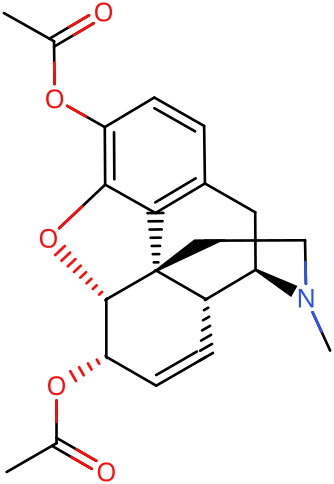
CC(=O)OC1C=CC2C3N(C)CCC22C1Oc1c(OC(C)=O)ccc(C3)c12GVGLGOZIDCSQPN-PVHGPHFFSA-NPharmacology
DrugBankDescription
Diamorphine (heroin) is a narcotic analgesic that may be habit-forming. It is a controlled substance (opium derivative) listed in the U.S. Code of Federal Regulations, Title 21 Parts 329.1, 1308.11 (1987). Sale is forbidden in the United States by Federal statute. (Merck Index, 11th ed) Internationally, diamorphine is controlled under Schedules I and IV of the Single Convention on Narcotic Drugs. As heroin, it is illegal to manufacture, possess, or sell in the United States and the UK. However, under the name diamorphine, heroin is a legal prescription drug in the United Kingdom.
Mechanism of Action
When administered orally, diamorphine experiences extensive first-pass metabolism by way of deacetylation to generate the active metabolites 6-monoacetylmorphine (6-MAM) and morphine . Alternatively, when given as an injection the acetyl groups present in the diamorphine/diacetylmorphine compound confer the substance lipophilicity that facilitates diamorphine's rapid crossing of the blood-brain-barrier . Once in the brain, diamorphine is metabolised via deacetylation to the active 6-MAM and morphine metabolites as well . Despite diamorphine possessing little to no opioid agonist activity itself, its rapid transit across the blood-brain-barrier elicits a far faster onset of activity in comparison to the extensive first-pass metabolism of oral administration . Regardless, the metabolism of diamorphine to morphine makes heroin a prodrug for the delivery of morphine . Morphine is subsequently a mu-opioid agonist. It acts on endogenous mu-opioid receptors that are spread in discrete packets throughout the brain, spinal cord and gut in almost all mammals . Morphine, along with other opioids, are agonists to four endogenous neurotransmitters . They are beta-endorphin, dynorphin, leu-enkephalin, and met-enkephalin . The body responds to morphine in the brain by reducing (and sometimes stopping) production of the endogenous opioids when morphine is present .
Pharmacodynamics
The onset of heroin's effects is dependent on the method of administration. Taken orally, heroin is totally metabolized in vivo via extensive first-pass metabolism into morphine before crossing the blood-brain barrier; so the effects are the same as orally administered morphine . Take by injection, diamorphine's acetyl groups facilitate rapid crossing into the brain . Once in the brain, heroin is rapidly metabolized into morphine by removal of the acetyl groups, therefore making it a prodrug for the delivery of morphine . Subsequently, whether eliciting actions peripherally (on smooth muscle, skeletal muscle, kidney, lung, liver, or spleen tissue , for example) or on the central nervous system, it is ultimately the morphine metabolite of heroin that then binds with opioid receptors and produces the narcotic opioid effects commonly associated with the substance .
Metabolism
Once administered into the body, diamorphine undergoes deacetylation via various esterase enzymes to generate active metabolites like 6-monoacetylmorphine and morphine . In particular, when administered orally, diamorphine undergoes extensive first pass metabolism .
Absorption
Bioavailability is less than 35% when orally administered . In particular, some studies have determined that the bioavailability of orally administered diamorphine could be as low as 22.9% (16.4-29.4%) on average in opioid-naive subjects . Nevertheless, diamorphine administered by any many medically indicated routes of administration leads to a rapid absorption . Peak serum levels are achieved five to ten minutes subcutaneously, three to five minutes intranasally and intramuscularly, and less than one minute intravenously .
Indication
Diamorphine, as a prescription medication in the United Kingdom, is indicated for use in the treatment of severe pain associated with surgical procedures, myocardial infarction or pain in the terminally ill and for the relief of dyspnoea in acute pulmonary edema .
Half-life
In humans, administered diamorphine has a half-life of approximately two to three minutes .
Protein Binding
Diamorphine does not bind to plasma protein . However, considering diamorphine is considered a prodrug for morphine, morphine itself is about 20 to 35% reversibly bound to human plasma proteins .
Elimination
The majority of the drug is excreted via the kidney as glucuronides and to a much lesser extent as morphine . About 7-10 % is eliminated via the biliary system into the faeces .
Volume of Distribution
Data regarding the volume of distribution specific to diamorphine is not readily accessible or available. However, considering diamorphine is considered a prodrug for morphine, the volume of distribution of morphine has been determined to be approximately 1 to 6 L/kg .
Clearance
Some studies have determined a relatively high systemic diacetylmorphine clearance of about 8.7 +/- 2.6 L/min, suggesting that the intestine, liver, and blood might all collectively take part in the first pass metabolism of diacetylmorphine to morphine , although such clearance observations were made only in opioid-addicted individuals . However, considering diamorphine is considered a prodrug for morphine, the mean adult plasma clearance of morphine is approximately 20 to 30 mL/min/kg .
Receptor Profile
Receptor Actions
Receptor Binding
History & Culture
1874–1897
Diamorphine was first synthesized in 1874 by C.R. Alder Wright, an English chemist working at St. Mary's Hospital Medical School in London. Wright had been experimenting with combining morphine with various acids, achieving the synthesis by boiling anhydrous morphine alkaloid with acetic anhydride. However, Wright's invention did not lead to any immediate developments. The compound remained obscure until it was independently re-synthesized 23 years later by chemist Felix Hoffmann at the Bayer pharmaceutical company in Elberfeld, Germany. Hoffmann's supervisor Heinrich Dreser had instructed him to acetylate morphine with the objective of producing codeine, a constituent of the opium poppy that is less potent and less addictive than morphine. Instead, the experiment produced an acetylated form of morphine approximately one and a half to two times more potent than morphine itself. Hoffmann synthesized the compound on 21 August 1897, just eleven days after he had synthesized aspirin using a similar acetylation process.
1898–1924
Bayer began marketing diacetylmorphine as an over-the-counter medication under the trademark name "Heroin" in 1898, a name reputedly coined by the head of Bayer's research department based on the German word "heroisch" meaning "heroic" or "strong." The company developed it primarily as a morphine substitute for cough suppressants that purportedly lacked morphine's addictive properties. Since morphine was a popular recreational drug at the time, Bayer sought to market a similar but non-addictive alternative. From 1898 through 1910, diamorphine was actively marketed as a non-addictive cough suppressant and morphine substitute. The 11th edition of the Encyclopædia Britannica, published in 1910, recommended heroin as preferable to morphine for treating the cough associated with pulmonary tuberculosis. However, contrary to Bayer's advertising claims, heroin would soon demonstrate one of the highest addiction rates among its users. Bayer ultimately lost its trademark rights to heroin, along with aspirin, under the 1919 Treaty of Versailles following Germany's defeat in World War I.
1914–1930
The United States passed the Harrison Narcotics Tax Act in 1914 to regulate the sale and distribution of diacetylmorphine and other opioids, initially allowing the drug to be prescribed and sold for medical purposes. A decade later, in 1924, the United States Congress passed the Heroin Act, banning its sale, importation, and manufacture entirely. Internationally, the Health Committee of the League of Nations banned diacetylmorphine in 1925, though implementation took more than three years. During this interim period, clandestine chemists produced massive quantities of the first designer drugs, including various diesters and monoesters of morphine and acetylated analogues of related compounds like hydromorphone and dihydromorphine, to meet continued worldwide demand. This production continued until 1930, when the Committee enacted the first major legislation banning diacetylmorphine analogues that offered no therapeutic advantage over existing medications.
1930–present
The French Connection trafficking route emerged in the 1930s, establishing one of the first major international heroin distribution networks. During World War II, heroin trafficking to the United States was virtually eliminated due to temporary trade disruptions caused by the conflict. Following the war, organized crime groups exploited the weakness of the postwar Italian government and established heroin laboratories in Sicily, strategically located along historic opium trade routes into Europe and the United States. Large-scale heroin production in China effectively ended with the communist victory in the civil war during the late 1940s. However, in the late 1960s and early 1970s, support for anti-communist Chinese Nationalist forces near the Sino-Burmese border and Hmong tribesmen in Laos contributed to the development of the Golden Triangle opium production region. Following the American withdrawal from Vietnam in 1973, this region supplied approximately one-third of the heroin consumed in the United States. The Balkan route has since become the principal corridor for trafficking illegal opiates, primarily heroin, from Afghanistan to Western and Central Europe.
Heroin use became particularly prevalent among jazz musicians during the mid-twentieth century. Notable figures affected included vocalist Billie Holiday, saxophonists Charlie Parker and Art Pepper, trumpeter and vocalist Chet Baker, guitarist Joe Pass, and pianist and singer Ray Charles—what observers described as a "staggering number" of jazz musicians who became addicted. The substance similarly affected rock musicians from the late 1960s through the 1990s. Prominent cases included Nirvana vocalist Kurt Cobain, whose addiction was extensively documented, and Pantera frontman Phil Anselmo, who turned to heroin while touring to manage chronic back pain. Other notable musicians who used heroin included James Taylor, Jimmy Page, John Lennon, Eric Clapton, Johnny Winter, Keith Richards, Janis Joplin, and many others. The drug's influence on these communities led numerous musicians to reference their heroin use in their work. Anthropologist Michael Agar once characterized heroin as "the perfect whatever drug," encapsulating its appeal across diverse contexts.
Subjective Effects
Physical
The physical effects of heroin can be broken down into several components which progressively intensify proportional to dosage.
- Euphoria: In comparison to other opioids, this particular substance can be considered as extremely intense in its physical euphoria when compared with that of other opioids such as codeine or tramadol. The sensation itself can be described as extreme feelings of hyper intense physical comfort, snugglyness, warmth, love and blissful euphoria.
- Pain relief: This component is subjectively different from other anaesthetics as it does not necessarily remove the pain entirely whilst still remaining equal in terms of its effectiveness. Instead of directly suppressing pain these substances simply dull the perceived sensation and cover it up with feelings of physical and emotional pleasure.
- Respiratory depression
- Itchiness
- Constipation
- Cough suppression
- Difficulty urinating
- Nausea
- Sedation
- Pupil constriction
Cognitive
The cognitive effects of heroin can be broken down into several components which progressively intensify proportional to dosage.
- Euphoria: In comparison to other opioids, this particular substance can be considered as extremely intense in its cognitive euphoria when compared with that of other opioids such as codeine or tramadol. The sensation itself can be described as powerful and overwhelming feeling of emotional bliss, contentment, love and happiness.
- Anxiety suppression
- Compulsive redosing
Sensory
- Internal hallucinations: One may experience a state of semi-consciousness and hypnagogia during heavy dosage nodding which results in dream-like states and up to level 3 imagery. This is often accompanied by ill defined geometry.
Forked from Subjective Effect Documentation by Josie Kins, July 2015. Via dose.wiki (CC0).
Like many other opioids, unadulterated heroin at appropriate dosages does not cause many long-term complications other than physical and psychological dependence and constipation. Outside of the extremely powerful addiction and physical dependence, the harmful or toxic aspects of opioid usage are exclusively associated with not taking the necessary precautions in regards to its administration, overdosing and using impure heroin products that contain harmful additives. Heavy dosages of heroin can result in severe respiratory depression which can result in dangerous or even fatal levels of anoxia (oxygen deprivation). This occurs because the breathing reflex is suppressed by agonism of µ-opioid receptors - this effect is proportional to the dosage of the substance consumed.
Carcinogenicity
No indication of carcinogenicity to humans (not listed by IARC).
Addiction & dependence
As with other opioids, the chronic use of heroin can be considered extremely addictive with a high potential for abuse and is capable of causing psychological and physical dependence among certain users. When psychological or physical addiction has developed, mental and physical withdrawal symptoms and cravings may occur if a person suddenly stops their usage. Tolerance to many of the effects of heroin develops with prolonged and repeated use.
Toxicity (DrugBank)
Overdosage with diamorphine well characterised by a number of symptoms including respiratory depression, pulmonary oedema, muscle flaccidity, coma or stupor, constricted pupils, cold, clammy skin and occasionally bradycardia and hypotension . The antidote for heroin overdose or poisoning is naloxone .
Effect Profile
Curated + 343 ReportsStrong euphoria, pain relief, and sedation with moderate itching/nausea
User Experiences
Tolerance & Pharmacokinetics
drugs.wikiNo tolerance chart. Our decay curves for opioids were estimates, and a curve can make tolerance look longer-lasting than it is, which is the dangerous direction.
Opioid tolerance drops fast when you stop, and even a few days off can be enough, so a dose that used to be normal can now stop your breathing. Overdose deaths rise sharply after prison, detox or leaving treatment, and tolerance also falls during a hospital stay. After any break, start with a much smaller amount, try a test dose first, don't use alone, and keep naloxone within reach. Alcohol, benzodiazepines, gabapentinoids and other sedatives make an opioid overdose much more likely.
Sources: FRANK: heroin · National Harm Reduction Coalition · WHO: opioid overdose · Merrall et al. 2010 · Binswanger et al. 2007 · Strang et al. 2003 · FDA 2019: gabapentinoids and breathing
Cross-Tolerances
Demographics
Gender Distribution
Age Distribution
Reports Over Time
Effect Analysis
Erowid + BluelightEffects aggregated from 300 experience reports (250 single-substance Erowid + 93 Bluelight)
Effect Sentiment Distribution
Confidence Distribution
Each bar is the share of reports mentioning the effect; its whisker, and the band on the rows below, is the 95% interval: where the share could plausibly be with other reports of the same kind.
Positive Effects 59
Adverse Effects 52
Show 29 more adverse effects
Show 18 neutral or unclassified mentions
Also reported in combinations. In the 127 Heroin reports where another drug was taken too, 29 (22.8%) mention hospital, emergency services or an overdose, 4 (3.1%) a seizure and 2 (1.6%) psychosis. In the 250 single-substance reports: 18.4%, 2.4% and 0.8%. These are not in the figures above: they cannot be put down to Heroin alone, and a mention is not always something that happened to the writer.
Dose-Response Correlation
How effect frequency changes across dose levels. Whiskers, and the numbers' hover text, give each figure's 95% interval.
Not drawn, too few reports (a dose tier needs 20): Intravenous Heavy (n=14). Why 20?
Subjective Effect Ontology
Experience ReportsStructured effect tags extracted from 427 Erowid & Bluelight experience reports using a controlled vocabulary of 220+ canonical effects across 15 domains.
Emotional
Gastrointestinal
Motor
Dosage Distribution
Dose distribution from experience reports, one dose per report (the first listed). Doses above Q3 + 3×IQR, far above what people typically take, are left out of the median and range and listed under each route: most are real heavy doses or overdoses, not mistakes.
2 reports gave a dose above the typical range (1,500–3,000 mg), so they are not in the figures above. 1 of them mentions hospital, emergency services or an overdose. Listing a dose here does not mean it is safe.
Real-World Dose Distribution
ErowidFrom 139 of 243 recorded dose entries: those that state a weight (mg, g or µg), in routes with at least five of them. Values above Q3 + 3×IQR, far above what people typically take, are left out; they can include real heavy doses and overdoses, not only mistakes.
Rectal (n=32)
Insufflated (n=27)
Smoked (n=17)
Oral (n=5)
Intravenous (n=45)
Intramuscular (n=6)
Common Combinations
Most co-occurring substances, as a share of all 377 reports filed under Heroin; whiskers are 95% intervals
Form / Preparation
Most common forms and preparations, as a share of the 182 reports that give one; whiskers are 95% intervals
Body-Weight Dosing
Dose per kg of body weight, one dose per report (the first listed), from reports giving a weight of 30–250 kg. Doses above Q3 + 3×IQR, far above what people typically take, are left out of the median and range and listed under each route.
Insufflated
1 report gave a dose above the typical range (13.774 mg/kg), so it is not in the figures above. Listing a dose here does not mean it is safe.
Show the report
Intravenous
2 reports gave a dose above the typical range (22.796–26.455 mg/kg), so they are not in the figures above. 1 of them mentions hospital, emergency services or an overdose. Listing a dose here does not mean it is safe.
Show the reports
- 26.455 mg/kg · mentions hospital, emergency services or an overdose
- 22.796 mg/kg
Smoked
1 report gave a dose above the typical range (16.949 mg/kg), so it is not in the figures above. Listing a dose here does not mean it is safe.
Show the report
Redose Patterns
Redosing behavior across 237 reports
Opioid Equivalence (MME)
NIH HEAL 2024 & CDC 2022Heroin (diacetylmorphine) ~6.7 mg ≈ 10 mg Morphine oral
Legal Status
| Country | Status | Notes |
|---|---|---|
| Australia | Schedule I (Narcotic Drugs Act) | Listed in Schedule I of the Narcotic Drugs Act of 1967. Personal quantities under 1 gram have been decriminalized in the Australian Capital Territory as of 28 October 2023. |
| Austria | Illegal (SMG) | Illegal to possess, produce, and sell under the Suchtmittelgesetz (SMG), Austria's Narcotic Substances Act. |
| Brazil | Controlled substance | Listed as a controlled substance under national drug legislation. Production, distribution, and possession are prohibited. |
| Canada | Schedule I (CDSA) | Controlled under the Controlled Drugs and Substances Act. Since September 2016, Health Canada has permitted prescription of pharmaceutical diacetylmorphine to severe addicts as a treatment regimen. A 2011 Supreme Court decision established a constitutional right under Section 7 of the Charter of Rights and Freedoms to access supervised injection sites. |
| Czech Republic | Decriminalized (personal use) | Personal possession of 1.5g or less has been decriminalized, with penalties comparable to a parking fine. Sales, production, and possession of larger quantities remain criminal offenses. |
| Finland | Controlled substance | Classified as a controlled substance under Finnish law. Production, distribution, and possession are illegal without a license. |
| Germany | Anlage I, II, III BtMG | Controlled under the Betäubungsmittelgesetz (Narcotics Act). Manufacturing, importing, possessing, selling, or transferring without license is prohibited. An exception exists for approved addiction treatment preparations, which may be prescribed on a narcotic prescription form. Since May 2009, heroin can be prescribed to addicts over 23 years old who have been addicted for at least 5 years and have attempted two other therapies. |
| Italy | Tabella I | Listed in Tabella I of the 'Tabelle delle sostanze stupefacenti e psicotrope.' Possession, purchase, and sale are illegal. |
| Latvia | Schedule I | Classified as a Schedule I controlled substance under Latvian drug legislation. Possession, production, and distribution are prohibited. |
| New Zealand | Class A | Controlled as a Class A substance under the Misuse of Drugs Act, the most restrictive classification carrying the most severe penalties. |
| Norway | Schedule I | Illegal to buy or possess without a special license. The government has established needle exchange facilities where addicts can obtain clean injection equipment, though the substance itself remains prohibited. |
| Poland | Controlled substance | Illegal to produce, sell, and possess under the 'wykaz środków odurzających i substancji psychotropowych' (list of narcotic drugs and psychotropic substances). |
| Portugal | Decriminalized (personal use) | Personal use decriminalized by Law 30/2000, effective July 2001. Possession of less than 1g is not a criminal offense, though the substance may be seized and the individual referred to a dissuasion commission for potential treatment. Sale or possession above the personal threshold remains a criminal offense punishable by imprisonment. |
| Russia | Schedule I | Classified as a Schedule I controlled substance under Russian narcotic drug legislation. Possession, production, and distribution are prohibited. |
| Switzerland | Controlled (Verzeichnis D) | Specifically named under Verzeichnis D of the Betäubungsmittelgesetz. Generally illegal to possess, but legally available to registered addicts through state-sanctioned heroin-assisted treatment programs. |
| United Kingdom | Schedule II / Class A | Controlled under the Misuse of Drugs Act. Illegal to buy, sell, or possess without a license. However, under the name diamorphine, it remains a legal prescription medication indicated for severe pain associated with surgical procedures, myocardial infarction, pain in terminally ill patients, and relief of dyspnoea in acute pulmonary edema. |
| United States | Schedule I | Controlled under the Controlled Substances Act as an opium derivative. Manufacturing, buying, possessing, or distributing without a DEA license is illegal. Heroin was federally prohibited in 1924 through the Heroin Act. |
Harm Reduction
drugs.wiki- Street heroin varies widely in purity and is frequently adulterated. Laboratory drug checking has repeatedly found heroin samples containing fentanyl, fluorofentanyl, 4‑ANPP precursors, caffeine/lidocaine cuts, and xylazine; these substantially increase overdose and morbidity risks. Always treat unknown powder as potentially fentanyl‑positive and use fentanyl test strips when feasible. Note that fentanyl strips do not detect nitazenes.
- Xylazine (a veterinary sedative) may be present with heroin/fentanyl (“tranq”). Naloxone should still be given during overdose because it reverses the opioid component, but it does not reverse xylazine’s sedative effects; expect prolonged sedation and provide rescue breathing.
- Do not mix with other depressants (alcohol, benzodiazepines, GHB, barbiturates, Z‑drugs). This combination is a leading pattern in fatal opioid poisonings due to additive respiratory depression.
- Gabapentinoids (pregabalin/gabapentin) significantly elevate overdose risk, especially with opioids; multiple EU countries report rising fatalities with pregabalin involvement. Avoid this combination.
- Tolerance drops quickly after even short breaks; resuming a previous dose after abstinence is a common cause of fatal overdose. Start far lower after any lapse.
- If injecting, base heroin (No.3) must be acidified with citric or ascorbic acid to dissolve; always use sterile water, new equipment, and avoid sharing to prevent infections (HIV, HBV/HCV, SSTIs). Rotate sites and use the finest appropriate needle and filtration possible.
- Smoked/insufflated routes generally have a slower onset and slightly lower overdose risk than IV; however, polydrug use still drives most severe outcomes. Use with a trusted person present and have naloxone on hand.
- Naloxone saves lives: carry it, train peers, and expect that multiple doses may be required if fentanyl/nitazenes are involved. Take‑home naloxone (THN) programmes are expanding across Europe; pharmacy access is widespread in the US. Continue rescue breathing while awaiting EMS.
- EUDA notes diamorphine crosses the BBB within ~20 s after injection and has a plasma half‑life of ~3 minutes; much of the clinical effect comes from rapid formation of 6‑MAM and morphine. Oral ingestion is comparatively ineffective. These kinetics explain rapid onset (“rush”), short parent half‑life, and multi‑hour effects.
- Terminology warning: “China white” is now often used for non‑heroin synthetic opioids (e.g., fentanyl analogues). Never assume composition from street names; rely on testing and conservative dosing.
References
Data Sources
Cited References
- Erowid: Heroin Basics
- Erowid: Heroin Dosage
- EUDA: Heroin Drug Profile
- Siegel et al. 1982: Heroin Overdose Death and Environmental Cues
- TripSit: Combo Chart
- Wright 1874: Synthesis of Diacetylmorphine
- DrugBank: Diamorphine Category
- DrugBank: Diamorphine Salt
- DrugBank: Oral Diacetylmorphine Study
- DrugBank: Swiss Medical Use
Additional references
- EUDA: Heroin drug profile (chemistry, pharmacology, kinetics, risks)
- DrugBank: Diamorphine (DB01452)
- PubChem: Diacetylmorphine hydrochloride (compound entry)
- TripSit: Drug combinations chart (opioids with alcohol/benzos/MAOIs etc.)
- DrugWise: Xylazine information (overdose management, naloxone still indicated)
- DrugWise: Heroin and other opiates (risks, overdose after a break; injecting risks)
- EUDA: Perspectives on benzodiazepine misuse among high‑risk opioid users (overdose synergy)
- EUDA: 2025 highlights – new synthetic opioids/nitazenes; take‑home naloxone expansion
- Erowid/DrugsData: Sept 2023 update – ‘sold as heroin’ samples with fentanyl/fluorofentanyl/xylazine
- NCBI Bookshelf (Medications for OUD Save Lives): Naloxone access/efficacy and pharmacy availability
- DrugWise: Harm reduction for drug users (clean equipment; don’t use alone; how to respond to OD)