
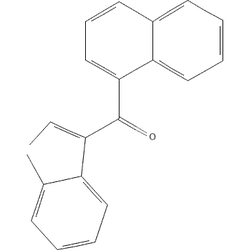
JWH-018 Stats & Data
JDNLPKCAXICMBW-UHFFFAOYSA-NPharmacology
DrugBankMechanism of Action
... JWH-018 is probably the most studied synthetic cannabinoid. It has been found in multiple preparations and has been shown to be a potent cannabinoid receptor (CB) agonist. CB1 is the principal receptor thought to be most highly responsible for the euphoria and psychoactive effects of THC. The CB2 receptor resides mostly in the immune system but has some effect on pain control and mood regulation. ...
Metabolism
... The high pharmacological and addictive potency of JWH-018 highlights the importance of elucidating the metabolism of JWH-018, without which a meaningful insight into its pharmacokinetics and its toxicity would not be possible. In the present study, the cytochrome P450 phase I metabolites of JWH-018 were investigated, after in vitro incubation of the drug with human liver microsomes, followed by liquid chromatography-tandem mass spectrometry analysis. This revealed monohydroxylation of the na
Receptor Profile
Receptor Actions
Measured Affinities
Guide to PHARMACOLOGYMeasured binding and functional data for JWH-018, curated by the IUPHAR/BPS Guide to PHARMACOLOGY. Each row cites the paper it came from. Lower concentrations mean tighter binding — a value in the sub-nanomolar range indicates a very potent interaction.
| Target | Action | Measure | Value | Concentration | Species | Source |
|---|---|---|---|---|---|---|
| CB2 receptor CNR2 | Full agonist | pKi | 8.5 | 3.16 nM | Human | PMID 10525107 |
| CB1 receptor CNR1 | Full agonist | pKi | 8 | 10 nM | Human | PMID 10525107 |
Reading this. pKi, pEC50 and pIC50 are negative log molar values, so a higher number means a tighter interaction; the concentration column converts them for you. Values from non-human species are laboratory measurements and do not translate directly to human effect. Receptor affinity is not a dose — it describes what a molecule binds, not how much of it is safe to take.
Receptor data from the IUPHAR/BPS Guide to PHARMACOLOGY (v2026.2), licensed CC BY-SA 4.0. Matched to this substance by InChIKey.
History & Culture
JWH-018 was synthesized by John W. Huffman, an organic chemist at Clemson University, as part of his research into compounds affecting the endocannabinoid system. The compound's designation derives from Huffman's initials.
2006–present
Beginning in 2006, products containing JWH-018 entered the grey market under the brand name Spice, sold as potpourri or incense and labeled "not for human consumption" to circumvent drug regulations. The brand expanded into a product family including Spice Gold, Spice Arctic Synergy, Spice Diamond, and Spice Tropical Synergy. On 15 December 2008, German pharmaceutical analysis identified JWH-018 as one of the active components in at least three versions of Spice products. The Spice brand became so influential that the term eventually came to be used generically to describe all synthetic cannabinoids, regardless of their specific chemical composition. Following regulatory bans, manufacturers demonstrated a pattern of circumventing controls through minor chemical modifications—analysis of products obtained four weeks after German prohibition found manufacturers had shortened the alkyl chain by one carbon atom to create technically distinct compounds.
Subjective Effects
Physical
- Spontaneous tactile sensations: The body high of JWH-018 can be described as a warm, soft, pleasurable, all-encompassing tingling sensation that spreads over the body. It maintains a consistent presence that quickly rises with the onset and hits its limit once the peak has been reached before immediately dissipating.
- Sedation: Generally, the effects on the user's energy levels are sedating. This encourages one to relax, lie down, and (at higher doses) fall asleep. It produces strong sedative effects that can be described as on par with 5F-PB-22 and more sedating when compared to THC, JWH-073, THJ-018, AM-2201, or 5F-UR-144 but less than that of 5F-AKB-48.
- Motor control loss: This substance causes a partial to moderate suppression of motor control which intensifies proportional to dose, but rarely results in a complete inability to walk and perform basic movements.
- Appetite enhancement: As with many other cannabinoids, JWH-018 causes an increase in appetite, known colloquially as "the munchies" in popular American and United Kingdom culture. Clinical studies and survey data have found that cannabis increases food enjoyment and interest in food. This is thought to be due to the way in which endocannabinoids in the hypothalamus activate cannabinoid receptors that are responsible for maintaining food intake.
- Dehydration: This is known colloquially as "cotton mouth" in popular American and United Kingdom culture.
- Vasodilation: Cannabinoids appear to decrease blood pressure by dilating the blood vessels and increasing blood flow throughout the body. The arteries in the eyeball expand from the decreased blood pressure and the heart rate increases to compensate for the reduction in pressure.
- Pain relief: Cannabinoids have been clinically demonstrated to provide pain relief via agonism of cannabinoid receptors CB1 and CB2, which extends to synthetic cannabinoid receptor agonists.
- Perception of increased weight or Perception of decreased weight
- Changes in gravity: JWH-018, like other cannabinoids, is capable of causing vertigo with which the environment appears to be spinning or oscillating. At moderate doses, it can spontaneously induce the sensation of falling, which can be overwhelming and uncomfortable. The propensity of this is greatly reduced and eliminated in proportion to tolerance.
Cognitive
- Current mind state enhancement: The most prominent cognitive component of cannabinoids is the way in which they enhance the emotions one is already feeling proportional to dose. This can result in euphoria, extreme laughter, and increased immersion within tasks and activities, or it can result in anxiety and paranoia depending on the user's current mind state.
- Euphoria: This can be considered very prominent in comparison to THJ-018, AM-2201, and 5F-UR-144 but less intense in comparison to JWH-073.
- Thought connectivity: This can attribute to fluid, more abstract thinking in comparison to linear thought.
- Anxiety: Subjectively, JWH-018 is less anxiogenic and stimulating than Δ9-THC, THJ-018, AM-2201, or 5F-UR-144 but more so than JWH-073.
- Paranoia: All cannabinoids are capable of inducing paranoia at high doses or with chronic administration.
- Thought deceleration
- Immersion enhancement
- Conceptual thinking
- Mindfulness
- Information processing suppression
- Dream suppression
Sensory
- Enhancements
- Colour enhancement
- Acuity suppression
- Geometry: As reported with other cannabinoids, JWH-018 can produce closed eye visuals at moderate doses, which can escalate into visual distortions such as a ripples in the field of vision upon continuous administration. Within users who also regularly use psychedelics, it is capable of inducing these consistently in a visual style which seems to be an averaged out depiction of all the psychedelics one has used within the past. These rarely extend beyond level 4 and are considered to be mild, fine, small and zoomed out but brighter and better defined than the geometry experienced with cannabis.
Forked from Subjective Effect Documentation work by Josie Kins, September 2015. Via dose.wiki (CC0).
Toxicity
PsychonautWikiThe toxicity and long-term health effects of recreational JWH-018 use do not seem to have been studied in any scientific context and the exact toxic dosage is unknown. This is because the drug has very little history of human usage. JWH-018, like many synthetic cannabinoids, is a full agonist of the CB1 receptors in contrast to the partial agonist Δ9-THC. Because of this, harm mediated by CB1 receptor agonism can be more severe than its partial agonist counterparts. JWH-018 has caused seizures and convulsions, and evidence suggests this is a result of inhibiting GABA neurotransmission more effectively than Δ9-THC.
Tolerance & Pharmacokinetics
drugs.wikiTolerance Decay
Anecdotal and limited preclinical data suggest rapid tachyphylaxis with daily use; spacing days between sessions reduces tolerance and likely risk. Data quality is mixed and skewed to user reports.
Cross-Tolerances
Demographics
Gender Distribution
Age Distribution
Reports Over Time
Effect Analysis
Erowid + BluelightEffects aggregated from 114 experience reports (80 single-substance Erowid + 34 Bluelight)
Effect Sentiment Distribution
Confidence Distribution
Each bar is the share of reports mentioning the effect; its whisker, and the band on the rows below, is the 95% interval: where the share could plausibly be with other reports of the same kind.
Positive Effects 27
Adverse Effects 65
Show 42 more adverse effects
Show 20 neutral or unclassified mentions
Also reported in combinations. In the 26 JWH-018 reports where another drug was taken too, 6 (23.1%) mention hospital, emergency services or an overdose, 3 (11.5%) a seizure and 0 (0.0%) psychosis. In the 80 single-substance reports: 25.0%, 7.5% and 3.8%. These are not in the figures above: they cannot be put down to JWH-018 alone, and a mention is not always something that happened to the writer.
Dosage Distribution
Dose distribution from experience reports, one dose per report (the first listed). Doses above Q3 + 3×IQR, far above what people typically take, are left out of the median and range and listed under each route: most are real heavy doses or overdoses, not mistakes.
1 dose more than 50 times the median may be a typing or unit error and is not in the figures either: check the report.
Real-World Dose Distribution
ErowidFrom 38 of 56 recorded dose entries: those that state a weight (mg, g or µg), in routes with at least five of them. Values above Q3 + 3×IQR, far above what people typically take, are left out; they can include real heavy doses and overdoses, not only mistakes.
Smoked (n=29)
Oral (n=7)
Common Combinations
Most co-occurring substances, as a share of all 106 reports filed under JWH-018; whiskers are 95% intervals
Form / Preparation
Most common forms and preparations, as a share of the 74 reports that give one; whiskers are 95% intervals
Body-Weight Dosing
Dose per kg of body weight, one dose per report (the first listed), from reports giving a weight of 30–250 kg. Doses above Q3 + 3×IQR, far above what people typically take, are left out of the median and range and listed under each route.
Smoked
1 dose more than 50 times the median may be a typing or unit error and is not in the figures either: check the report.
Oral
Redose Patterns
Redosing behavior across 80 reports
Legal Status
| Country | Status | Notes |
|---|---|---|
| United Kingdom | Controlled (Misuse of Drugs Act) | Classified under the Misuse of Drugs Act at the end of 2009. JWH-018 was among the first synthetic cannabinoids to be formally controlled in the UK, prompted by its widespread availability in products marketed as 'Spice' or herbal incense. |
| United States | Schedule I | Placed under federal control during the summer of 2012. Prior to scheduling, JWH-018 was sold openly in head shops and online under the guise of incense or potpourri labeled 'not for human consumption' to circumvent drug laws. |
Harm Reduction
drugs.wikiJWH‑018 is a full CB1 agonist with near-maximal efficacy (unlike Δ9‑THC’s partial agonism), yielding a much steeper dose‑response and a narrow safety margin—small increments can cause outsized effects. Blends sold as ‘Spice/K2’ are highly variable and often contain multiple or different noids than advertised; potency ‘hot‑spots’ and adulteration are common, so homogenization or volumetric preparation is safer than sprinkling on plant material. Inhalation peaks within minutes, making rapid redose tempting; wait ≥15 minutes between tiny measured inhalations to gauge effect and avoid panic reactions, vomiting, or syncope. Prominent toxicity signs include severe anxiety/agitation, tachycardia/hypertension, emesis, seizures, psychosis, and hyperthermia; seek urgent care for chest pain, persistent confusion, or any seizure. First-line ED care is supportive with benzodiazepines for agitation/seizures and active cooling/hydration; there is no specific antidote. Seizure risk appears higher with synthetic cannabinoids than with cannabis; combining with bupropion, tramadol, or stimulants adds further risk. Oral use has slower onset and a longer, less predictable course—common overdose pattern is early redose before the first dose peaks. Heavy cannabis tolerance does not protect against JWH‑018; tolerance builds rapidly, but cross‑tolerance is incomplete and does not prevent adverse reactions. Avoid driving and hazardous tasks for several hours after use; effects on coordination and judgment can persist beyond the perceived ‘high’. Pregnancy and lactation: cannabinoids cross the placenta and concentrate in breast milk; synthetic analog effects are poorly defined—avoid exposure. Routine reagent kits are not reliable for identifying specific noids; only accredited lab analysis can confirm identity/potency.
References
Data Sources
Cited References
- Atwood et al. (2010) - JWH-018 CB1 Potency
- Brents et al. (2011) - Phase I Metabolites Activity
- Every-Palmer (2011) - JWH-018 and Psychosis
- Freeman et al. (2013) - Stroke Association
- Grigoryev et al. (2022) - Psychotomimetic Effects Study
- Human Inhalation Pharmacokinetics (2–3 mg)
- JWH-018 Phase 1 Pilot Study
- Koller et al. (2022) - Cannabinoid-Induced Seizures
- PsychonautWiki: JWH-018
- Rat Tolerance and CB1 Desensitization
- Schneir et al. (2011) - Synthetic Cannabinoid Intoxication
- Schneir et al. (2012) - Convulsions Associated with Use
- Human inhalation PK (2–3 mg)
- Phase-1 pilot, 2 & 3 mg inhaled
- Psychotomimetic 5.5 mg study
- Rat tolerance & CB1 desensitisation
- Severe toxicity with seizures
- CYP2C9 polymorphism metabolism
Additional references
- EUDA synthetic cannabinoids drug profile (background, variability, structural class)
- EUDA Joint Report table: JWH‑018 CB1 efficacy (full agonist; high Emax) and severe adverse events list
- Euro-DEN analysis: higher seizure odds with synthetic cannabinoids vs many drugs
- NCBI Bookshelf (CBHSQ/SAMHSA): synthetic cannabinoids cause severe agitation, seizures, psychosis; withdrawal can occur
- NCBI StatPearls: cannabinoid/synthetic cannabinoid toxicity and ED management (benzodiazepines first-line; supportive care)
- DrugBank review: JWH‑018 metabolism primarily via CYP1A2 and CYP2C9; UGT in secondary metabolism
- Erowid Spice product page: mislabeling, multiple actives, variability in herbal blends
- UNODC 2013 report (mirrored by Erowid): synthetic cannabinoids can raise blood pressure and cause myocardial ischemia
- Drugs-Forum wiki and threads: tolerance anecdotes; dosing pitfalls incl. ‘eyeballing’ risk; oral duration reports
- Drugs-Forum thread: oral JWH‑018 duration and effects example
- Drugs-Forum thread: ‘eyeballing’ warnings and mismeasurement risk
- EUDA 2025 NPS report: mis-selling of semi-synthetic/synthetic cannabinoids in cannabis products