
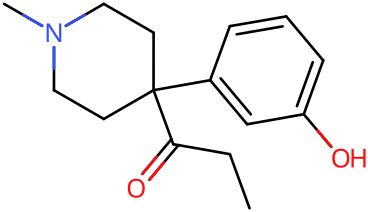
Ketobemidone Stats & Data
CCC(=O)C1(CCN(C)CC1)c1cccc(O)c1ALFGKMXHOUSVAD-UHFFFAOYSA-NPharmacology
DrugBankDescription
Ketobemidone is a powerful opioid analgesic. It also has some NMDA-antagonist properties. This makes it useful for some types of pain that don't respond well to other opioids. The most commonly cited equalisation ratio for analgesic doses is 25 mg of ketobemidone hydrobromide to 60 mg of morphine hydrochloride or sulfate and circa 8 mg of ketobemidone by injection.
Mechanism of Action
Ketobemidone (Cliradon, Ketogan, Ketodur, Cymidon, Ketorax, &c.) is a powerful opioid analgesic. It also has some NMDA-antagonist properties. This makes it useful for some types of pain that don't respond well to other opioids. The most commonly cited equalisation ratio for analgesic doses is 25 mg of ketobemidone hydrobromide to 60 mg of morphine hydrochloride or sulfate and circa 8 mg of ketobemidone by injection.
Metabolism
Ketobemidone is mainly metabolised by conjugation of the phenolic hydroxyl group, and by N-desmethylation. Only about 13-24% is excreted unchanged after iv. administration.
Indication
For the treatment of all types of severe pain, such as postoperative, cancer, kidney stones and fractures.
Half-life
Plasma half-life: 2.42 +/- 0.41 h (m +/- SD). Elimination half-life: 3.27 +/- 0.32 h
Toxicity
DrugBankToxicity (DrugBank)
Base: Rat Intravenous LD50: 10 mg/kg; Mouse Intravenous LD50: 14 mg/kg. Hydrochloride salt: Rat Oral LD50: 215 mg/kg; Rat Intravenous LD50: 40 mg/kg
Effect Profile
Curated + 1 ReportsStrong euphoria with moderate itching/nausea, mild pain relief, low sedation
Tolerance & Pharmacokinetics
drugs.wikiNo tolerance chart. Our decay curves for opioids were estimates, and a curve can make tolerance look longer-lasting than it is, which is the dangerous direction.
Opioid tolerance drops fast when you stop, and even a few days off can be enough, so a dose that used to be normal can now stop your breathing. Overdose deaths rise sharply after prison, detox or leaving treatment, and tolerance also falls during a hospital stay. After any break, start with a much smaller amount, try a test dose first, don't use alone, and keep naloxone within reach. Alcohol, benzodiazepines, gabapentinoids and other sedatives make an opioid overdose much more likely.
Sources: FRANK: heroin · National Harm Reduction Coalition · WHO: opioid overdose · Merrall et al. 2010 · Binswanger et al. 2007 · Strang et al. 2003 · FDA 2019: gabapentinoids and breathing
Experience Report Analysis
ErowidDemographics
Gender Distribution
Too few reports for a chart: gender is known from 3 reports, and a split is drawn only from 20 reports or more. Counts are shown instead. Why 20?
- Male 3 of 3
Age Distribution
Reports Over Time
Real-World Dose Distribution
ErowidFrom 6 of 9 recorded dose entries: those that state a weight (mg, g or µg), in routes with at least five of them. Values above Q3 + 3×IQR, far above what people typically take, are left out; they can include real heavy doses and overdoses, not only mistakes.
Oral (n=6)
Form / Preparation
Most common forms and preparations, as a share of the 3 reports that give one
Too few reports for bars: these forms come from 3 reports, and a bar is drawn only from 20 reports or more. With fewer, a percentage cannot tell a common effect from a rare one. Counts are shown instead. Why 20?
- Pill / Tablet 2 of 3