
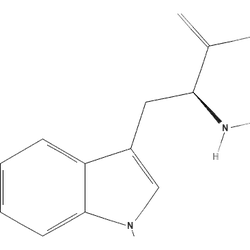
L-Tryptophan Stats & Data
C1=CC=C2C(=C1)C(=CN2)CC(C(=O)O)NQIVBCDIJIAJPQS-VIFPVBQESA-NPharmacology
DrugBankDescription
An essential amino acid that is necessary for normal growth in infants and for nitrogen balance in adults. It is a precursor of indole alkaloids in plants. It is a precursor of serotonin (hence its use as an antidepressant and sleep aid). It can be a precursor to niacin, albeit inefficiently, in mammals.
Mechanism of Action
A number of important side reactions occur during the catabolism of tryptophan on the pathway to acetoacetate. The first enzyme of the catabolic pathway is an iron porphyrin oxygenase that opens the indole ring. The latter enzyme is highly inducible, its concentration rising almost 10-fold on a diet high in tryptophan. Kynurenine is the first key branch point intermediate in the pathway. Kynurenine undergoes deamniation in a standard transamination reaction yielding kynurenic acid. Kynurenic acid and metabolites have been shown to act as antiexcitotoxics and anticonvulsives. A second side branch reaction produces anthranilic acid plus alanine. Another equivalent of alanine is produced further along the main catabolic pathway, and it is the production of these alanine residues that allows tryptophan to be classified among the glucogenic and ketogenic amino acids. The second important branch point converts kynurenine into 2-amino-3-carboxymuconic semialdehyde, which has two fates. The main flow of carbon elements from this intermediate is to glutarate. An important side reaction in liver is a transamination and several rearrangements to produce limited amounts of nicotinic acid, which leads to production of a small amount of NAD+ and NADP+.
Pharmacodynamics
Tryptophan is critical for the production of the body's proteins, enzymes and muscle tissue. It is also essential for the production of niacin, the synthesis of the neurotransmitter serotonin and melatonin. Tryptophan supplements can be used as natural relaxants to help relieve insomnia. Tryptophan can also reduce anxiety and depression and has been shown to reduce the intensity of migraine headaches. Other promising indications include the relief of chronic pain, reduction of impulsivity or mania and the treatment of obsessive or compulsive disorders. Tryptophan also appears to help the immune system and can reduce the risk of cardiac spasms. Tryptophan deficiencies may lead to coronary artery spasms. Tryptophan is used as an essential nutrient in infant formulas and intravenous feeding. Tryptophan is marketed as a prescription drug (Tryptan) for those who do not seem to respond well to conventional antidepressants. It may also be used to treat those afflicted with seasonal affective disorder (a winter-onset depression). Tryptopan serves as the precursor for the synthesis of serotonin (5-hydroxytryptamine, 5-HT) and melatonin (N-acetyl-5-methoxytryptamine).
Indication
Tryptophan may be useful in increasing serotonin production, promoting healthy sleep, managing depression by enhancing mental and emotional well-being, managing pain tolerance, and managing weight.
Measured Affinities
Guide to PHARMACOLOGYMeasured binding and functional data for L-tryptophan, curated by the IUPHAR/BPS Guide to PHARMACOLOGY. Each row cites the paper it came from. Lower concentrations mean tighter binding — a value in the sub-nanomolar range indicates a very potent interaction.
| Target | Action | Measure | Value | Concentration | Species | Source |
|---|---|---|---|---|---|---|
| GPR139 GPR139 | Agonist | pIC50 | 4.59 | 25,704 nM | Human | PMID 26349500 |
| GPR139 GPR139 | Agonist | pEC50 | 3.66 | 218,776 nM | Human | PMID 24826842 |
| GPR139 GPR139 | Agonist | pKi | 3.13 | 741,310 nM | Human | PMID 26349500 |
| Proton-coupled Amino acid Transporter 1 SLC36A1 | Inhibition | pKi | 2.3 | 5,011,872 nM | Human | PMID 16126914 |
| CaS receptor CASR | Positive | pKd | — | — | Human | — |
Reading this. pKi, pEC50 and pIC50 are negative log molar values, so a higher number means a tighter interaction; the concentration column converts them for you. Values from non-human species are laboratory measurements and do not translate directly to human effect. Receptor affinity is not a dose — it describes what a molecule binds, not how much of it is safe to take.
Receptor data from the IUPHAR/BPS Guide to PHARMACOLOGY (v2026.2), licensed CC BY-SA 4.0. Matched to this substance by InChIKey.
Safe in the present practices of use and concentration. Ingredient, concentration, and use information are available in documents discoverable at https://cir-reports.cir-safety.org A number of important side reactions occur during the catabolism of tryptophan on the pathway to acetoacetate. The first enzyme of the catabolic pathway is an iron porphyrin oxygenase that opens the indole ring.
Carcinogenicity
No indication of carcinogenicity to humans (not listed by IARC).
Toxicity (DrugBank)
Oral rat LD50: > 16 gm/kg. Investigated as a tumorigen, mutagen, reproductive effector. Symptoms of overdose include agitation, confusion, diarrhea, fever, overactive reflexes, poor coordination, restlessness, shivering, sweating, talking or acting with excitement you cannot control, trembling or shaking, twitching, and vomiting.
Experience Report Analysis
ErowidDemographics
Gender Distribution
Too few reports for a chart: gender is known from 8 reports, and a split is drawn only from 20 reports or more. Counts are shown instead. Why 20?
- Male 8 of 8