
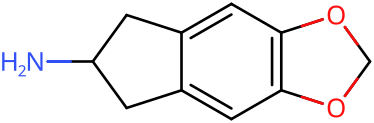
MDAI Stats & Data
NC1Cc2cc3OCOc3cc2C1FQDRMHHCWZAXJM-UHFFFAOYSA-NInteraction Warnings
The neurotoxic effects of MDMA may be increased when combined with other stimulants.
This combination may increase strain on the heart.
Receptor Profile
Receptor Actions
Subjective Effects
Physical
- Physical euphoria
- Enhancement of touch
- Sedation: The biggest difference between MDAI and MDMA is that due to a comparative lack of dopamine reuptake inhibition, MDAI primarily results in moderate sedation and therefore discourages physical activities such as running, dancing or climbing.
- Spontaneous tactile sensations: The body high of MDAI can be described as a moderate to extreme euphoric, soft and warm tingling sensation that encompasses the entire body. It is capable of becoming overwhelmingly pleasurable at higher dosages.
- Vibrating vision: At high dosages, a person's eyeballs may begin to spontaneously wiggle back and forth in a rapid motion, causing the vision to become blurry and temporarily out of focus (nystagmus).
Cognitive
The general head space of MDAI is described by many as one of euphoria and feelings of love or empathy. It contains a number of typical entactogenic cognitive effects.
- Euphoria: Strong emotional euphoria and feelings of happiness are present within MDAI and are a direct result of serotonin and dopamine release.
- Increased empathy, love and sociability: This particular effect is equally as pronounced, powerful and therapeutic as that of MDMA or 2C-B. It is the most obvious and noticeable effect within any MDAI experience and dominates the head space.
- Acceleration of thought
- Mindfulness
Sensory
The visual effects of MDAI only occur at higher dosages and are subtly psychedelic.
- Tracers
- Increased visual acuity
- Enhancement of colour
Forked from Subjective Effect Documentation by Josie Kins, August 2014. Via dose.wiki (CC0).
Toxicity
PsychonautWikiMDAI and other similar drugs have been widely used in scientific research as they are able to replicate many of the effects of MDMA, but without causing the associated neurotoxicity. No tests have been performed on cardiovascular toxicity. There is currently no scientific data on the lethal dose of MDAI in humans and the exact toxic dosage is unknown. Due to its action as a serotonin reuptake inhibitor, overdoses of this substance would likely result in serotonin syndrome. It is strongly recommended that one use harm reduction practices when using this substance.
Addiction & dependence
Although no formal studies have been conducted, MDAI can be considered somewhat habit-forming with a low potential for abuse and is unlikely to be capable of causing psychological dependence among most users. This is because unlike traditional stimulants, MDAI does not increase concentrations of dopamine. If addiction has developed, cravings and withdrawal effects may occur if a person suddenly stops their usage.
Effect Profile
Curated + 45 ReportsLow visuals with mild body load
Moderate euphoria and sensory enhancement with mild empathy, low stimulation
Moderate euphoria with mild stimulation, low focus
Tolerance & Pharmacokinetics
drugs.wikiTolerance Decay
Demographics
Gender Distribution
Age Distribution
Reports Over Time
Effect Analysis
Erowid + BluelightEffects aggregated from 45 experience reports (19 single-substance Erowid + 26 Bluelight)
Effect Sentiment Distribution
Confidence Distribution
Each bar is the share of reports mentioning the effect; its whisker, and the band on the rows below, is the 95% interval: where the share could plausibly be with other reports of the same kind.
Rows resting on fewer than 20 reports show a count (“3 of 7”) instead of a bar. Why 20?
Positive Effects 48
Adverse Effects 36
Show 16 more adverse effects
Show 19 neutral or unclassified mentions
Also reported in combinations. In the 22 MDAI reports where another drug was taken too, 1 (4.5%) mentions hospital, emergency services or an overdose, 0 (0.0%) a seizure and 0 (0.0%) psychosis. In the 19 single-substance reports: 0, 0 and 1. These are not in the figures above: they cannot be put down to MDAI alone, and a mention is not always something that happened to the writer.
Dosage Distribution
Dose distribution from experience reports, one dose per report (the first listed). Doses above Q3 + 3×IQR, far above what people typically take, are left out of the median and range and listed under each route: most are real heavy doses or overdoses, not mistakes.
Real-World Dose Distribution
ErowidFrom 69 of 70 recorded dose entries: those that state a weight (mg, g or µg), in routes with at least five of them. Values above Q3 + 3×IQR, far above what people typically take, are left out; they can include real heavy doses and overdoses, not only mistakes.
Oral (n=54)
Insufflated (n=13)
Common Combinations
Most co-occurring substances, as a share of all 41 reports filed under MDAI; whiskers are 95% intervals
Form / Preparation
Most common forms and preparations, as a share of the 36 reports that give one; whiskers are 95% intervals
Body-Weight Dosing
Dose per kg of body weight, one dose per report (the first listed), from reports giving a weight of 30–250 kg. Doses above Q3 + 3×IQR, far above what people typically take, are left out of the median and range and listed under each route.
Redose Patterns
Redosing behavior across 36 reports
Legal Status
| Country | Status | Notes |
|---|---|---|
| Austria | MDAI is illegal to possess, produce and sell under the NPSG (Neue-Psychoaktive-Substanzen-Gesetz Österreich). | |
| Brazil | MDAI is illegal to possess, produce and sell under Portaria SVS/MS nº 344. | |
| China | As of October 2015 MDAI is a controlled substance in China. | |
| Denmark | MDAI is illegal in Denmark as of September 2015. | |
| Finland | Scheduled in the "government decree on psychoactive substances banned from the consumer market". | |
| Germany | MDAI is controlled under the NpSG ( New Psychoactive Substances Act ) as of November 26, 2016. | Production and import with the aim to place it on the market, administration to another person and trading is punishable. Possession is illegal but not penalized. |
| Japan | MDAI is a controlled substance in Japan effective March 30th, 2013. | |
| Switzerland | As of December 2011 MDAI is a controlled substance in Switzerland. | |
| United Kingdom | MDAI is illegal to produce, supply, or import under the Psychoactive Substance Act, which came into effect on May 26th, 2016. | |
| United States | legal | Caution : All legal information should be verified through other sources. see below U.S. FEDERAL LEGAL SUMMARY MDAI - REGULATED: No - STATUS: Not Approved ForHuman Consumption - SCHEDULE: Un-Scheduled MDAI is uncontrolled in the United States under federal law. This means it is generally considered legal to buy, possess, and distribute (sell, trade or give). If sold as a supplement, sales must conform to U.S. supplement laws. If sold for consumption as a food or drug, sales are regulated by the FDA. It is possible that it would be considered an analog in which case, sales for human consumption or possession with the intent to ingest could be prosecuted under the Federal Analogue Act or state analog acts. U.S. STATE LAW |