
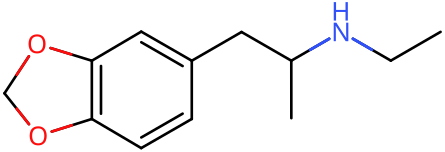
MDEA Stats & Data
CCNC(C)CC1=CC2=C(C=C1)OCO2PVXVWWANJIWJOO-UHFFFAOYSA-NReceptor Profile
Receptor Actions
Toxicity
PsychonautWikiShort-term physical health risks of MDEA consumption include dehydration, insomnia, hyperthermia, and hyponatremia. Continuous activity without sufficient rest or rehydration may cause body temperature to rise to dangerous levels, and loss of fluid via excessive perspiration puts the body at further risk as the stimulatory and euphoric qualities of the drug may render the user oblivious to their energy expenditure for quite some time. Diuretics such as alcohol may exacerbate these risks further. The exact toxic dosage is unknown, but considered to be far greater than its active dose.
Organ-specific toxicity
As with MDMA, the neurotoxicity of MDEA use has long been the subject of debate. Scientific study has resulted in the general agreement that, although it is physically safe to try in a responsible context, the administration of repeated or high dosages of MDEA is likely to be neurotoxic and cardiotoxic in some form. Like other powerful serotonin releasing agents, MDEA is thought to cause down-regulation of serotonin reuptake transporters in the brain.
Effect Profile
Curated + 3 ReportsLow headspace with mild body load
Moderate euphoria with mild stimulation and sensory enhancement, low empathy
Moderate euphoria with strong anxiety/jitters, mild stimulation, low focus
Tolerance & Pharmacokinetics
drugs.wikiNo tolerance chart. No study has measured how long tolerance to it lasts, so this page shows what is known instead of a curve.
No study has measured tolerance to MDEA in people. PsychonautWiki estimates that tolerance halves in 1-1.5 months and is gone in 2-3 months, without citing a source. What is known about repeat MDMA doses has not been tested for MDEA.
Sources: PsychonautWiki: MDEA
Experience Report Analysis
ErowidDemographics
Gender Distribution
Too few reports for a chart: gender is known from 9 reports, and a split is drawn only from 20 reports or more. Counts are shown instead. Why 20?
- Not Specified 2 of 9
- Male 5 of 9
- Female 2 of 9
Age Distribution
Reports Over Time
Real-World Dose Distribution
ErowidFrom 7 of 12 recorded dose entries: those that state a weight (mg, g or µg), in routes with at least five of them. Values above Q3 + 3×IQR, far above what people typically take, are left out; they can include real heavy doses and overdoses, not only mistakes.
Oral (n=7)
Form / Preparation
Most common forms and preparations, as a share of the 7 reports that give one
Too few reports for bars: these forms come from 7 reports, and a bar is drawn only from 20 reports or more. With fewer, a percentage cannot tell a common effect from a rare one. Counts are shown instead. Why 20?
- Capsule 4 of 7
- Pill / Tablet 2 of 7
Legal Status
| Country | Status | Notes |
|---|---|---|
| Austria | MDEA is illegal to possess, produce and sell under the SMG (Suchtmittelgesetz Österreich). | |
| Brazil | MDEA is illegal to possess, produce or sell as it is listed on Portaria SVS/MS nº 344 as "MDE". | |
| Canada | MDEA is listed on the CSDA in Schedule I. | |
| France | MDEA is scheduled as a "stupéfiant", i.e. | a recognized drug of abuse. It is illegal to possess, buy, sell or manufacture. |
| Germany | MDEA is controlled under Anlage I BtMG (Narcotics Act, Schedule I) as of April 15, 1991. | It is illegal to manufacture, possess, import, export, buy, sell, procure or to dispense it without a license. ( MDE ) |
| Switzerland | MDEA is a controlled substance specifically named under Verzeichnis D. | |
| United Kingdom | MDEA is a Class A drug. | |
| United States | In the United States, MDEA was introduced recreationally in 1985 as a legal substitute to the newly banned MDMA. | MDEA was made a Schedule 1 substance in the United States on October 15, 1987. |