
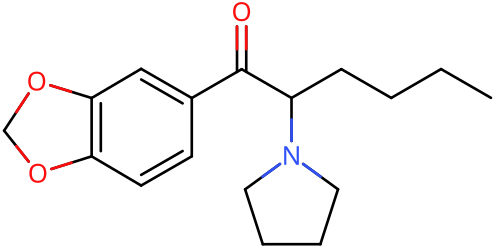
MDPHP Stats & Data
CCCCC(C(=O)C1=CC2=C(C=C1)OCO2)N3CCCC3OBLFRFGUZZRECT-UHFFFAOYSA-NReceptor Profile
Receptor Actions
Effect Profile
Curated + 2 ReportsStrong euphoria and stimulation with strong anxiety/jitters, moderate focus
Tolerance & Pharmacokinetics
drugs.wikiTolerance Decay
Strong acute tolerance within a session with rapidly diminishing euphoria; inter‑session tolerance decays over several days. Data are largely anecdotal from user reports across pyrrolidinophenones; individual variability is large.
Cross-Tolerances
Experience Report Analysis
ErowidDemographics
Gender Distribution
Too few reports for a chart: gender is known from 2 reports, and a split is drawn only from 20 reports or more. Counts are shown instead. Why 20?
- Male 2 of 2
Age Distribution
Reports Over Time
Real-World Dose Distribution
ErowidFrom 125 of 149 recorded dose entries: those that state a weight (mg, g or µg), in routes with at least five of them. Values above Q3 + 3×IQR, far above what people typically take, are left out; they can include real heavy doses and overdoses, not only mistakes.
Insufflated (n=98)
Smoked (n=6)
Oral (n=16)
Form / Preparation
Most common forms and preparations, as a share of the 2 reports that give one
Too few reports for bars: these forms come from 2 reports, and a bar is drawn only from 20 reports or more. With fewer, a percentage cannot tell a common effect from a rare one. Counts are shown instead. Why 20?
- Powder / Crystals 2 of 2
Legal Status
| Country | Status | Notes |
|---|---|---|
| Australia | In Western Australia, MDPV has been banned under the Poisons Act 1964, having been included in Appendix A Schedule 9 of the Poisons Act 1964 as from February 11, 2012. | The Director of Public Prosecutions for Western Australia announced that anyone intending to sell or supply MDPV faces a maximum $100,000 fine or 25 years in jail. Users face a $2000 fine or two years' jail. Therefore, anyone caught with MDPV can be charged with possession, selling, supplying or intent to sell or supply. |
| Austria | Since June 26, 2019, MDPV is illegal to possess, produce and sell under the SMG. | (Suchtmittelgesetz Österreich) |
| Belgium | MDPV is a controlled substance as of March 20, 2013. | |
| Brazil | MDPV is illegal to produce, sell, or possess as it is listed on Portaria SVS/MS nº 344. | |
| Bulgaria | MDPV is controlled under the Narcotic Substances Control Law as of February 2011. | |
| Canada | Canadian Health Minister Leona Aglukkaq announced on June 5, 2012, that MDPV would be listed on Schedule I of the Controlled Drugs and Substances Act, which was realized on September 26, 2012. | |
| Croatia | MDPV is a controlled substance. | |
| Cyprus | MDPV a Class B controlled substance, as it is covered by the cathinones catch-all clause. | |
| Czech Republic | MDPV is a controlled substance. | |
| Denmark | MDPV is a controlled substance. | |
| Estonia | MDPV is a controlled substance as of November 29, 2010. | |
| Finland | MDPV is specifically listed as a controlled substance in Finland (listed appendix IV substance as of June 28, 2010), | |
| France | MDPV is a controlled substance as of August 2, 2012. | |
| Germany | MDPV is controlled under Anlage II BtMG ( Narcotics Act, Schedule II ) as of July 26, 2012. | It is illegal to manufacture, possess, import, export, buy, sell, procure or dispense it without a license. |
| Hungary | MDPV a Schedule A controlled psychotropic substance. | |
| Ireland | MDPV is covered by the Misuse of Drugs Acts since May 11, 2010. | |
| Italy | MDPV is a controlled substance as of December 29, 2011. | |
| Latvia | MDPV is a controlled substance. | |
| Luxembourg | MDPV is a controlled substance as of July 30, 2012. | |
| Norway | MDPV is a controlled substance as of Febuary 14, 2013. | |
| Poland | MDPV is a controlled substance. | |
| Slovakia | MDPV a Schedule I controlled psychotropic substance as of March 1, 2011. | |
| Slovenia | MDPV is a controlled substance. | |
| Sweden | MDPV is a controlled substance. | In Sweden a 33-year-old man has been sentenced to six years in prison by an appellate court, Hovrätt, for possession of 250 grams of MDPV that had been acquired prior to criminalization. |
| Switzerland | MDPV is a controlled substance specifically named under Verzeichnis D. | |
| Turkey | MDPV is a controlled substance. | |
| United Kingdom | In the UK, following the ACMD's report on substituted cathinone derivatives, MDPV is a Class B drug under The Misuse of Drugs Act 1971 (Amendment) Order 2010, making it illegal to sell, buy, or possess without a license. | |
| United States | In the United States, MDPV is a DEA federally scheduled drug. | On October 21, 2011, the DEA issued a temporary one-year ban on MDPV, classifying it as a schedule I substance. Schedule I status is reserved for substances with a high potential for abuse, no currently accepted use for treatment in the United States and a lack of accepted safety standards for use under medical supervision. Before the federal ban was announced, MDPV was already banned in Louisiana and Florida. On March 24, 2011, Kentucky passed bill HB 121, which makes MDPV, as well as three other cathinones, controlled substances in the state. It also makes it a Class A misdemeanor to sell the drug, and a Class B misdemeanor to possess it. MDPV is banned in New Jersey under Pamela's Law. The law is named after Pamela Schmidt, a Rutgers University student who was murdered in March 2011 by an alleged user of MDPV. A toxicology report later found no "bath salts" in his system. On May 5, 2011, Tennessee Governor Bill Haslam signed a law making it a crime "to knowingly produce, manufacture, distribute, sell, offer for sale or possess with intent to produce, manufacture, distribute, sell, or offer for sale" any product containing MDPV. On July 6, 2011, the governor of Maine signed a bill establishing fines for possession and penalties for trafficking of MDPV. On October 17, 2011, an Ohio law banning synthetic drugs took effect barring selling and/or possession of "any material, compound, mixture, or preparation that contains any quantity of the following substances having a stimulant effect on the central nervous system, including their salts, isomers, and salts of isomers", listing ephedrine and pyrovalerone. It also specifically includes MDPV. Four days after this Ohio law was passed, the DEA's national emergency ban was implemented. On December 8, 2011, under the Synthetic Drug Control Act, the US House of Representatives voted to ban MDPV and a variety of other synthetic drugs that had been legally sold in stores. |
Harm Reduction
drugs.wiki• Multiple forensic case reports confirm that MDPHP alone can be lethal and often presents with pulmonary edema and severe sympathomimetic signs; reported post‑mortem blood levels vary widely, reflecting unknown human pharmacokinetics and possible multi‑timepoint use. Oral ingestion has been inferred around 60–90 minutes before collapse in at least one case. • PK in humans is not characterized; forensic authors explicitly note that no formal ADME data are available. Effects often outlast expected elimination due to redosing and sleep loss. • Vaporizing freebase produces an almost instantaneous rush, very short peak, and intense craving to redose every minutes; multi‑hour binges with psychosis and severe sleep deprivation are repeatedly reported. • Oral dosing is generally the least compulsive; spacing redoses by several hours markedly reduces adverse effects and next‑day insomnia. • Prominent adverse effects include tachycardia, hypertension, vasoconstriction with cold extremities, jaw tension, sweating, anxiety/paranoia, and insomnia; high doses and sleep deprivation increase risk of stimulant psychosis. • Non‑selective beta‑blockers can theoretically worsen stimulant‑induced vasoconstriction; for agitation/overstimulation, first‑line harm‑reduction is rest in a cool environment and anxiolytics (e.g., prescribed benzodiazepines) rather than self‑medicating with beta‑blockers. • Avoid combinations that lower seizure threshold (e.g., tramadol, high‑dose bupropion). • Mislabeling within the cathinone market is common (e.g., α‑PVP/MDPPP sold as 3‑MMC); reagent/drug‑checking is advised and test a tiny dose first even if it looks familiar. • Freebase/smoking leaves a persistent amine‑like odor that can cling to hair/clothes and indoor spaces; ensure ventilation and consider routes that reduce neighborhood exposure and binge risk. • For nasal use, crush finely, use personal equipment, pre/post saline, and rotate nostrils to reduce tissue injury. • Maintain hydration and electrolytes, avoid overheating and prolonged exertion, and protect sleep; many severe reactions follow continuous wakefulness rather than a single dose.
References
Data Sources
Cited References
- Baumann et al. 2013 - Powerful Cocaine-Like Actions of MDPV
- Baumann et al. 2017 - Neuropharmacology of MDPV and Related Analogs
- Bluelight: MDPV Dosage Question Thread
- Coppola & Mondola 2012 - MDPV Chemistry and Pharmacology
- Drugs-Forum: MDPV Drug Info Discussion
- EMCDDA: 2014 - MDPV Risk Assessment Report
- Erowid: MDPV Dose Chart
- Fantegrossi et al. 2013 - In Vivo Effects of MDPV in Mice
- Froberg et al. 2015 - Acute MDPV Toxicity (ToxIC Registry)
- Horsley et al. 2018 - Behavioural and Hyperthermic Profile of MDPV
- Marinetti & Antonides 2013 - Hyperthermia and Multiorgan Failure After Bath Salts
- Marusich et al. 2014 - Pharmacology of MDPV-Related Synthetic Stimulants
- Saha et al. 2024 - Cardiotoxicity After Synthetic Cathinone Use
- Simmler et al. 2017 - Stereoselective Actions of MDPV at Monoamine Transporters
- Winstock et al. 2015 - Intoxications Involving MDPV in Sweden 2010-2014
- Behavioural, Pharmacokinetic, Metabolic and Hyperthermic Profile of MDPV (Frontiers in Psychiatry, 2018)
- Stereoselective actions of MDPV at monoamine transporters (ACS Chem Neurosci, 2017)
- Powerful cocaine-like actions of MDPV (Neuropsychopharmacology, 2013)
- Hyperthermia and multiorgan failure after bath-salts injection (Case Report, 2012)
- Intoxications involving MDPV in Sweden 2010-2014
- Anodyne substance page – MDPV
- Anodyne Wiki: 3,4 Methylenedioxy Α Pyrrolidinopentiophenone
Additional references
- Erowid MDPHP experience index
- Erowid experience (insufflated 20+20 mg; stimulant effects; minimal euphoria)
- Erowid experience (vaporized 10–15 mg; short-lived stimulation)
- PubChem record: MDPHP HCl (synonyms/identity)
- Fatal monointoxication case (MDPHP only)
- Postmortem distribution in fatal intoxication (high central/peripheral blood; vitreous; hair)
- Polydrug fatal case (MDPHP with MDPPP/MDPV; tissue distribution)
- Bluelight MDPHP thread (low‑mg insufflation reports)
- Reddit summary: dosage/usage notes; oral 10–40 mg functional use pattern
- Reddit report: oral onset ~1 h; lasts ~6 h; insufflation ~20 min
- TripSit combinations chart (general cautions; MAOIs, stimulants)
- Erowid 4‑MMC basics (MAOI warning for cathinones)
- Erowid Beta‑blockers interactions page (caution with strong stimulants)
- Hi‑Ground cathinones page (route safety, snorting care)
- Saferparty: frequent cathinone mislabelling (α‑PVP, MDPPP sold as other cathinones)