
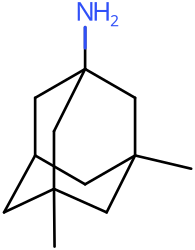
Memantine Stats & Data
CC12CC3CC(C)(C1)CC(N)(C3)C2BUGYDGFZZOZRHP-UHFFFAOYSA-NPharmacology
DrugBankDescription
Initially approved by the FDA in 2013, memantine is an N-methyl-D-aspartate (NMDA) receptor antagonist used in the management of Alzheimer's Disease (AD). It is different from many other Alzheimer's Disease medications, as it works by a different mechanism than the cholinesterase enzyme inhibitors normally employed in the management of Alzheimer's disease . Memantine blocks the effects of glutamate, a neurotransmitter in the brain that leads to neuronal excitability and excessive stimulation in Alzheimer's Disease . In 2010, it was estimated that 36 million people worldwide live with Alzheimer's Disease. In 2013, this number increased to 44 million. Almost doubling every 20 years, the prevalence of Alzheimer's Disease is predicted to reach 66 million by 2030 and to 115 million by 2050 . In December 2013, the G8 dementia summit concluded that dementia should be considered a global priority with the objective of developing a cure or a disease-modifying therapy by the year 2025 .
Mechanism of Action
Continuous activation of the N-methyl-D-aspartate (NMDA) receptors in the central nervous system caused by _glutamate_ is thought to cause some of the Alzheimer's disease symptoms. This overactivation is thought to contribute to neurotoxicity due to the excitatory properties of glutamate . The pharmacological effect of memantine likely occurs via the drug's behavior as an uncompetitive (open-channel) NMDA receptor antagonist, preventing glutamate action on this receptor. Memantine has a preference for the NMDA receptor-operated cation channels. Despite these antagonist effects, memantine has not been proven to prevent or retard the neurodegeneration seen in patients diagnosed with Alzheimer’s disease .
Pharmacodynamics
**General effects** This drug inhibits calcium influx into cells that is normally caused by chronic NMDA receptor activation by glutamate . This leads to the improvement of Alzheimer's dementia symptoms, demonstrated by increased cognition and other beneficial central nervous system effects . **Effects on neuroplasticity** Like other NMDA receptor antagonists, memantine at high doses can reduce neuronal synaptic plasticity that is involved in learning and memory processes. At lower concentrations, which are normally used in the clinical setting, memantine can enhance neuronal synaptic plasticity in the brain, improve memory, and act as a neuroprotectant against the destruction of neurons caused by excitatory neurotransmitters . **Effect on various receptors** Memantine has demonstrated minimal activity for GABA, benzodiazepine, dopamine, adrenergic, histamine, and glycine receptors, as well as voltage-dependent Ca2+, Na+ or K+ channels. This drug has shown antagonist activity at the 5HT3 receptors. Laboratory studies suggest that memantine does not affect the reversible inhibition of the acetylcholinesterase normally caused by donepezil, galantamine, or tacrine .
Metabolism
This drug is partially metabolized in the liver. The hepatic CYP450 enzyme system does not majorly contribute to the metabolism of this drug .
Absorption
After an oral dose, memantine is well absorbed. Its peak drug concentrations are attained in about 3-7 hours. Memantine shows linear pharmacokinetics when given at normal therapeutic doses. This drug can be taken without regard to food, as there is no effect of food on memantine absorption .
Indication
Memantine is used to manage moderate to severe Alzheimer's dementia . A more recent systemic review and meta-analysis indicates that memantine is beneficial as a first line drug for the treatment of Alzheimer's dementia. Cholinesterase inhibitors may be added to memantine for further beneficial effects on behavioral symptoms and other symptoms of dementia .
Half-life
Within the range of 60-100 hours . The terminal elimination half-life was significantly increased in patients with moderate to severe renal impairment, in comparison with patients with normal renal function . Exercise caution when this drug is administered to patients with renal dysfunction.
Protein Binding
The protein binding for memantine is about 45% .
Elimination
This drug is mainly excreted in the urine. Approximately 48% of administered memantine is excreted unchanged in urine . The remainder of the drug is metabolized to three main metabolites. These metabolites are the N-glucuronide conjugate, 6-hydroxy memantine, and 1-nitroso-deaminated memantine, which show minimal NMDA receptor antagonist activity .
Volume of Distribution
The mean volume of distribution of memantine is 9-11 L/kg .
Clearance
This drug is cleared by active tubular secretion in the kidneys. Tubular reabsorption of this drug is pH dependent .
Receptor Profile
Receptor Actions
Receptor Binding
Measured Affinities
Guide to PHARMACOLOGYMeasured binding and functional data for memantine, curated by the IUPHAR/BPS Guide to PHARMACOLOGY. Each row cites the paper it came from. Lower concentrations mean tighter binding — a value in the sub-nanomolar range indicates a very potent interaction.
| Target | Action | Measure | Value | Concentration | Species | Source |
|---|---|---|---|---|---|---|
| GluN2C Grin2c | Antagonist | pKi | 6.15 | 707.95 nM | Rat | PMID 10229619 |
Reading this. pKi, pEC50 and pIC50 are negative log molar values, so a higher number means a tighter interaction; the concentration column converts them for you. Values from non-human species are laboratory measurements and do not translate directly to human effect. Receptor affinity is not a dose — it describes what a molecule binds, not how much of it is safe to take.
Receptor data from the IUPHAR/BPS Guide to PHARMACOLOGY (v2026.2), licensed CC BY-SA 4.0. Matched to this substance by InChIKey.
History & Culture
1963–1989
Memantine was first synthesized and patented by Eli Lilly and Company in 1963, originally developed as a potential anti-diabetic agent. However, the compound proved ineffective at lowering blood sugar and the project stalled. Nearly a decade later, in 1972, researchers discovered that memantine possessed central nervous system activity, prompting Merz to acquire and develop the compound for neurological conditions, initially focusing on Parkinson's disease. The drug's mechanism of action remained unclear during early development. Researchers initially theorized that memantine worked through direct or indirect modulation of dopaminergic, noradrenergic, and serotonergic systems. It was not until 1989—after clinical trials had already begun—that memantine was identified as an NMDA receptor antagonist. The earlier proposed mechanisms were subsequently recognized to occur only at concentrations approximately 100-fold higher than those achieved at therapeutic doses.
1986–2003
Memantine was first studied for the treatment of Alzheimer's disease in 1986. Three years later, in 1989, the drug received approval and was first marketed for dementia in Germany under the brand name Axura, making it one of the earliest NMDA receptor antagonists used clinically for neurodegenerative disease. International expansion accelerated in 2000, when Merz established partnerships with several pharmaceutical companies: Forest Laboratories for development in the United States under the brand name Namenda, Suntory for the Japanese market, and Lundbeck for Europe and other markets under the name Ebixa. These collaborations facilitated regulatory approval in the European Union in 2002 and in the United States in 2003. By 2023, memantine had become the 145th most commonly prescribed medication in the United States, with over three million prescriptions dispensed annually.
Recreational use of memantine at supratherapeutic doses has been documented. As a weak NMDA receptor antagonist, the drug produces dissociative effects reminiscent of phencyclidine at sufficiently high doses, and even therapeutic doses have been observed to produce mild dissociative-like effects in clinical studies. Research examining self-reported use on Reddit revealed that memantine is used both recreationally for its dissociative properties and as a nootropic for perceived cognitive enhancement. The same analysis identified patterns of self-medication for various conditions without strong scientific basis supporting such uses. The drug's very long duration of action, exceeding 40 hours, has likely limited its appeal for recreational misuse compared to shorter-acting dissociatives. Similar patterns of non-medical use have been observed with the structurally related compound amantadine.
The toxicity and long-term health effects of recreational memantine use do not seem to have been studied in any scientific context and the exact toxic dosage is unknown, although up to 400mg has been tolerated. This is because memantine has very little history of recreational human usage. Anecdotal evidence from people who have tried memantine within the community suggests that there do not seem to be any negative health effects attributed to simply trying this drug at low to moderate doses by itself and using it sparingly (but nothing can be completely guaranteed). Independent research should always be done to ensure that a combination of two or more substances is safe before consumption.
Carcinogenicity
No indication of carcinogenicity to humans (not listed by IARC).
Toxicity (DrugBank)
**LD50** Oral LD50, mouse 437-498 mg/kg Oral LD50, rat 328-370 mg/kg **Carcinogenesis, Mutagenesis, Impairment of Fertility** No evidence of carcinogenicity was seen in mouse and rat models administered memantine at doses equivalent to supratherapeutic human doses . Additionally, no genotoxic potential was noted when a battery of assays was performed. No effects on fertility or reproductive performance were noted in rats given to 18 mg/kg/day (equivalent to 9 times the maximum recommended human dose) orally from 14 days preceding mating through gestation and lactation in females, or for 60 preceding mating activity in males animals . **Use in pregnancy** This drug is considered a pregnancy category B drug, meaning no sufficiently controlled and adequate studies of memantine in pregnant women have been performed. This drug should be taken during pregnancy only if the potential benefit justifies the possible fetal risk . **Use in nursing** It is unknown whether memantine is excreted in human milk. Due to that fact that many drugs are found excreted in human milk, caution should be observed when this drug is taken by a nursing mother .
Effect Profile
Curated + 20 ReportsStrong dissociative depth with moderate mania and insight, mild motor impairment
Tolerance & Pharmacokinetics
drugs.wikiTolerance Decay
Anecdotal reports suggest tolerance builds with frequent or daily use and decays over weeks of abstinence; cross-tolerance among NMDA antagonists is commonly reported by users but lacks controlled human data. Given memantine’s long half-life, apparent tolerance may reflect persistent baseline plasma levels rather than receptor-level adaptations. Data quality: anecdotal.
Cross-Tolerances
Demographics
Gender Distribution
Age Distribution
Reports Over Time
Effect Analysis
Erowid + BluelightEffects aggregated from 20 experience reports (10 single-substance Erowid + 10 Bluelight)
Effect Sentiment Distribution
Confidence Distribution
Each bar is the share of reports mentioning the effect; its whisker, and the band on the rows below, is the 95% interval: where the share could plausibly be with other reports of the same kind.
Rows resting on fewer than 20 reports show a count (“3 of 7”) instead of a bar. Why 20?
Positive Effects 35
Adverse Effects 19
Show 20 neutral or unclassified mentions
Also reported in combinations. In the 18 Memantine reports where another drug was taken too, 2 mention hospital, emergency services or an overdose, 0 a seizure and 1 psychosis (too few reports for percentages). In the 10 single-substance reports: 1, 0 and 0. These are not in the figures above: they cannot be put down to Memantine alone, and a mention is not always something that happened to the writer.
Dosage Distribution
Dose distribution from experience reports, one dose per report (the first listed). Doses above Q3 + 3×IQR, far above what people typically take, are left out of the median and range and listed under each route: most are real heavy doses or overdoses, not mistakes.
Real-World Dose Distribution
ErowidFrom 46 of 52 recorded dose entries: those that state a weight (mg, g or µg), in routes with at least five of them. Values above Q3 + 3×IQR, far above what people typically take, are left out; they can include real heavy doses and overdoses, not only mistakes.
Oral (n=46)
Common Combinations
Most co-occurring substances, as a share of all 28 reports filed under Memantine; whiskers are 95% intervals
Form / Preparation
Most common forms and preparations, as a share of the 18 reports that give one
Too few reports for bars: these forms come from 18 reports, and a bar is drawn only from 20 reports or more. With fewer, a percentage cannot tell a common effect from a rare one. Counts are shown instead. Why 20?
- Pill / Tablet 10 of 18
- Liquid 3 of 18
- Powder / Crystals 3 of 18
- Capsule 2 of 18
Body-Weight Dosing
Dose per kg of body weight, one dose per report (the first listed), from reports giving a weight of 30–250 kg. Doses above Q3 + 3×IQR, far above what people typically take, are left out of the median and range and listed under each route.
Redose Patterns
Redosing behavior across 22 reports
Legal Status
| Country | Status | Notes |
|---|---|---|
| Canada | Prescription medication | Approved pharmaceutical available by prescription. Generic and brand name formulations have been marketed since at least 2010, including products from multiple labellers. |
| European Union | Prescription medication | Approved and marketed as a prescription pharmaceutical across EU member states. Brand name products including Axura have been available since at least 2016. |
| United States | Prescription medication (Rx-only) | FDA-approved in 2013 for the management of Alzheimer's disease. Not a scheduled controlled substance under the Controlled Substances Act. Available only by prescription; generic and brand name formulations are marketed. |
Harm Reduction
drugs.wiki— Long half-life and accumulation: Memantine’s elimination half-life is ~60–80 h, with renal clearance influenced by urine pH via pH-dependent tubular reabsorption; accumulation and prolonged effects are common, so spacing trials by ≥48–72 h reduces unintended multi-day intoxication. Source: StatPearls (pharmacokinetics). — Urine alkalinization: Raising urinary pH (≈8) can reduce clearance ~80%, substantially increasing exposure and adverse-effect risk; this occurs with carbonic anhydrase inhibitors (acetazolamide, topiramate, zonisamide) and alkalinizing agents (e.g., sodium bicarbonate, potassium citrate). List alkalinizers as dangerous/unsafe interactions. Source: StatPearls (drug–drug interactions); StatPearls (cystinuria management showing potassium citrate alkalinizes urine). — Renal impairment: In moderate–severe renal impairment, AUC roughly increases 60–115% and half-life increases 41–95%; recreational high dosing should be avoided or minimized to prevent prolonged toxicity. Source: StatPearls (renal impairment PK). — CNS depressants: Memantine can cause dizziness/somnolence; combining with alcohol, opioids, benzodiazepines or barbiturates increases risks of accidents, aspiration, and amnesia. This is a general CNS safety principle supported by the memantine adverse-effect profile. Source: StatPearls (adverse effects). — Other NMDA antagonists: Combining with amantadine, ketamine, or dextromethorphan increases neuropsychiatric adverse events; therefore, list as dangerous/unsafe combinations. Source: StatPearls. — Cardiovascular and stimulant caution: Memantine has been associated with hypertension and tachycardia; stimulants and nicotine can additively increase heart rate/blood pressure; advise caution, especially in CVD. Source: StatPearls (adverse effects). — Psychiatric risk: Uncommon adverse effects include hallucinations, agitation, and rare serious neuropsychiatric syndromes; mania-like reactions are reported anecdotally with high/repeated doses. Warn users with mood/psychotic disorders. Source: StatPearls (adverse effects); user reports. — Driving/next-day impairment: Due to long half-life and delayed offset, cognition/coordination can remain impaired ≥24–72 h; advise against driving/operating machinery the day of use and potentially the following day. Supported by PK and many user reports describing prolonged after-effects. Sources: StatPearls; user reports. — Route of administration: Non-oral routes are discouraged; IM reports note burning/irritation and unpredictable kinetics. Emphasize oral-only. Source: Bluelight first-time caution thread. — Titration/redosing: Because onset may be delayed (1–3 h) and effects last long, early redosing can result in stacking and protracted dissociation; advise small single trials and avoid boosters within the same day. Sources: StatPearls (onset for ER; long t1/2) and user reports/experience vaults. — Hepatic safety: Clinically apparent hepatotoxicity is rare, but has been reported; advise avoiding heavy alcohol binges and monitoring for jaundice if used repeatedly. Source: LiverTox. — Pregnancy/lactation/pediatrics: Safety not established; avoid non-medical use in pregnancy or while breastfeeding and avoid pediatric exposure. Source: StatPearls. — Product form: Distinguish IR vs ER; do not crush ER beads; verify tablet identity (avoid counterfeits). Source: StatPearls (dosage forms/ER specifics). — Set/setting and sitter: Dissociation plus amnesia raises accident risk; a sober sitter and safe environment reduce harms; Erowid experiential literature repeatedly highlights prolonged and unpredictable effects. Sources: Erowid experience vaults.
References
Cited References
- Bluelight: Memantine megathread
- Bluelight: Memantine higher dose discussion
- Erowid: Memantine Vault
- Erowid Experience: A Few Words of Caution (exp32398)
- Erowid Experience: Useful But Not Recreational (exp108837)
- Erowid Experience: Being Disconnected From Reality (exp109789)
- Memantine misuse and social networks: Reddit analysis (PMC)
- NCBI: StatPearls - Memantine
- Pharmacokinetics of memantine (PMC6822834)
- PsychonautWiki: Memantine
- Rammes et al. - Pharmacodynamics of Memantine (PMC2645549)
- Reddit: r/ResearchChemicals - 500mg trip report
- Nervewing: Ether + Memantine
- Clinical review (PMC2762361)
- Memantine vs Ketamine NMDAR study
- Drugs.com – Ketamine + Memantine interaction
- Drugs.com – Alcohol interaction
Additional references
- StatPearls – Memantine (mechanism, PK, dosing, DDIs, adverse effects)
- DrugBank – Memantine (synonyms, metabolites, half-life)
- LiverTox – Memantine (rare hepatotoxicity)
- Erowid Experience Vaults – Memantine (user reports)
- Bluelight – Memantine first-time caution (non-oral route irritancy; prolonged effects)