
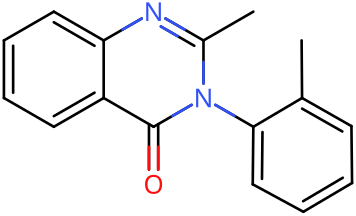
Methaqualone Stats & Data
JEYCTXHKTXCGPB-UHFFFAOYSA-NInteraction Warnings
This combination can result in an increased risk of vomiting during unconsciousness and death from the resulting suffocation. If this occurs, users should attempt to fall asleep in the recovery position or have a friend move them into it.
It is dangerous to combine depressants with stimulants due to the risk of excessive intoxication. Stimulants decrease the sedative effect of methaqualone, which is the main factor most people consider when determining their level of intoxication. Once the stimulant wears off, the effects of depressants will be significantly increased, leading to intensified disinhibition as well as other effects.
Pharmacology
DrugBankDescription
Methaqualone is a sedative-hypnotic drug that is similar in effect to barbiturates, a general central nervous system depressant. The sedative-hypnotic activity was first noted by Indian researchers in the 1950s and in 1962 methaqualone itself was patented in the US by Wallace and Tiernan. Its use peaked in the early 1970s as a hypnotic, sedative, and muscle relaxant commonly used for insomnia. It has also been used illegally as a recreational drug, commonly known as Quaaludes, Sopors, Ludes or Mandrax (particularly in the 1970s in North America) depending on the manufacturer. Since at least 2001, it has been widely used in South Africa, where it is commonly referred to as "smarties" or "geluk-tablette" (meaning happy tablets). Clandestinely produced methaqualone is still seized by government agencies and police forces around the world.
Indication
For the treatment of insomnia, and as a sedative and muscle relaxant.
Receptor Profile
Receptor Actions
Receptor Binding
History & Culture
1951–1962
Methaqualone was first synthesized in India in 1951 by M.I. Gujral as part of a research program seeking antimalarial compounds. Although the substance proved ineffective against malaria, researchers identified its hypnotic properties by 1955. A subsequent pharmacological study in 1957 confirmed methaqualone was the most active compound among the group synthesized during this research effort. The substance was patented in the United States by Wallace and Tiernan in 1962, setting the stage for its pharmaceutical development.
1960–1968
Methaqualone entered pharmaceutical markets across multiple countries throughout the early 1960s, marketed as a safer alternative to barbiturate sedatives. In West Germany, Merck launched the drug under the brand name Revonal in 1960, offering 200 mg and 300 mg tablets. Reports of misuse led to prescription requirements being implemented in 1963, after which overdose incidents reportedly declined significantly. Eisai Company introduced methaqualone to Japan in October 1960 as Hyminal, initially available without prescription. Widespread nonmedical use prompted authorities to designate it a "powerful drug" by June 1964, restricting sales to pharmacies with mandatory record-keeping requirements. In the United Kingdom, Roussel Laboratories launched Mandrax in 1965, a preparation combining methaqualone with diphenhydramine. The product addressed significant demand for a nonbarbiturate sleeping medication following the thalidomide disaster. By 1968, methaqualone had become the most widely prescribed sedative in Britain. Its recreational popularity increased further when heroin became more restricted in April 1968 and injectable methamphetamine was withdrawn later that year.
1965–1984
The FDA approved methaqualone in 1965 with minimal regulatory controls. William H. Rorer marketed the drug as Quaalude, advertising it as a safe and non-addictive medication primarily indicated for insomnia and anxiety. Despite early reports of nonmedical use emerging from other countries, the FDA approved a new 300 mg formulation in 1967, doubling the available per-tablet dosage. By 1972, methaqualone had become one of the most popular recreational drugs in the country. Regulatory response came in 1973 when the substance was placed in Schedule II. Rorer subsequently sold its rights to Quaalude to Lemmon Pharmaceuticals in 1978. After experiencing declining popularity in the mid-1970s, recreational use resurged around 1978 before the substance was ultimately moved to Schedule I in June 1984.
1960s–1970s
Methaqualone developed a substantial recreational following throughout the 1960s and 1970s, becoming particularly associated with the hippie movement and disco club scene. Users gave the drug numerous nicknames including "ludes," "disco biscuits," "mandies," and "randy mandies." The term "wall bangers" emerged in reference to the motor impairment the substance commonly produced. The drug was widely characterized as an aphrodisiac beginning in this era, with some users referring to it as a "love drug" and claiming it could substantially enhance sexual desire. This reputation persisted in cultural memory and has been depicted in films such as The Wolf of Wall Street.
1980s–2010s
During the 1980s and 1990s, the South African apartheid regime operated Project Coast, a chemical and biological weapons program that at one point focused on nonlethal riot control agents, including methaqualone. This period contributed to the substance becoming established in the country. Mandrax became particularly entrenched within coloured and Indian communities in South Africa. A distinctive consumption method known as "white pipe" developed, in which users combine crushed tablets with cannabis or tobacco and smoke the mixture through a broken-off bottle neck. Since at least 2001, the drug has remained widely used throughout South Africa, commonly referred to by local names including "smarties" and "geluk-tablette," the latter translating to "happy tablets." Clandestinely produced methaqualone continues to be seized by authorities in the country and elsewhere around the world.
Subjective Effects
Physical
- Sedation: In terms of energy level alterations, this drug is extremely sedating and often results in an overwhelmingly lethargic state. At higher levels, this causes users to suddenly feel as if they are extremely sleep deprived and have not slept for days, forcing them to sit down and generally feel as if they are constantly on the verge of passing out instead of engaging in physical activities. This sense of sleep deprivation increases proportional to dosage and eventually becomes powerful enough to force a person into complete unconsciousness.
- Physical euphoria: This compound is unusually euphoric in comparison to other compounds within the same class.
- Dizziness
- Muscle relaxation
- Motor control loss
- Respiratory depression
- Constipation
- Changes in felt gravity
Cognitive
- Anxiety suppression
- Thought deceleration
- Disinhibition
- Autonomous voice communication
- Dream potentiation
- Analysis suppression
- Euphoria
- Compulsive redosing
- Increased libido
- Increased music appreciation
Sensory
The visual effects of methaqualone are unusually strong for other depressants of its class. They can be broken down into several components which progressively intensify proportional to dosage.
- Visual acuity suppression
- Double vision
- Visual disconnection: A sense of subtle disconnection from visual input is often experienced with high dosage methaqualone.
- Internal hallucinations: The internal hallucinations of methaqualone can be described as more solid than psychedelics and do not seem to be composed of visual geometry. The most common way in which they manifest themselves are through hypnagogic scenarios. They are most common during high dosages and can be comprehensively described through their variations as lucid in believability, fixed in style, autonomous in controllability, and equal in new experiences and memory replays in content.
Forked from Subjective Effect Documentation by Josie Kins, September 2015. Via dose.wiki (CC0).
Independent research should always be done to ensure that a combination of two or more substances is safe before consumption. Overdose of methaqualone can lead to seizures, coma or death. Taking doses of over 300mg can be dangerous for first time users. Depending on the state of the user's individual tolerance, doses of about 8,000mg per day can be fatal whilst others on even higher doses (of up to 20,000mg) may survive. Although the exact lethal dosage of methaqualone has not been formally established, like many depressants, it is safe at appropriate dosages.
Toxicity (DrugBank)
Symptoms of overdose include delirium, convulsions, muscle spasms or seizure, cardiac arrest, shortness or loss of breath, vomiting or nausea, and coma or death. The LD50 for mice is 1250 mg/kg and for rats is 326 mg/kg (Strasenburg Labs).
Tolerance & Pharmacokinetics
drugs.wikiNo tolerance chart. Our decay curves for these drugs were estimates, and a curve can make tolerance look longer-lasting than it is, which is the dangerous direction.
How fast tolerance to these drugs fades after a break has not been measured well enough to draw, so don't count on a dose you used to take still being safe: after time off, start with a much smaller amount and don't use alone. Mixing sedatives with each other, with alcohol or with opioids sharply raises the risk of a fatal overdose. If you've been using regularly, don't stop suddenly: withdrawal from benzodiazepines, alcohol or GHB/GBL can cause seizures or delirium, so get medical help to cut down gradually.
Sources: FRANK: benzodiazepines · Alcohol and Drug Foundation: GHB · FDA 2020: benzodiazepine boxed warning · FDA 2019: gabapentinoids and breathing · NHS: alcohol use disorder
Cross-Tolerances
Experience Report Analysis
ErowidDemographics
Gender Distribution
Age Distribution
Reports Over Time
Effect Analysis
ErowidEffects aggregated from 13 experience reports (13 single-substance Erowid)
Effect Sentiment Distribution
Confidence Distribution
Each bar is the share of reports mentioning the effect; its whisker, and the band on the rows below, is the 95% interval: where the share could plausibly be with other reports of the same kind.
Too few reports for bars: these effects come from 13 single-substance Erowid reports, and a bar is drawn only from 20 reports or more. With fewer, a percentage cannot tell a common effect from a rare one. Counts are shown instead. Why 20?
Positive Effects 2
Adverse Effects 2
Also reported in combinations. In the 8 Methaqualone reports where another drug was taken too, 0 mention hospital, emergency services or an overdose, 1 a seizure and 0 psychosis (too few reports for percentages). In the 13 single-substance reports: 1, 0 and 0. These are not in the figures above: they cannot be put down to Methaqualone alone, and a mention is not always something that happened to the writer.
Real-World Dose Distribution
ErowidFrom 15 of 25 recorded dose entries: those that state a weight (mg, g or µg), in routes with at least five of them. Values above Q3 + 3×IQR, far above what people typically take, are left out; they can include real heavy doses and overdoses, not only mistakes.
Oral (n=12)
Common Combinations
Most co-occurring substances, as a share of all 21 reports filed under Methaqualone; whiskers are 95% intervals
Form / Preparation
Most common forms and preparations, as a share of the 15 reports that give one
Too few reports for bars: these forms come from 15 reports, and a bar is drawn only from 20 reports or more. With fewer, a percentage cannot tell a common effect from a rare one. Counts are shown instead. Why 20?
- Pill / Tablet 8 of 15
- Powder / Crystals 5 of 15
- Capsule 2 of 15
Body-Weight Dosing
Dose per kg of body weight, one dose per report (the first listed), from reports giving a weight of 30–250 kg. Doses above Q3 + 3×IQR, far above what people typically take, are left out of the median and range and listed under each route.
Redose Patterns
Redosing behavior across 16 reports
Too few reports for a chart: redosing is known from 16 reports, and a split is drawn only from 20 reports or more. Counts are shown instead. Why 20?
- Single dose 11 of 16
- Redosed 5 of 16
Legal Status
| Country | Status | Notes |
|---|---|---|
| Australia | Schedule 9 | Classified as a prohibited substance with no recognized medical value. Possession, manufacture, and distribution require a license. |
| Austria | Illegal (SMG) | Controlled under the Suchtmittelgesetz (Austrian Narcotics Act). Possession, production, and sale are prohibited without authorization. |
| Canada | Schedule III CDSA | Controlled under the Controlled Drugs and Substances Act. Requires a valid prescription or license to legally possess. Pharmaceutical methaqualone remains available through legitimate prescription channels. |
| Germany | Anlage II BtMG | Controlled under the Betäubungsmittelgesetz. Manufacturing, importing, possessing, selling, or transferring without license is prohibited. Initially sold over-the-counter in the 1960s before prescription requirements were introduced in 1963 following reports of misuse. |
| Japan | Controlled (Powerful Drug) | Designated as a 'powerful drug' in June 1964 after reports of widespread nonmedical use. Containers must display 'powerful' in red lettering. Sales restricted to pharmacies with mandatory record-keeping including recipient name, address, occupation, drug purpose, and transfer date. Prohibited for sale to individuals under 14 or those deemed unlikely to handle the substance responsibly. |
| Switzerland | Controlled (Verzeichnis A) | Specifically listed as a controlled substance under Verzeichnis A of Swiss narcotics legislation. Unlike some jurisdictions, medicinal use remains permitted under appropriate licensing. |
| United Kingdom | Class B | Initially controlled under the Drugs Prevention of Misuse Act 1970, making importation without Home Office license and unauthorized possession criminal offenses. The Misuse of Drugs Act 1971 was amended in July 1973 to include methaqualone, strengthening controls and increasing penalties. Regulatory measures such as handwritten prescription requirements were implemented. |
| United States | Schedule I | Originally approved by the FDA in 1965 with minimal controls. Placed in Schedule II in 1973 following concerns about abuse potential. Moved to Schedule I in June 1984 after Congress passed legislation specifically targeting methaqualone. Under current law, it is illegal to manufacture, buy, possess, or distribute without a DEA license. Lemmon, the final domestic manufacturer, ceased production in November 1983. |
Harm Reduction
drugs.wikiReasoning for additions and changes precedes this JSON. See below.
1) Dose and duration verification: Multiple harm-reduction sources converge on an oral onset around 20–45 minutes and a 4–8 hour main effect window; users often report 300 mg as a common recreational dose, with tolerance driving some to escalate. These ranges justify keeping the listed oral ranges but adding a caution about variability and rapid tolerance. Source: Erowid Methaqualone Basics and Vault.
2) Depressant combinations: Combining methaqualone with alcohol, benzodiazepines, barbiturates, opioids, or GHB/GBL is high-risk due to additive/synergistic CNS and respiratory depression; aspiration risk rises if unconscious. TripSit’s combination guidance and DrugWise’s interaction notes support class-based cautions; therefore these are placed under 'dangerous' and 'unsafe', with first-generation antihistamines under 'caution'. Sources: TripSit Drug Combinations; DrugWise Alcohol/Drug interactions pages.
3) Tolerance & overdose risk: Erowid notes that tolerance develops quickly and that tolerance to euphoric effects rises faster than to respiratory depression, increasing overdose risk as people escalate doses. This justifies explicit tolerance guidance and conservative redose advice. Source: Erowid Methaqualone Basics.
4) Dependence & withdrawal: Methaqualone’s sedative-hypnotic profile and historical clinical experience resemble barbiturates in dependence potential; barbiturate-class withdrawal can be severe and occasionally life-threatening (seizures, delirium), warranting medical supervision for cessation after heavy/prolonged use. This supports strengthening the dependence warning. Source: DrugWise Barbiturates (clinical HR context for sedative-hypnotic withdrawal).
5) Pharmacokinetics and interactions: DrugBank lists methaqualone as a CYP3A/CYP3A4 substrate. While quantitative PK is sparse publicly, this supports a pragmatic caution that strong CYP3A4 inhibitors (e.g., certain azoles/macrolides/cimetidine) may raise levels and inducers (e.g., rifampin/carbamazepine) may lower them. We therefore add a general CYP3A4 caution under 'caution' interactions and mark half-life as uncertain/variable. Source: DrugBank DB04833.
6) Legality & supply quality: Methaqualone is widely controlled (e.g., US Schedule I; UK Class B). Illicit supply is common and identity may be unreliable; users should treat unknown 'quaalude' tablets/powders as suspect and use lab-based drug checking where available. Sources: Isomerdesign scheduling index; Saferparty Zürich and Toronto’s Drug Checking Service (availability of lab drug checking).
7) Practical HR: Because onset can be delayed toward an hour (or longer with food), impatient redosing increases overdose risk. Keep first sessions at the low end of 'light', avoid alcohol/other depressants entirely, and do not drive/operate machinery during the experience or the following morning if residual sedation persists. Put anyone overly sedated/unconscious in the recovery position and seek medical help; this is standard depressant HR reflected in TripSit and DrugWise resources.
8) Names/brands/slang: Common brand/colloquial names (Quaalude, Sopor, Mandrax, Ludes/714s) are documented in the Erowid vault; including them improves cross-referencing and counterfeit awareness.
9) Data quality: Many contemporary details (dosage in illicit contexts, effect timings) derive from user reports and HR archives; we therefore label tolerance and some PK elements as low-to-anecdotal quality and encourage drug checking for identification.
Additional harm-reduction notes: Illicit tablets/powders may contain benzodiazepines, sedating antihistamines, or other depressants; assume variability and test where possible. Escalating to 'strong/heavy' ranges substantially increases ataxia, amnesia, and respiratory compromise; do not combine with any other downer. Consider spacing uses by at least several days to a week to reduce tolerance and risk of dose escalation. Keep sessions in a safe environment with a sober sitter if new to the drug. If dependent or using daily, do not stop abruptly; seek medical support for tapering. These points synthesize the above sources and widely accepted HR practice for depressants.
References
Data Sources
Cited References
Additional references
- Erowid Methaqualone Vault
- Erowid Methaqualone Basics
- DrugBank: Methaqualone (DB04833)
- TripSit Drug Combinations (depressants/benzos/alcohol/GHB)
- DrugWise: Drug interactions / Alcohol
- DrugWise: Alcohol (mixing cautions)
- Isomer Design: Scheduling index (Methaqualone)
- Saferparty Zürich: Drug checking service (availability)
- Toronto Drug Checking Service (availability)