
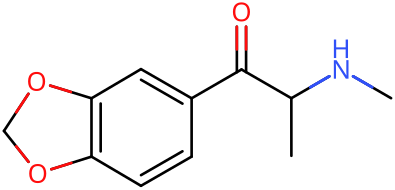
Methylone Stats & Data
CNC(C)C(=O)c1ccc2OCOc2c1VKEQBMCRQDSRET-UHFFFAOYSA-NInteraction Warnings
Methylone can be potentially dangerous in combination with other stimulants as it can increase one's heart rate and blood pressure to dangerous levels.
This combination may increase strain on the heart.
Pharmacology
DrugBankMechanism of Action
A reproducible, simple, and small-scale method for determining the re-uptake and release of monoamines (dopamine, serotonin (5-HT) and norepinephrine) using rat brain synaptosomes /was developed/. These assays were then applied to study the effects of different kinds of non-medically used psychoactive drugs on monoamine re-uptake and release. The phenethylamine derivatives, 4-fluoroamphetamine, 2-methylamino-3,4-methylene-dioxy-propiophenone (methylone), 1-(1,3-benzodioxol-5-yl)-2-butanamine (BD
Metabolism
In recent years, a new class of designer drugs has appeared on the drugs of abuse market in many countries, namely, the so-called beta-keto (bk) designer drugs such as mephedrone (bk-4-methylmethamphetamine), butylone (bk-MBDB), and methylone (bk-MDMA). The aim of the present study was to identify the metabolites of mephedrone in rat and human urine using GC-MS techniques and to include mephedrone, butylone, and methylone within the authors' systematic toxicological analysis (STA) procedure. Six
Receptor Profile
Receptor Actions
History & Culture
1996–present
Methylone was first synthesized by chemists Peyton Jacob III and Alexander Shulgin in the mid-1990s, with the compound first described in scientific literature by 1996. The synthesis occurred after the publication of Shulgin's PiHKAL in 1991, and consequently methylone was not included in that work; it was later documented in The Shulgin Index (2011). Jacob and Shulgin patented methylone as a potential antidepressant and antiparkinsonian agent, though these therapeutic applications were never developed or brought to market. Shulgin himself noted that the compound has "almost the same potency of MDMA, but it does not produce the same effects," describing it as having "an almost antidepressant action, pleasant and positive, but not the unique magic of MDMA." The name "methylone" later created some confusion, as it is also a trademarked brand name for an injectable form of methylprednisolone, a corticosteroid hormone used to treat arthritis and severe allergic reactions. While an alternate chemical nomenclature of bk-MDMA (beta-keto-MDMA) was proposed, "methylone" had already become widely established before the trademark conflict was noticed. The analogous naming convention was however adopted for related compounds such as bk-MDEA and bk-MBDB.
2004–2006
Methylone was encountered as a designer and recreational drug by 2004, approximately a decade after its initial synthesis. The compound was marketed under various product names, most notably "Explosion," which was confirmed through chemical analysis to contain methylone as its active ingredient. It was also sold as pure powder and in formulations marketed as household chemicals. In the Netherlands, methylone was available in smartshops until early April 2005. In New Zealand, the substance was sold from November 2005 to April 2006 as an MDMA substitute under the brand name "Ease," before being withdrawn following legal disputes with the government. During its period of legal availability, methylone was frequently mis-sold as MDMA. However, users have characterized it as less empathogenic and more stimulating than MDMA, with a notably shorter duration of effects.
2024–present
Despite never being developed following its original 1996 patent for antidepressant and antiparkinsonian use, methylone has re-emerged as a subject of clinical investigation. Under the developmental code TSND-201, Transcend Therapeutics is investigating the compound for the treatment of post-traumatic stress disorder (PTSD). As of July 2024, the substance is in phase 2 clinical trials for this indication.
Subjective Effects
Physical
- Spontaneous tactile sensations: The body high of methylone can be described as a moderate to extreme euphoric tingling sensation that encompasses the entire body. It is capable of becoming overwhelmingly pleasurable at higher dosages.
- Stimulation
- Temperature regulation suppression
- Tactile enhancement
Cognitive
The general head space of methylone is described by many as one of extreme mental stimulation, feelings of love or empathy and powerful euphoria. It contains a large number of typical psychedelic, entactogenic and stimulant cognitive effects.
- Euphoria: Strong emotional euphoria and feelings of happiness are present within methylone. In comparison to MDMA, it is closer in effects to that of the euphoria felt within amphetamine and mephedrone.
- Empathy, love and sociability enhancement: Although distinct and powerful in its effects, this particular feeling is less pronounced and therapeutic when compared to that of MDMA. It can be described as less forceful and more internal in its manifestation.
- Time distortion: Strong feelings of time compression are common within methylone and speed up the experience of time quite noticeably.
- Unity and interconnectedness: This component most consistently manifests itself at high dosages within large crowds at raves and musical events.
- Thought acceleration
- Mindfulness
Sensory
- Vibrating vision: At high dosages, a person's eyeballs may begin to spontaneously wiggle back and forth in a rapid motion, causing the vision to become blurry and temporarily out of focus (nystagmus).
Forked from Subjective Effect Documentation by Josie Kins, October 2014. Via dose.wiki (CC0).
Toxicity
PsychonautWikiThe toxicity and long-term health effects of recreational methylone use do not seem to have been studied in any scientific context and the exact toxic dosage is unknown. This is because methylone has a very limited history of human usage. Anecdotal evidence from people who have tried methylone within the community suggests that there do not seem to be any negative health effects attributed to simply trying it at low to moderate doses by itself and using it sparingly (but nothing can be completely guaranteed). It is strongly recommended that one use harm reduction practices when using this substance.
Addiction & dependence
As with other stimulants, the chronic use of methylone can be considered moderately addictive with a high potential for abuse and is capable of causing psychological dependence among certain users. When addiction has developed, cravings and withdrawal effects may occur if a person suddenly stops their usage. Tolerance to many of the effects of methylone develops with prolonged and repeated use.
Effect Profile
Curated + 137 ReportsStrong empathy, stimulation, sensory enhancement, and euphoria
Strong stimulation and euphoria with strong anxiety/jitters, moderate focus
Empirical Duration
Erowid ReportsMedian times after the dose that Erowid reports state. A curve is drawn only when reports state all four points (onset, peak begins, comedown begins, back to baseline) and the medians fall in that order. No point is estimated from another.
No curve: fewer than 5 reports state the return to baseline, and no point is estimated from another.
Community Effects
TripSitTolerance & Pharmacokinetics
drugs.wikiNo tolerance chart. No study has measured how long tolerance to it lasts, so this page shows what is known instead of a curve.
No study has measured tolerance to methylone in people. PsychonautWiki estimates that tolerance halves in 1-3 weeks and is gone in 3-6 weeks, without citing a source.
Sources: PsychonautWiki: methylone
Cross-Tolerances
Demographics
Gender Distribution
Age Distribution
Reports Over Time
Effect Analysis
Erowid + BluelightEffects aggregated from 126 experience reports (76 single-substance Erowid + 61 Bluelight)
Effect Sentiment Distribution
Confidence Distribution
Each bar is the share of reports mentioning the effect; its whisker, and the band on the rows below, is the 95% interval: where the share could plausibly be with other reports of the same kind.
Positive Effects 63
Adverse Effects 57
Show 37 more adverse effects
Show 32 neutral or unclassified mentions
Also reported in combinations. In the 91 Methylone reports where another drug was taken too, 6 (6.6%) mention hospital, emergency services or an overdose, 3 (3.3%) a seizure and 4 (4.4%) psychosis. In the 76 single-substance reports: 7.9%, 1.3% and 2.6%. These are not in the figures above: they cannot be put down to Methylone alone, and a mention is not always something that happened to the writer.
Dose-Response Correlation
How effect frequency changes across dose levels. Whiskers, and the numbers' hover text, give each figure's 95% interval.
Not drawn, too few reports (a dose tier needs 20): Oral Light (n=11). Why 20?
View data table
| Effect | Common (n=20) |
|---|---|
| Euphoria | 75.0% (95% interval 53 to 89 percent) |
| Empathy | 70.0% (95% interval 48 to 86 percent) |
| Stimulation | 45.0% (95% interval 26 to 66 percent) |
| Music Enhancement | 45.0% (95% interval 26 to 66 percent) |
| Anxiety | 35.0% (95% interval 18 to 57 percent) |
| Sedation | 35.0% (95% interval 18 to 57 percent) |
| Introspection | 30.0% (95% interval 14 to 52 percent) |
| Increased Heart Rate | 30.0% (95% interval 14 to 52 percent) |
| Body High | 25.0% (95% interval 11 to 47 percent) |
| Jaw Clenching | 25.0% (95% interval 11 to 47 percent) |
| Nausea | 20.0% (95% interval 8 to 42 percent) |
| Confusion | 20.0% (95% interval 8 to 42 percent) |
| Tactile Enhancement | 20.0% (95% interval 8 to 42 percent) |
| Pupil Dilation | 15.0% (95% interval 5 to 36 percent) |
| Closed-Eye Visuals | 10.0% (95% interval 3 to 30 percent) |
Subjective Effect Ontology
Experience ReportsStructured effect tags extracted from 217 Erowid & Bluelight experience reports using a controlled vocabulary of 220+ canonical effects across 15 domains.
Emotional
Motor
Dose–Effect Mapping
Experience ReportsHow reported effects shift across dose tiers, based on 76 single-substance experience reports. The shaded band on each bar is its 95% interval. An arrow (↑ ↓) marks a change between the lowest and highest tier that count an effect only when the gap is bigger than chance would explain; ~ means no clear change. How changes are called
Not drawn, too few reports (a dose tier needs 20): Oral Light (n=11). Why 20?
Limited tier coverage — most reports fall within the Common range. Effects at other dose levels may not be represented.
| Effect | Common (n=20) | Change with dose |
|---|---|---|
| euphoria | ||
| empathy | ||
| stimulation | ||
| music enhancement | ||
| anxiety | ||
| sedation | ||
| introspection | ||
| increased heart rate | ||
| body high | ||
| jaw clenching | ||
| nausea | ||
| confusion | ||
| tactile enhancement | ||
| pupil dilation | ||
| closed-eye visuals | ||
| visual distortions | ||
| sweating | ||
| color enhancement | ||
| focus enhancement | ||
| muscle tension |
Showing top 20 of 22 effects
Dosage Distribution
Dose distribution from experience reports, one dose per report (the first listed). Doses above Q3 + 3×IQR, far above what people typically take, are left out of the median and range and listed under each route: most are real heavy doses or overdoses, not mistakes.
2 reports gave a dose above the typical range (500 mg), so they are not in the figures above. 1 of them mentions hospital, emergency services or an overdose. Listing a dose here does not mean it is safe.
Real-World Dose Distribution
ErowidFrom 272 of 294 recorded dose entries: those that state a weight (mg, g or µg), in routes with at least five of them. Values above Q3 + 3×IQR, far above what people typically take, are left out; they can include real heavy doses and overdoses, not only mistakes.
Oral (n=213)
Insufflated (n=46)
Intravenous (n=11)
Common Combinations
Most co-occurring substances, as a share of all 167 reports filed under Methylone; whiskers are 95% intervals
Form / Preparation
Most common forms and preparations, as a share of the 129 reports that give one; whiskers are 95% intervals
Body-Weight Dosing
Dose per kg of body weight, one dose per report (the first listed), from reports giving a weight of 30–250 kg. Doses above Q3 + 3×IQR, far above what people typically take, are left out of the median and range and listed under each route.
Oral
2 reports gave a dose above the typical range (7.874–8.818 mg/kg), so they are not in the figures above. 1 of them mentions hospital, emergency services or an overdose. Listing a dose here does not mean it is safe.
Show the reports
- 8.818 mg/kg
- 7.874 mg/kg · another drug taken too · mentions hospital, emergency services or an overdose
Insufflated
1 report gave a dose above the typical range (14.706 mg/kg), so it is not in the figures above. Listing a dose here does not mean it is safe.
Show the report
- 14.706 mg/kg · another drug taken too
Redose Patterns
Redosing behavior across 133 reports
Legal Status
| Country | Status | Notes |
|---|---|---|
| Austria | Illegal (SMG) | Prohibited under the Suchtmittelgesetz (Narcotics Act) since June 26, 2019. Possession, production, and sale are illegal. |
| Brazil | Controlled | Listed as a controlled substance under Portaria SVS/MS nº 344. Added to national controls on February 18, 2014, alongside several other synthetic cathinones and phenethylamines. |
| Canada | Unclear/Possibly unscheduled | Not explicitly listed on the schedules of the Controlled Drugs and Substances Act. Health Canada has suggested it may fall under amphetamine analogue provisions; however, methylone bears the same chemical distinction from amphetamine as cathinone does, and cathinone is specifically not considered an amphetamine analogue, creating legal ambiguity. |
| Croatia | Controlled | Reportedly outlawed in February 2011 under national drug control legislation. |
| Denmark | Controlled | Illegal since February 8, 2008, with exceptions permitted only for scientific and medicinal research purposes. |
| Estonia | Schedule I | Added to Schedule I in February 2011 alongside several other cathinone derivatives and synthetic cannabinoids. |
| Finland | Controlled (hard-drug category) | Listed on the Finnish controlled substances schedule in the hard-drug category, carrying penalties associated with serious drug offenses. |
| Germany | Anlage II BtMG | Listed under Anlage II of the Betäubungsmittelgesetz (Narcotics Act) as of July 2012. Manufacturing, possession, import, export, purchase, sale, procurement, and dispensing without a license is illegal. |
| Netherlands | Medicine Act (unregistered) | Covered under the Medicine Act (Geneesmiddelenwet). Since methylone is not officially registered as an approved pharmaceutical, trading in the substance is prohibited. Previously available in smartshops until April 2005 when the Public Health Minister declared it illegal. |
| New Zealand | Class C (by interpretation) | Not explicitly scheduled under the Misuse of Drugs Act and falls outside the strict definition of an 'amphetamine analogue,' but law enforcement authorities consider it 'substantially similar' to methcathinone and treat it as a Class C controlled substance. |
| Russia | Schedule I | Classified as a Schedule I prohibited substance under Russian drug control legislation. |
| Slovak Republic | Controlled | Controlled substance as of March 1, 2011, scheduled alongside other synthetic cathinones and cannabinoid receptor agonists. |
| Sweden | Schedule I | Classified as a Schedule I narcotic substance as of October 1, 2010. |
| Switzerland | Controlled (Verzeichnis D) | Specifically named as a controlled substance under Verzeichnis D of Swiss narcotics legislation. |
| United Kingdom | Class B | Controlled under the Misuse of Drugs Act 1971 as part of the cathinone catch-all clause. Import and sale restrictions took effect March 31, 2010, with full controls enacted April 16, 2010. |
| United States | Schedule I | The DEA issued an emergency scheduling order on October 21, 2011, followed by a final rule permanently adding methylone to Schedule I on April 12, 2013. Manufacturing, possession, and distribution without a DEA license is prohibited. Prior to federal action, numerous states including Florida, Louisiana, Georgia, and Pennsylvania enacted their own emergency bans on methylone as part of 'bath salts' legislation beginning in early 2011. |
References
Data Sources
Cited References
- Bluelight: The Big & Dandy bk-MDMA (Methylone) Thread
- Cozzi et al. 1999 - Inhibition of plasma membrane monoamine transporters by beta-ketoamphetamines
- Erowid Methylone Vault: Dosage
- Erowid Methylone Vault: Effects
- Nagai et al. 2007 - The effects of non-medically used psychoactive drugs on monoamine neurotransmission in rat brain
- Poyatos et al. 2022 - Pharmacological effects of methylone and MDMA in humans
- TripSit Wiki: Drug Combinations
- TripSit Factsheet: Methylone