
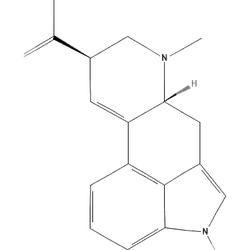
MiPLA Stats & Data
ROICYBLUWUMJFF-RDTXWAMCSA-NReceptor Profile
Receptor Actions
Receptor Binding
History & Culture
MiPLA was originally synthesized by Albert Hofmann at Sandoz Laboratories as part of the foundational structure-activity relationship research into LSD. Eli Lilly and Company subsequently filed a patent for the compound in 1956, with formal publication following in 1961. The compound underwent more detailed investigation during the 1990s by David E. Nichols and his research team at Purdue University. MiPLA has primarily served as a pharmacological research tool for elucidating the serotonergic mechanisms through which LSD produces its hallucinogenic effects, with particular focus on its binding characteristics at the 5-HT2A receptor. Alexander Shulgin also documented early human trials with the substance in his "Pharmacology Notes #9" and "Pharmacology Notes C," reporting that subjects experienced LSD-like psychedelic effects at doses suggesting a potency approximately two to three times lower than LSD. MiPLA first emerged on the recreational drug market as a novel designer drug around 2018.
Toxicity
PsychonautWikiThe toxicity and long-term health effects of recreational MiPLA use has not been studied in any scientific context and the exact toxic dose is unknown. This is because MiPLA is a research chemical with very little history of human usage. The current body of anecdotal reports suggests that there are no negative health effects attributed to simply trying the substance by itself at low to moderate doses and using it very sparingly (but nothing can be completely guaranteed). Independent research should always be done to ensure that a combination of two or more substances is safe before consumption. However, as is the case for LSD, it is possible that MiPLA can act as a potential trigger for those with underlying psychiatric conditions.
Overdose
The LD50 of MiPLA is unknown. Adverse psychological reactions may be more likely to occur at higher doses. Some of these include anxiety, delusions, panic attacks and (more rarely) seizures.
Addiction & dependence
Like other serotonergic psychedelics, MiPLA is believed to have a low potential for abuse and dependence. This is owing to its structural and pharmacological similarities with LSD. See this section to learn more about the dependence and abuse potential of LSD.
Effect Profile
Curated + 3 ReportsMild visuals and headspace with mild body load
Tolerance & Pharmacokinetics
drugs.wikiTolerance Decay
Cross-Tolerances
Experience Report Analysis
ErowidDemographics
Gender Distribution
Too few reports for a chart: gender is known from 7 reports, and a split is drawn only from 20 reports or more. Counts are shown instead. Why 20?
- Male 5 of 7
- Not Specified 1 of 7
- Female 1 of 7
Age Distribution
Reports Over Time
Effect Analysis
ErowidEffects aggregated from 3 experience reports (3 single-substance Erowid)
Effect Sentiment Distribution
Confidence Distribution
Each bar is the share of reports mentioning the effect; its whisker, and the band on the rows below, is the 95% interval: where the share could plausibly be with other reports of the same kind.
Too few reports for bars: these effects come from 3 single-substance Erowid reports, and a bar is drawn only from 20 reports or more. With fewer, a percentage cannot tell a common effect from a rare one. Counts are shown instead. Why 20?
Positive Effects 2
Adverse Effects 1
Real-World Dose Distribution
ErowidFrom 8 of 9 recorded dose entries: those that state a weight (mg, g or µg), in routes with at least five of them. Values above Q3 + 3×IQR, far above what people typically take, are left out; they can include real heavy doses and overdoses, not only mistakes.
Sublingual (n=8)
Form / Preparation
Most common forms and preparations, as a share of the 7 reports that give one
Too few reports for bars: these forms come from 7 reports, and a bar is drawn only from 20 reports or more. With fewer, a percentage cannot tell a common effect from a rare one. Counts are shown instead. Why 20?
- Blotter / Tab 7 of 7
Legal Status
| Country | Status | Notes |
|---|---|---|
| Austria | Unscheduled (grey area) | Not specifically prohibited but may fall under the Neue-Psychoaktive-Substanzen-Gesetz (NPSG) due to structural similarity to LSD. |
| Germany | NpSG controlled | Regulated under the Neue Psychoaktive Substanzen Gesetz (New Psychoactive Substances Act) since July 18, 2019. Production, import with intent to distribute, administration to others, and commercial trading are prohibited offenses. Possession is technically illegal but does not carry penalties. |
| Switzerland | Controlled (Verzeichnis E) | Classified as a controlled substance under Verzeichnis E point 263 as a defined derivative of lysergic acid. Exempted when used for legitimate scientific or industrial purposes. |
| United States | Unscheduled | Not specifically scheduled under the Controlled Substances Act. May be prosecuted under the Federal Analogue Act as a structural analogue of LSD when intended for human consumption. |
References
Data Sources
Cited References
- Bluelight: The Big & Dandy MIPLA Thread
- Erowid: MiPLA Experience Vault
- Halberstadt et al. (2019) - Pharmacological characterization of ECPLA
- Huang et al. (1994) - Drug discrimination and receptor binding studies of N-isopropyl lysergamide derivatives
- Isomer Design: MiPLA (PiHKAL)
- Nichols, D.E. (2001) - LSD and its lysergamide cousins
- Halberstadt et al. (2018) - Pharmacological characterization of ECPLA
- Nichols, D.E. (2001) - LSD and its lysergamide cousins