
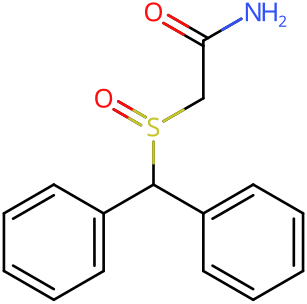
Modafinil Stats & Data
NC(=O)CS(=O)C(c1ccccc1)c1ccccc1YFGHCGITMMYXAQ-UHFFFAOYSA-NInteraction Warnings
The neurotoxic effects of MDMA may be increased when combined with other stimulants.
Pharmacology
DrugBankDescription
Modafinil is a stimulant drug marketed as a 'wakefulness promoting agent' and is one of the stimulants used in the treatment of narcolepsy. Narcolepsy is caused by dysfunction of a family of wakefulness-promoting and sleep-suppressing peptides, the orexins, whose neurons are activated by modafinil. The prexin neuron activation is associated with psychoactivation and euphoria. The exact mechanism of action is unclear, although in vitro studies have shown it to inhibit the reuptake of dopamine by binding to the dopamine reuptake pump, and lead to an increase in extracellular dopamine. Modafinil activates glutamatergic circuits while inhibiting GABA.
Mechanism of Action
The exact mechanism of action is unclear, although <i>in vitro</i> studies have shown it to inhibit the reuptake of dopamine by binding to the dopamine reuptake pump, and lead to an increase in extracellular dopamine. Modafinil activates glutamatergic circuits while inhibiting GABA. Modafinil is thought to have less potential for abuse than other stimulants due to the absence of any significant euphoric or pleasurable effects. It is possible that modafinil acts by a synergistic combination of mechanisms including direct inhibition of dopamine reuptake, indirect inhibition of noradrenalin reuptake in the VLPO and orexin activation. Modafinil has partial alpha 1B-adrenergic agonist effects by directly stimulating the receptors.
Pharmacodynamics
Modafinil is a stimulant drug marketed as a 'wakefulness promoting agent' and is one of the stimulants used in the treatment of narcolepsy. Narcolepsy is caused by dysfunction of a family of wakefulness-promoting and sleep-suppressing peptides, the orexins, whose neurons are activated by modafinil. The prexin neuron activation is associated with psychoactivation and euphoria. Modafinil is not indicated for complaints of lack of energy or fatigue; but it appears to be very helpful for some patients. Also, it has been used in the treatment of hypersomnia, a disorder in which patients lack the capacity for meaningful sleep and may require ten or more hours per day. Recent studies have have found that modafinil may help recovering cocaine addicts fight their addiction.
Absorption
Rapid following oral administration.
Indication
To improve wakefulness in patients with excessive daytime sleepiness (EDS) associated with narcolepsy.
Elimination
The major route of elimination is metabolism (~90%), primarily by the liver, with subsequent renal elimination of the metabolites.
Receptor Profile
Receptor Actions
Receptor Binding
Measured Affinities
Guide to PHARMACOLOGYMeasured binding and functional data for modafinil, curated by the IUPHAR/BPS Guide to PHARMACOLOGY. Each row cites the paper it came from. Lower concentrations mean tighter binding — a value in the sub-nanomolar range indicates a very potent interaction.
| Target | Action | Measure | Value | Concentration | Species | Source |
|---|---|---|---|---|---|---|
| DAT Slc6a3 | Inhibition | pKi | 5.42 | 3,802 nM | Rat | PMID 15537337 |
Reading this. pKi, pEC50 and pIC50 are negative log molar values, so a higher number means a tighter interaction; the concentration column converts them for you. Values from non-human species are laboratory measurements and do not translate directly to human effect. Receptor affinity is not a dose — it describes what a molecule binds, not how much of it is safe to take.
Receptor data from the IUPHAR/BPS Guide to PHARMACOLOGY (v2026.2), licensed CC BY-SA 4.0. Matched to this substance by InChIKey.
History & Culture
1970s–1994
Modafinil was developed in France by neurophysiology professor Michel Jouvet and Lafon Laboratories. The compound emerged from research into a series of benzhydryl sulfinyl compounds initiated in the late 1970s. The first of these compounds to reach clinical use was adrafinil, which was offered as an experimental treatment for narcolepsy in France in 1986. Researchers subsequently identified modafinil as the primary active metabolite of adrafinil, differing from its parent compound only by lacking a polar hydroxyl group on its terminal amide. This metabolite demonstrated similar wakefulness-promoting activity but would eventually become far more widely used than the original compound.
1994–2012
Modafinil received its first regulatory approval in France in 1994, where it was marketed under the brand name Modiodal. The United States Food and Drug Administration approved the drug in 1998 for the treatment of narcolepsy, followed by additional approvals in 2003 for shift work sleep disorder and obstructive sleep apnea. The United Kingdom approved modafinil in December 2002. The pharmaceutical company Cephalon acquired the rights to modafinil from Lafon Laboratories, subsequently purchasing the French company outright in 2001. Cephalon marketed the drug in the United States under the brand name Provigil. In 2007, Cephalon introduced armodafinil, the isolated R-enantiomer of modafinil, as a second-generation product. The parent compound adrafinil, which never received FDA approval, was eventually withdrawn from the French market in 2011. Generic versions of modafinil became available in the United States in 2012 following extensive patent litigation.
1991–present
Modafinil has seen significant adoption within military contexts as a fatigue countermeasure. During the Gulf War, the compound was used by the French Foreign Legion, the United States Air Force, and US Marines to enhance what military planners term "operational tempo"—the speed and intensity at which military operations are executed. Armed forces in the United States, United Kingdom, India, and France have evaluated modafinil as an alternative to traditional amphetamines for managing sleep deprivation during combat operations or extended missions. The US military ultimately approved modafinil for specific Air Force missions, replacing amphetamines as the standard fatigue management agent. The compound is also available to astronauts aboard the International Space Station to address fatigue resulting from circadian rhythm disruption in orbit.
2003–2015
The regulation of modafinil as a doping agent has generated considerable controversy in competitive athletics, with several high-profile cases drawing significant media attention. The World Anti-Doping Agency officially added modafinil to its list of prohibited substances on August 3, 2004—just ten days before the opening of the 2004 Summer Olympics. Some athletes who tested positive argued that the substance was not explicitly banned at the time of their violations, though WADA maintained that modafinil was sufficiently related to already-prohibited substances to warrant enforcement. American sprinter Kelli White tested positive for modafinil following her 100-meter victory at the 2003 World Championships in Paris. Despite claiming she used the medication to treat narcolepsy, the International Association of Athletics Federations ruled that modafinil constituted a performance-enhancing drug, and White was stripped of her gold medals. Subsequent doping cases involving modafinil included cyclist David Clinger and basketball player Diana Taurasi in 2010, as well as rower Timothy Grant in 2015. The BALCO scandal also brought attention to unsubstantiated but widely circulated reports that baseball player Barry Bonds had included modafinil in his supplemental regimen alongside anabolic steroids and human growth hormone.
Beyond its approved medical indications, modafinil has gained substantial mainstream popularity as a cognitive enhancement agent or "smart drug," valued for its purported ability to improve memory, reduce the desire for sleep, and increase general productivity. By 2017, modafinil had become the 328th most commonly prescribed medication in the United States. Ongoing research has also investigated potential applications in addiction medicine, with some studies exploring whether modafinil may assist individuals recovering from cocaine dependence in maintaining abstinence.
Subjective Effects
Physical
The physical effects of modafinil can be broken down into several components.
- Stimulation: In terms of its effects on the user's physical energy levels, modafinil is commonly considered to be stimulating and energetic, but can be considered as much less stimulating when compared to amphetamine. This stimulation encourages physical movement and activities such as running, playing sports, socializing, and/or exercising. The particular style of stimulation which modafinil presents can result in jaw clenching, teeth grinding, or other involuntary movements comparable to that of traditional stimulants at high doses, but are manifested much less consistently and intensely when compared to amphetamine or cocaine.
- Dehydration: Dehydration and dry mouth commonly occur due to an increase in motivation to engage in physical activities as well as an increased sense of focus which causes one to forget to drink water.
- Headaches: In terms of physical discomfort, modafinil can cause headaches especially if dehydrated, if you have not eaten food, or if you have been sitting in an awkward position for an extended period of time focused intensely on a task.
- Photophobia: Although uncommon, modafinil can cause a temporary visual intolerance to light.
- Appetite suppression: The above components are also accompanied by a suppression of appetite which is usually less intense in strength in comparison to the appetite suppression experienced with amphetamine.
- Diarrhea: Modafinil has the tendency to increase the frequency of bowel movements in certain individuals.
- Increased heart rate
- Dizziness
- Nausea
Cognitive
The cognitive effects of modafinil can be broken down into several components.
- Wakefulness
- Focus enhancement
- Thought acceleration
- Memory enhancement
- Motivation enhancement
- Current mind state enhancement
- Anxiety
Forked from Subjective Effect Documentation by Josie Kins, August 2015. Via dose.wiki (CC0).
The long-term safety and effectiveness of modafinil as a drug of regular usage have not been determined. Anecdotal reports from people who have tried modafinil suggest that there do not seem to be any negative health effects attributed to simply trying this substance at low to moderate doses by itself or using it sparingly (but nothing can be completely guaranteed). It is worth noting that as this compound is a commonly prescribed pharmaceutical, it is considerably less likely to have unpredictable adverse health effects than the typical research chemical. Nevertheless, it is strongly recommended that one use harm reduction practices if using this substance.
Carcinogenicity
No indication of carcinogenicity to humans (not listed by IARC).
Liver injury risk
Low concern (rare serious cases reported)
Effect Profile
Curated + 149 ReportsStrong stimulation and focus with strong anxiety/jitters, mild euphoria
Empirical Duration
Erowid ReportsMedian times after the dose that Erowid reports state. A curve is drawn only when reports state all four points (onset, peak begins, comedown begins, back to baseline) and the medians fall in that order. No point is estimated from another.
No curve: fewer than 5 reports state the start of the peak or the start of the comedown, and no point is estimated from another.
Demographics
Gender Distribution
Age Distribution
Reports Over Time
Effect Analysis
Erowid + BluelightEffects aggregated from 149 experience reports (137 single-substance Erowid + 12 Bluelight)
Effect Sentiment Distribution
Confidence Distribution
Each bar is the share of reports mentioning the effect; its whisker, and the band on the rows below, is the 95% interval: where the share could plausibly be with other reports of the same kind.
Rows resting on fewer than 20 reports show a count (“3 of 7”) instead of a bar. Why 20?
Positive Effects 28
Adverse Effects 38
Show 18 more adverse effects
Show 15 neutral or unclassified mentions
Also reported in combinations. In the 66 Modafinil reports where another drug was taken too, 6 (9.1%) mention hospital, emergency services or an overdose, 2 (3.0%) a seizure and 4 (6.1%) psychosis. In the 137 single-substance reports: 4.4%, 0.7% and 2.9%. These are not in the figures above: they cannot be put down to Modafinil alone, and a mention is not always something that happened to the writer.
Dose-Response Correlation
How effect frequency changes across dose levels. Whiskers, and the numbers' hover text, give each figure's 95% interval.
Not drawn, too few reports (a dose tier needs 20): Oral Common (n=15), Oral Heavy (n=15). Why 20?
View data table
| Effect | Strong (n=35) |
|---|---|
| Stimulation | 77.1% (95% interval 61 to 88 percent) |
| Sedation | 48.6% (95% interval 33 to 64 percent) |
| Focus Enhancement | 42.9% (95% interval 28 to 59 percent) |
| Anxiety | 37.1% (95% interval 23 to 54 percent) |
| Euphoria | 22.9% (95% interval 12 to 39 percent) |
| Headache | 17.1% (95% interval 8 to 33 percent) |
| Increased Heart Rate | 17.1% (95% interval 8 to 33 percent) |
| Empathy | 14.3% (95% interval 6 to 29 percent) |
| Memory Suppression | 11.4% (95% interval 4 to 26 percent) |
| Auditory Effects | 11.4% (95% interval 4 to 26 percent) |
| Hospital | 11.4% (95% interval 4 to 26 percent) |
| Confusion | 11.4% (95% interval 4 to 26 percent) |
| Music Enhancement | 8.6% (95% interval 3 to 22 percent) |
| Body High | 8.6% (95% interval 3 to 22 percent) |
| Color Enhancement | 8.6% (95% interval 3 to 22 percent) |
Subjective Effect Ontology
Experience ReportsStructured effect tags extracted from 215 Erowid & Bluelight experience reports using a controlled vocabulary of 220+ canonical effects across 15 domains.
Cognitive
Motor
Dose–Effect Mapping
Experience ReportsHow reported effects shift across dose tiers, based on 137 single-substance experience reports. The shaded band on each bar is its 95% interval. An arrow (↑ ↓) marks a change between the lowest and highest tier that count an effect only when the gap is bigger than chance would explain; ~ means no clear change. How changes are called
Not drawn, too few reports (a dose tier needs 20): Oral Common (n=15), Oral Heavy (n=15). Why 20?
Limited tier coverage — most reports fall within the Strong range. Effects at other dose levels may not be represented.
| Effect | Strong (n=35) | Change with dose |
|---|---|---|
| stimulation | ||
| sedation | ||
| focus enhancement | ||
| anxiety | ||
| euphoria | ||
| headache | ||
| increased heart rate | ||
| empathy | ||
| memory suppression | ||
| auditory effects | ||
| hospital | ||
| confusion | ||
| music enhancement | ||
| body high | ||
| color enhancement | ||
| nausea | ||
| appetite suppression | ||
| jaw clenching | ||
| visual distortions | ||
| muscle tension |
Showing top 20 of 22 effects
Dosage Distribution
Dose distribution from experience reports, one dose per report (the first listed). Doses above Q3 + 3×IQR, far above what people typically take, are left out of the median and range and listed under each route: most are real heavy doses or overdoses, not mistakes.
6 reports gave a dose above the typical range (600–1,200 mg), so they are not in the figures above. 1 of them mentions hospital, emergency services or an overdose. Listing a dose here does not mean it is safe.
Real-World Dose Distribution
ErowidFrom 237 of 247 recorded dose entries: those that state a weight (mg, g or µg), in routes with at least five of them. Values above Q3 + 3×IQR, far above what people typically take, are left out; they can include real heavy doses and overdoses, not only mistakes.
Oral (n=214)
Insufflated (n=10)
Common Combinations
Most co-occurring substances, as a share of all 203 reports filed under Modafinil; whiskers are 95% intervals
Form / Preparation
Most common forms and preparations, as a share of the 100 reports that give one; whiskers are 95% intervals
Body-Weight Dosing
Dose per kg of body weight, one dose per report (the first listed), from reports giving a weight of 30–250 kg. Doses above Q3 + 3×IQR, far above what people typically take, are left out of the median and range and listed under each route.
Oral
4 reports gave a dose above the typical range (10.695–20.339 mg/kg), so they are not in the figures above. 1 of them mentions hospital, emergency services or an overdose. Listing a dose here does not mean it is safe.
Show the reports
- 20.339 mg/kg · another drug taken too
- 14.706 mg/kg
- 11.38 mg/kg · mentions hospital, emergency services or an overdose
- 10.695 mg/kg · another drug taken too
Insufflated
Redose Patterns
Redosing behavior across 147 reports
Legal Status
| Country | Status | Notes |
|---|---|---|
| Argentina | Regulated | Officially regulated as a prescription medicine. Reports suggest pharmacies may sell without prescription due to limited familiarity with regulations. |
| Australia | Schedule 4 (Prescription Only) | Classified as a prescription-only medicine under the Poisons Standard. Can be prescribed for sleep apnea and narcolepsy. Sold under the brand name Modavigil. |
| Austria | NR (Prescription Only) | Classified as prescription-only with repeated dispense prohibited. Requires a new prescription for each dispensing. |
| Canada | Schedule F | Listed in Part I of Schedule F of Canada's Food and Drug Regulations. Requires a prescription for both human and veterinary use. Available under brand names including Alertec since 1999. |
| Finland | Prescription Only (Not Controlled) | Not classified as a controlled substance but regulated as a prescription drug. As of February 2011, pharmacies do not typically stock modafinil and the European Medicines Agency recommends restricting its use to narcolepsy treatment only. |
| France | Prescription Only | Available by prescription since 1994 under the brand name Modiodal. Subject to EMA recommendations limiting use to excessive sleepiness associated with narcolepsy. |
| Germany | Prescription Only (Anlage 1 AMVV) | Classified as a prescription medicine under Anlage 1 of the Arzneimittelverschreibungsverordnung. In February 2008, it was removed from Anlage III of the Betäubungsmittelgesetz (similar to US Schedule III-IV) and is now available with a standard prescription. |
| Italy | Prescription Only | Available by prescription under the brand name Provigil. |
| Mexico | Uncontrolled (Prescription Recommended) | Sold under the brand name Modiodal. Does not appear to be scheduled as a controlled substance, though it is marketed as a prescription pharmaceutical. |
| New Zealand | Prescription Medicine | Classified as a prescription medicine under the Medicines Act 1981. Sold under the brand name Modavigil. The Act prohibits importing, procuring, receiving, storing, using, or possessing any prescription medicine without reasonable excuse. |
| Romania | Controlled Substance | Classified as a controlled substance. Importing through mail order without proper authorization may result in fines up to 3000 Euro. |
| Russian Federation | Schedule II | Listed in Schedule II of controlled substances. Banned for personal possession, sale, and from most medical use. |
| Spain | Prescription Medicine | Available by prescription under the brand name Modiodal. Reports indicate some pharmacies may dispense without prescription for indicated conditions, though this practice is not officially sanctioned. |
| Sweden | Schedule 4 | Classified as a Schedule 4 drug. Prescribed for narcolepsy and hypersomnia. Sold under the brand name Modiodal in 100mg tablets. |
| Switzerland | Abgabekategorie B | Listed as a Category B pharmaceutical, which requires a physician's prescription for dispensing. |
| Turkey | Uncontrolled | Available without prescription from pharmacies. Not classified as a controlled substance. |
| United Kingdom | Prescription Only Medicine (POM) | Licensed as a prescription-only medicine but not scheduled as a controlled substance. Possession without a valid prescription is not a criminal offense. Legal personal import permitted under Section 13 of the Medicines Act 1968. Prescribing restrictions were reduced in 2004. |
| United States | Schedule IV | Controlled under the Controlled Substances Act. Illegal to sell without DEA license and illegal to buy or possess without a valid prescription. Approved by the FDA in 1998 for narcolepsy, obstructive sleep apnea, and shift work sleep disorder. |