
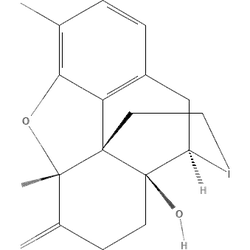
Naltrexone Stats & Data
O=C1CCC2(O)C3Cc4ccc(O)c5OC1C2(CCN3CC1CC1)c45DQCKKXVULJGBQN-XFWGSAIBSA-NPharmacology
DrugBankDescription
Derivative of noroxymorphone that is the N-cyclopropylmethyl congener of naloxone. It is a narcotic antagonist that is effective orally, longer lasting and more potent than naloxone, and has been proposed for the treatment of heroin addiction. The FDA has approved naltrexone for the treatment of alcohol dependence.
Mechanism of Action
Naltrexone is a pure opiate antagonist and has little or no agonist activity. The mechanism of action of naltrexone in alcoholism is not understood; however, involvement of the endogenous opioid system is suggested by preclinical data. Naltrexone is thought to act as a competitive antagonist at mc, κ, and δ receptors in the CNS, with the highest affintiy for the μ receptor. Naltrexone competitively binds to such receptors and may block the effects of endogenous opioids. This leads to the antagonization of most of the subjective and objective effects of opiates, including respiratory depression, miosis, euphoria, and drug craving. The major metabolite of naltrexone, 6-β-naltrexol, is also an opiate antagonist and may contribute to the antagonistic activity of the drug.
Pharmacodynamics
Naltrexone, a pure opioid antagonist, is a synthetic congener of oxymorphone with no opioid agonist properties. Naltrexone is indicated in the treatment of alcohol dependence and for the blockade of the effects of exogenously administered opioids. It markedly attenuates or completely blocks, reversibly, the subjective effects of intravenously administered opioids. When co-administered with morphine, on a chronic basis, naltrexone blocks the physical dependence to morphine, heroin and other opioids. In subjects physically dependent on opioids, naltrexone will precipitate withdrawal symptomatology.
Metabolism
Hepatic. When administered orally, naltrexone undergoes extensive biotransformation and is metabolized to 6 beta-naltrexol (which may contribute to the therapeutic effect) and other minor metabolites.
Absorption
Although well absorbed orally, naltrexone is subject to significant first pass metabolism with oral bioavailability estimates ranging from 5 to 40%.
Indication
Used as an adjunct to a medically supervised behaviour modification program in the maintenance of opiate cessation in individuals who were formerly physically dependent on opiates and who have successfully undergone detoxification. Also used for the management of alcohol dependence in conjunction with a behavioural modification program.
Half-life
4 hours for naltrexone and 13 hours for the active metabolite 6 beta-naltrexol.
Protein Binding
21% bound to plasma proteins over the therapeutic dose range.
Elimination
Both parent drug and metabolites are excreted primarily by the kidney (53% to 79% of the dose), however, urinary excretion of unchanged naltrexone accounts for less than 2% of an oral dose and fecal excretion is a minor elimination pathway. The renal clearance for naltrexone ranges from 30 to 127 mL/min and suggests that renal elimination is primarily by glomerular filtration.
Measured Affinities
Guide to PHARMACOLOGYMeasured binding and functional data for naltrexone, curated by the IUPHAR/BPS Guide to PHARMACOLOGY. Each row cites the paper it came from. Lower concentrations mean tighter binding — a value in the sub-nanomolar range indicates a very potent interaction.
| Target | Action | Measure | Value | Concentration | Species | Source |
|---|---|---|---|---|---|---|
| κ receptor Oprk1 | Antagonist | pIC50 | 9.2 | 0.631 nM | Mouse | PMID 8393575 |
| δ receptor OPRD1 | Antagonist | pKi | 8 | 10 nM | Human | PMID 9686407 |
| δ receptor Oprd1 | Antagonist | pKi | 6.8 | 158.49 nM | Mouse | PMID 8114680 |
| κ receptor OPRK1 | Antagonist | pKi | — | — | Human | — |
| μ receptor OPRM1 | Antagonist | pKi | — | — | Human | — |
Reading this. pKi, pEC50 and pIC50 are negative log molar values, so a higher number means a tighter interaction; the concentration column converts them for you. Values from non-human species are laboratory measurements and do not translate directly to human effect. Receptor affinity is not a dose — it describes what a molecule binds, not how much of it is safe to take.
Receptor data from the IUPHAR/BPS Guide to PHARMACOLOGY (v2026.2), licensed CC BY-SA 4.0. Matched to this substance by InChIKey.
Toxicity
DrugBankNaltrexone is a pure antagonist with essentially no actions of its own — no euphoria, no dependence, nothing to divert. Common side effects at treatment doses are mundane: nausea (~10% in the oral trials), headache, dizziness, fatigue, insomnia; the monthly injection adds injection-site reactions. The old hepatotoxicity boxed warning was removed in 2013 — it came from 1980s studies at up to 300 mg/day, and no cases of naltrexone-caused hepatic failure were identified — though a precaution remains to stop if signs of acute hepatitis develop. The real dangers are situational rather than toxic: precipitated withdrawal at initiation, and the reset-tolerance overdose window when treatment stops or a dose is missed.
Toxicity (DrugBank)
In the mouse, rat and guinea pig, the oral LD50s were 1,100-1,550 mg/kg; 1,450 mg/kg; and 1,490 mg/kg; respectively. High doses of naltrexone (generally >1,000 mg/kg) produce salivation, depression/reduced activity, tremors, and convulsions.
Experience Report Analysis
ErowidDemographics
Gender Distribution
Too few reports for a chart: gender is known from 15 reports, and a split is drawn only from 20 reports or more. Counts are shown instead. Why 20?
- Male 9 of 15
- Not Specified 2 of 15
- Female 4 of 15
Age Distribution
Reports Over Time
Effect Analysis
ErowidEffects aggregated from 6 experience reports (6 single-substance Erowid)
Effect Sentiment Distribution
Confidence Distribution
Each bar is the share of reports mentioning the effect; its whisker, and the band on the rows below, is the 95% interval: where the share could plausibly be with other reports of the same kind.
Too few reports for bars: these effects come from 6 single-substance Erowid reports, and a bar is drawn only from 20 reports or more. With fewer, a percentage cannot tell a common effect from a rare one. Counts are shown instead. Why 20?
Positive Effects 0
Adverse Effects 1
Also reported in combinations. In the 9 Naltrexone reports where another drug was taken too, 3 mention hospital, emergency services or an overdose, 0 a seizure and 0 psychosis (too few reports for percentages). In the 6 single-substance reports: 0, 1 and 0. These are not in the figures above: they cannot be put down to Naltrexone alone, and a mention is not always something that happened to the writer.
Real-World Dose Distribution
ErowidFrom 13 of 15 recorded dose entries: those that state a weight (mg, g or µg), in routes with at least five of them. Values above Q3 + 3×IQR, far above what people typically take, are left out; they can include real heavy doses and overdoses, not only mistakes.
Oral (n=13)
Common Combinations
Most co-occurring substances, as a share of all 15 reports filed under Naltrexone
Too few reports for bars: these combinations come from 15 reports, and a bar is drawn only from 20 reports or more. With fewer, a percentage cannot tell a common effect from a rare one. Counts are shown instead. Why 20?
- Kratom 5 of 15
- Alcohol 3 of 15
Form / Preparation
Most common forms and preparations, as a share of the 7 reports that give one
Too few reports for bars: these forms come from 7 reports, and a bar is drawn only from 20 reports or more. With fewer, a percentage cannot tell a common effect from a rare one. Counts are shown instead. Why 20?
- Pill / Tablet 4 of 7
Body-Weight Dosing
Dose per kg of body weight, one dose per report (the first listed), from reports giving a weight of 30–250 kg. Doses above Q3 + 3×IQR, far above what people typically take, are left out of the median and range and listed under each route.
Redose Patterns
Redosing behavior across 13 reports
Too few reports for a chart: redosing is known from 13 reports, and a split is drawn only from 20 reports or more. Counts are shown instead. Why 20?
- Single dose 13 of 13
- Redosed 0 of 13