
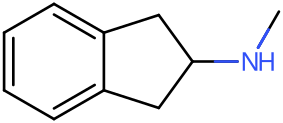
NM-2-AI Stats & Data
SXWZQUCTTOBHJT-UHFFFAOYSA-NInteraction Warnings
NM-2-AI can be potentially dangerous in combination with other stimulants as it can increase one's heart rate and blood pressure to dangerous levels.
The neurotoxic effects of MDMA may be increased when combined with amphetamine and other stimulants.
This combination may increase strain on the heart.
Receptor Profile
Receptor Actions
History & Culture
NM-2-AI is a novel stimulant belonging to the aminoindane chemical class. Structurally, it represents a rigid analogue of methamphetamine and shares close chemical relationships with other aminoindane compounds such as 2-AI and MDAI. The substance emerged on the online research chemical market as a designer drug, where it has been sold through various vendors. It remains a lesser-known compound compared to its aminoindane relatives, with limited documentation of its history or cultural significance beyond its presence in the contemporary designer drug landscape.
Subjective Effects
Physical
The physical effects of NM2AI can be broken down into several components which progressively intensify proportional to dosage.
- Stimulation: In terms of its effects on the physical energy levels of the user, NM2AI is usually considered to be energetic and stimulating in a fashion that is similar to that of amphetamine but stronger than that of modafinil or caffeine. It is similar yet distinct from the stimulation experienced on MDMA, encouraging physical activities such as dancing, socializing, running, or cleaning. The particular style of stimulation which NM2AI presents can be described as forced. This means that at higher doses, it becomes difficult or impossible to keep still as jaw clenching, involuntarily bodily shakes and vibrations become present, resulting in extreme shaking of the entire body, unsteadiness of the hands, and a general lack of motor control.
- Increased heart rate
- Dehydration
- Appetite suppression
- Nausea
- Temporary erectile dysfunction
- Increased perspiration
- Increased blood pressure
Cognitive
The general head space of NM2AI is described by many as one of mental stimulation, increased focus, and euphoria. It contains a large number of typical stimulant cognitive effects. Although negative side effects are usually mild at low to moderate doses, they become increasingly likely to manifest themselves with higher amounts or extended usage. This particularly holds true during the offset of the experience.
- Focus enhancement: This component is most effective at low to moderate doses as anything higher will usually impair concentration.
- Motivation enhancement: This compound can be considered as slightly more functional than that of 2-AI and therefore more effective for performing tasks whilst under its influence.
- Euphoria: This compound can be considered as considerably less euphoric than that of 2-AI and therefore less effective for recreational purposes.
- Thought acceleration
- Wakefulness
- Analysis enhancement
- Memory enhancement
- Compulsive redosing
- Cognitive fatigue
- Anxiety
- Depression
Forked from Subjective Effect Documentation by Josie Kins, September 2015. Via dose.wiki (CC0).
Toxicity
PsychonautWikiThe toxicity and long-term health effects of recreational NM-2-AI use do not seem to have been studied in any scientific context and the exact toxic dosage is unknown. This is because NM-2-AI has very little history of human usage. Anecdotal evidence from people who have tried NM-2-AI within the community suggest that there do not seem to be any negative health effects attributed to simply trying this drug at low to moderate doses by itself and using it sparingly (but nothing can be completely guaranteed). It is strongly recommended that one use harm reduction practices when using this drug.
Effect Profile
CuratedMild auditory effects with low body load and visuals
Moderate stimulation and euphoria with mild sensory enhancement
Strong focus with strong anxiety/jitters, moderate euphoria, mild stimulation
Tolerance & Pharmacokinetics
drugs.wikiTolerance Decay
Pattern inferred from related aminoindanes and user reports rather than controlled data.
Legal Status
| Country | Status | Notes |
|---|---|---|
| Germany | NpSG (Neue-psychoaktive-Stoffe-Gesetz) | Controlled under the New Psychoactive Substances Act since November 26, 2016. Production and import with intent to distribute, administration to others, and trading are punishable offenses. Possession is technically illegal but not subject to criminal penalties. |
| Switzerland | Verzeichnis E | Specifically named as a controlled substance under Schedule E of Swiss narcotics legislation. |
| United Kingdom | Psychoactive Substances Act 2016 | Production, supply, and import are prohibited under the Psychoactive Substances Act, which came into effect on May 26, 2016. |
Harm Reduction
drugs.wikiEvidence-based harm-reduction additions and clarifications: 1) Batch variability and weak stand‑alone effects are frequently reported; treat each new source as unknown potency and begin with a low test dose. 2) Redosing can increase blood pressure/heart rate without adding much euphoria—avoid chasing effects and wait at least 90–120 minutes before considering any redose. 3) Oral administration avoids the pronounced nasal causticity many users report when snorting; if insufflating, finely crush, use small lines spaced apart, alternate nostrils, and rinse with isotonic saline to reduce damage. 4) Avoid combining with other stimulants (including high caffeine) or with alcohol; such mixes increase strain on the cardiovascular system and can mask impairment. 5) Absolutely avoid MAOIs; use strong caution with SNRIs/SSRIs due to unpredictable serotonergic modulation and with seizure‑threshold–lowering drugs (e.g., bupropion, tramadol). 6) Measure doses with a milligram‑accurate scale or use volumetric dosing; do not eyeball powders. 7) Because onset may be delayed up to ~1 hour, premature redosing increases risk of over‑stimulation. 8) Monitor for irritability, anxiety, headache, or mood drop; these are reported at higher doses or with repeated use—post‑use rest, nutrition, and hydration help recovery. 9) Use drug checking whenever possible; reagent and especially lab drug‑checking services help detect mislabeling or adulterants. 10) As with other stimulants, maintain moderate hydration, take cooling breaks in hot environments, and avoid strenuous activity during peaks. 11) Do not drive or operate machinery while under effects or during the residual phase; sleep can be fragmented despite perceived fatigue.
References
Data Sources
Cited References
- 2-Aminoindan and its ring-substituted derivatives interact with plasma membrane monoamine transporters (2019)
- Behavioral and Pharmacokinetics Studies of N-Methyl-2-Aminoindane (NM2AI) in Mice (2023)
- Bluelight thread: NM-2-AI (2013)
- Comparison of biological effects of N-alkylated congeners (1980)
- Drug Users Bible - NM2AI entry
- Metabolism Study of N-Methyl 2-Aminoindane (NM2AI) (2021)
- Pharmacological profile of mephedrone analogs and related new psychoactive substances (2018)
- The metabolic fate of 2-aminoindane and N-methyl-2-aminoindane (2020)
- Behavioral and Pharmacokinetics Studies of N-Methyl-2-Aminoindane (2023)
- Reddit discussion: “what is NM-2AI like?” (2021)
Additional references
- Drug Users Bible – NM2AI entry
- Bluelight thread: NM-2-AI (2013) – variable, often underwhelming effects and negative mood at higher doses
- Reddit: NM-2AI HCL insufflation experience (2021) – strong burn, short euphoria, headache
- Reddit: r/ResearchChemicalsNL “NM-2AI Good?!?” (2024) – multiple users report weak/lame stimulant profile
- Hi‑Ground: Amphetamine – general stimulant HR (BP/HR, overheating risks)
- Hi‑Ground: Alcohol – warns on co‑use with stimulants
- Hi‑Ground: Benzos page – general snorting harm advice that applies broadly to powders
- Hi‑Ground: TripSit resource link (combinations chart)
- Drugchecking.community – Tips & Help (why to check drugs; harm-reduction basics)