
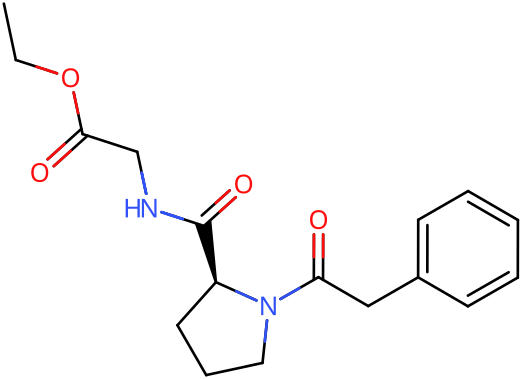
Noopept Stats & Data
CCOC(=O)CNC(=O)C1CCCN1C(=O)Cc1ccccc1PJNSMUBMSNAEEN-AWEZNQCLSA-NReceptor Profile
Receptor Actions
Subjective Effects
Physical
- Spontaneous tactile sensations: The body high which noopept presents can be described as a faint, all-encompassing, soft and consistent tingling sensation.
- Stimulation: The stimulation which noopept presents can be considered as primarily subtle and encouraged over forceful and distinct.
Cognitive
- Wakefulness
- Thought connectivity
- Focus enhancement
- Thought acceleration
- Motivation enhancement
- Memory enhancement
- Rejuvenation
- Anxiety suppression
Sensory
- Acuity enhancement: Some users have described noopept's visual effects as "widescreen HD vision."
- Colour enhancement: Noopept has been described to make colours appear more vibrant.
Forked from Subjective Effect Documentation by Josie Kins, September 2015. Via dose.wiki (CC0).
Toxicity
PsychonautWikiThe toxicity and long-term health effects of recreational omberacetam use do not seem to have been studied in any scientific context and the exact toxic dosage is unknown. This is because omberacetam has very little history of human usage. Anecdotal evidence from people who have tried omberacetam within the community suggest that there do not seem to be any negative health effects attributed to simply trying this drug at low to moderate doses by itself and using it sparingly (but nothing can be completely guaranteed). It is strongly recommended that one use harm reduction practices when using this drug. High doses of omberacetam (above 20 mg) can cause short-term memory loss, brain fog, irritability, sleep disturbances, and headache.
Tolerance & Pharmacokinetics
drugs.wikiTolerance Decay
Many report subtle tolerance after continuous daily use for weeks; limited to anecdotal evidence. Spacing doses (e.g., 2–3 days/week) or cycling may help maintain effect. Cross-tolerance within racetams is plausible but not quantified.
Cross-Tolerances
Experience Report Analysis
ErowidDemographics
Gender Distribution
Too few reports for a chart: gender is known from 13 reports, and a split is drawn only from 20 reports or more. Counts are shown instead. Why 20?
- Male 12 of 13
- Not Specified 1 of 13
Age Distribution
Reports Over Time
Effect Analysis
ErowidEffects aggregated from 4 experience reports (4 single-substance Erowid)
Effect Sentiment Distribution
Confidence Distribution
Each bar is the share of reports mentioning the effect; its whisker, and the band on the rows below, is the 95% interval: where the share could plausibly be with other reports of the same kind.
Too few reports for bars: these effects come from 4 single-substance Erowid reports, and a bar is drawn only from 20 reports or more. With fewer, a percentage cannot tell a common effect from a rare one. Counts are shown instead. Why 20?
Positive Effects 0
Adverse Effects 1
Real-World Dose Distribution
ErowidFrom 13 of 22 recorded dose entries: those that state a weight (mg, g or µg), in routes with at least five of them. Values above Q3 + 3×IQR, far above what people typically take, are left out; they can include real heavy doses and overdoses, not only mistakes.
Oral (n=11)
Form / Preparation
Most common forms and preparations, as a share of the 4 reports that give one
Too few reports for bars: these forms come from 4 reports, and a bar is drawn only from 20 reports or more. With fewer, a percentage cannot tell a common effect from a rare one. Counts are shown instead. Why 20?
- Liquid 2 of 4
Redose Patterns
Redosing behavior across 10 reports
Too few reports for a chart: redosing is known from 10 reports, and a split is drawn only from 20 reports or more. Counts are shown instead. Why 20?
- Single dose 8 of 10
- Redosed 2 of 10
Harm Reduction
drugs.wikiPotency varies by supplier; unregulated market products have shown high rates of mislabeling in drug-checking programs for other substances—obtain third-party COAs and consider reagent or service-based testing when available. Start with 3–5 mg to assess sensitivity and avoid redosing within the first 2 hours to reduce risk of headaches, irritability, or insomnia. Insomnia is more likely with late-day dosing; avoid taking after mid-afternoon until you understand your response. Headaches are reported and often ascribed by users to cholinergic imbalance; while some find choline supplements helpful, controlled evidence is limited—add only if a consistent personal benefit is observed and keep doses modest. Combination with alcohol has produced unpleasant and risky experiences for some (confusion, dysphoria); if mixing, use minimal alcohol and avoid escalating either substance. Co-administration with phenibut or other CNS depressants can unpredictably blunt or intensify effects—space uses by at least 12–24 hours and avoid first-time combinations. Intranasal use is not recommended due to local irritation and uncertain bioavailability; oral or sublingual routes are safer and sufficient. If using daily, consider cycling (e.g., several weeks on followed by a similar or longer break) to limit tolerance and evaluate ongoing need; data are anecdotal and long-term safety is not established. Avoid in pregnancy/breastfeeding and in individuals with uncontrolled anxiety or sleep disorders until a cautious single low-dose trial in a safe setting demonstrates tolerability. Do not drive or operate machinery on first use or after dose changes, given interindividual variability and occasional paradoxical anxiety or sedation.
References
Data Sources
Cited References
- Bluelight: Noopept Megathread
- Drug Users Bible: Noopept
- DrugBank: Omberacetam
- Erowid: Noopept Vault
- Examine.com: N-Phenylacetyl-L-prolylglycine ethyl ester
- Gudasheva et al. 2002 - The original novel nootropic and neuroprotective agent noopept
- IJEST 2021 - Finding the optimal dosage for nootropic agent Noopept
- Neznamov & Teleshova 2009 - Comparative studies of Noopept and piracetam
- Ostrovskaya et al. 2018 - Pharmacokinetics of noopept and its active metabolite cycloprolyl glycine in rats
- PsychonautWiki: Omberacetam
- PubChem: 1-(2-Phenylacetyl)-L-prolylglycine ethyl ester
Additional references
- DrugBank: Avotermin (DB11955) shows user-provided ID is a different drug
- Drug Users Bible: Noopept (dosage ranges, context)
- Erowid Experience Vaults (Noopept entries incl. with alcohol/phenibut)
- BlueLight: Noopept & The Placebo Effect (community trial write-up)
- SubstanceSearch: Noopept (onset/duration overview)
- Effect Index: Memory enhancement / thought-organization (lists Noopept among inducers)