
O-PCE Stats & Data
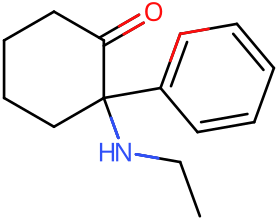
CCNC1(CCCCC1=O)c1ccccc1IDLSBAANXISGEI-UHFFFAOYSA-NReceptor Profile
Receptor Actions
Receptor Binding
History & Culture
O-PCE emerged as part of the wave of novel arylcyclohexylamine designer drugs that appeared on the online research chemical market following the decline in MXE availability. The compound was specifically developed and marketed as a functional replacement for MXE and other dissociatives that had become increasingly difficult to obtain due to international scheduling efforts. The substance became available primarily through online research chemical vendors, where it continues to be sold for recreational purposes. Unlike many established dissociatives, O-PCE has received minimal attention in the scientific literature, with almost no formal research examining its pharmacological profile, toxicity, or potential for abuse and dependence in humans. This lack of scientific documentation is characteristic of many contemporary designer drugs that enter the market faster than researchers can study them.
Toxicity
PsychonautWikiThe toxicity and long-term health effects of recreational O-PCE use do not seem to have been studied in any scientific context and the exact toxic dosage is unknown. This is because O-PCE has very little history of human usage. Anecdotal evidence from people who have tried O-PCE within the community suggests that there do not seem to be any negative health effects attributed to simply trying this substance at low to moderate doses by itself and using it sparingly (but nothing can be completely guaranteed). O-PCE shares a close structural relationship to deschloroketamine (O-PCM) and ketamine (2-Cl-O-PCM), which has been speculated to have immuno-modulative properties. It is not known whether O-PCE also has these properties due to the lack of sufficient scientific research.
Effect Profile
Curated + 10 ReportsStrong dissociative depth with strong mania and motor impairment, low insight
Duration Timeline
BluelightCommunity Effects
TripSitTolerance & Pharmacokinetics
drugs.wikiTolerance Decay
Rapid tolerance build and partial cross‑tolerance across arylcyclohexylamines are widely reported; values above are heuristic and based on anecdotal patterns. Space sessions 10–14 days when possible to reduce escalation risk.
Cross-Tolerances
Experience Report Analysis
ErowidDemographics
Gender Distribution
Too few reports for a chart: gender is known from 18 reports, and a split is drawn only from 20 reports or more. Counts are shown instead. Why 20?
- Male 15 of 18
- Female 2 of 18
- Not Specified 1 of 18
Age Distribution
Reports Over Time
Effect Analysis
ErowidEffects aggregated from 10 experience reports (10 single-substance Erowid)
Effect Sentiment Distribution
Confidence Distribution
Each bar is the share of reports mentioning the effect; its whisker, and the band on the rows below, is the 95% interval: where the share could plausibly be with other reports of the same kind.
Too few reports for bars: these effects come from 10 single-substance Erowid reports, and a bar is drawn only from 20 reports or more. With fewer, a percentage cannot tell a common effect from a rare one. Counts are shown instead. Why 20?
Positive Effects 5
Adverse Effects 4
Show 5 neutral or unclassified mentions
Also reported in combinations. In the 8 O-PCE reports where another drug was taken too, 1 mentions hospital, emergency services or an overdose, 0 a seizure and 1 psychosis (too few reports for percentages). In the 10 single-substance reports: 0, 0 and 1. These are not in the figures above: they cannot be put down to O-PCE alone, and a mention is not always something that happened to the writer.
Real-World Dose Distribution
ErowidFrom 25 of 32 recorded dose entries: those that state a weight (mg, g or µg), in routes with at least five of them. Values above Q3 + 3×IQR, far above what people typically take, are left out; they can include real heavy doses and overdoses, not only mistakes.
Insufflated (n=17)
Oral (n=8)
Common Combinations
Most co-occurring substances, as a share of all 18 reports filed under O-PCE
Too few reports for bars: these combinations come from 18 reports, and a bar is drawn only from 20 reports or more. With fewer, a percentage cannot tell a common effect from a rare one. Counts are shown instead. Why 20?
- THC 3 of 18
Form / Preparation
Most common forms and preparations, as a share of the 14 reports that give one
Too few reports for bars: these forms come from 14 reports, and a bar is drawn only from 20 reports or more. With fewer, a percentage cannot tell a common effect from a rare one. Counts are shown instead. Why 20?
- Powder / Crystals 11 of 14
- Liquid 2 of 14
Body-Weight Dosing
Dose per kg of body weight, one dose per report (the first listed), from reports giving a weight of 30–250 kg. Doses above Q3 + 3×IQR, far above what people typically take, are left out of the median and range and listed under each route.
Redose Patterns
Redosing behavior across 15 reports
Too few reports for a chart: redosing is known from 15 reports, and a split is drawn only from 20 reports or more. Counts are shown instead. Why 20?
- Single dose 7 of 15
- Redosed 8 of 15
Legal Status
| Country | Status | Notes |
|---|---|---|
| Czech Republic | Schedule I (List 4) | Classified as a controlled substance under Schedule I (List 4). Despite this scheduling, limited exceptions exist for research purposes and restricted therapeutic applications. |
| Germany | Controlled (NpSG) | Regulated under the Neue-psychoaktive-Stoffe-Gesetz (New Psychoactive Substances Act) since July 18, 2019. Manufacturing and importing for market distribution, administering to others, and commercial trading are criminally punishable offenses. Personal possession remains illegal but is not subject to criminal penalties. |
| Netherlands | Uncontrolled | Not currently scheduled under Dutch drug legislation. Available for purchase as a research chemical through legitimate vendors. |
| Switzerland | Controlled (Verzeichnis E) | Explicitly named as a controlled substance under Verzeichnis E of the Swiss narcotics regulations. |
| United Kingdom | Class B | Controlled under the Misuse of Drugs Act 1971. As an N-alkyl derivative of 2-amino-2-phenylcyclohexanone, it falls under the arylcyclohexylamine generic clause introduced by Statutory Instrument 2013/239, which became effective on February 26, 2013. Possession, production, supply, and importation are prohibited. |
Harm Reduction
drugs.wikiHarm‑reduction rationale and key guidance (with sources): 1) Mislabeling/adulteration: O‑PCE has been repeatedly sold as “ketamine,” creating overdose risk due to higher potency and longer duration; Swiss drug‑checking issued a 2025 alert for 2‑Oxo‑PCE sold as ketamine and warned it may be 3–4× stronger with longer effects. Always use a trusted drug‑checking service before use. 2) Acute toxicity profile: a 2017 outbreak (n=56) found predominant impaired consciousness (84%), confusion (60%), hypertension (80%), tachycardia (40%), and convulsions (16%) with confirmed O‑PCE as sole agent in many cases; management was supportive. Avoid if you have uncontrolled cardiovascular disease or seizure history. 3) Duration can outlast ketamine: community HR sources report 2–5 h (IN) and 3–6+ h (oral) with after‑effects up to 1–2 days; some services warn 6–10 h at higher doses. Plan set/setting, avoid driving/operating machinery for the rest of the day, and keep a sober sitter for higher doses. 4) Redosing risks: slow come‑up and long plateaus make stacking common; wait at least 60–120 min (IN) or 2–3 h (oral) before considering any additional dosing to avoid unexpectedly deep dissociation or holes. 5) Depressant combinations (alcohol, benzos, opioids, GHB) increase sedation, confusion and aspiration risk; avoid these mixes. General combo guidance flags dissociative+depressant as risky. Carry naloxone if opioids may be present in your supply. 6) Stimulant and polysubstance use: stimulants may exacerbate O‑PCE‑related hypertension, anxiety, and mania‑like states; polysubstance cases were common in outbreaks. Titrate especially cautiously if any stimulant is onboard. 7) Bladder/urinary risk likely extends to this class: ketamine cystitis is well‑documented and can progress to severe LUTS and renal complications; while direct O‑PCE data are limited, class‑based caution (limit frequency, hydrate, seek care early if urinary symptoms emerge) is prudent. Avoid if you currently have a UTI. 8) Nasal harm reduction: finely crush, use your own straw, and rinse with sterile water/saline before and after to reduce mucosal damage; repeated snorting can injure septum. Consider oral dosing to reduce local damage. 9) Tolerance and compulsive use: arylcyclohexylamines can produce rapid tolerance (days) with partial reset over 1–2 weeks; spacing sessions helps reduce escalation and dependence risk. 10) Market variability and isomer confusion: fluorinated analogs (e.g., “FXE”) have been widely misidentified in the unregulated market; this underscores the need for professional analysis rather than assuming identity from vendor labels.
References
Cited References
- Bluelight: The Big & Dandy Eticyclidone Thread
- Characterization of 3-HO-PCE Metabolism (PMC)
- Chong et al. (2017) - 2-oxo-PCE: ketamine analogue on the streets
- Erowid: Experience Vaults - O-PCE Reports
- Morris & Wallach (2014) - From PCP to MXE: comprehensive review of dissociative drugs
- Theofel et al. (2019) - Fatal Case Involving N-Ethyldeschloroketamine and Venlafaxine
- Wallach & Brandt (2018) - Ketamine-Based New Psychoactive Substances
Additional references
- Erowid Novel Drug Briefs (O‑PCE)
- Erowid Experience Vaults – O‑PCE (overview categories)
- SubstanceSearch – O‑PCE timing summary
- Saferparty.ch warning: 2‑Oxo‑PCE sold as ketamine (Apr 8, 2025)
- TripSit – Drug combination chart (general guidance)
- Hi‑Ground – Ketamine safer‑snorting tips (generalizable to O‑PCE IN use)
- PubMed – Cluster of acute poisonings with 2‑Oxo‑PCE (2017)
- PubMed – Fatal case involving N‑ethyldeschloroketamine (2‑Oxo‑PCE)
- PubMed – Emergence of 2‑Oxo‑PCE in HK seizures and DUID
- DrugWise – Ketamine (dependence and urinary risks)
- Reddit – FXE misidentification to 2‑FXE (Canket) discussions (market variability)