
Oxymorphone Stats & Data
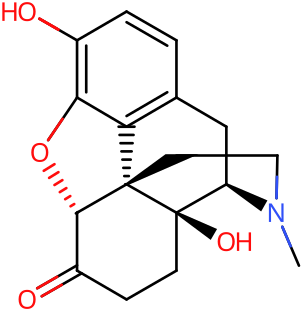
CN1CCC23C4C(=O)CCC3(O)C1Cc1ccc(O)c(O4)c12UQCNKQCJZOAFTQ-ISWURRPUSA-NPharmacology
DrugBankDescription
An opioid analgesic with actions and uses similar to those of morphine, apart from an absence of cough suppressant activity. It is used in the treatment of moderate to severe pain, including pain in obstetrics. It may also be used as an adjunct to anesthesia (From Martindale, The Extra Pharmacopoeia, 30th ed, p1092). On June 8, 2017, FDA requested Endo Pharmaceuticals to remove the medication from the market due to opioid misuse and abuse risks associated with the product's injectable reformulation.
Mechanism of Action
Oxymorphone interacts predominantly with the opioid mu-receptor. These mu-binding sites are discretely distributed in the human brain, with high densities in the posterior amygdala, hypothalamus, thalamus, nucleus caudatus, putamen, and certain cortical areas. They are also found on the terminal axons of primary afferents within laminae I and II (substantia gelatinosa) of the spinal cord and in the spinal nucleus of the trigeminal nerve. Also, it has been shown that oxymorphone binds to and inhibits GABA inhibitory interneurons via mu-receptors. These interneurons normally inhibit the descending pain inhibition pathway. So, without the inhibitory signals, pain modulation can proceed downstream.
Pharmacodynamics
Oxymorphone is a semi-synthetic opioid substitute for morphine. It is a potent analgesic. Opioid analgesics exert their principal pharmacologic effects on the CNS and the gastrointestinal tract. The principal actions of therapeutic value are analgesia and sedation. Opioids produce respiratory depression by direct action on brain stem respiratory centers. The mechanism of respiratory depression involves a reduction in the responsiveness of the brain stem respiratory centers to increases in carbon dioxide tension and to electrical stimulation.
Metabolism
Oxymorphone undergoes extensive hepatic metabolism in humans. After a 10 mg oral dose, 49% was excreted over a five-day period in the urine. Of this, 82% was excreted in the first 24 hours after administration. The recovered drug-related products contained the oxymorphone (1.9%), the conjugate of oxymorphone (44.1%), the 6(beta)-carbinol produced by 6-keto reduction of oxymorphone (0.3%), and the conjugates of 6(beta)-carbinol (2.6%) and 6(alpha)-carbinol (0.1%).
Indication
For the treatment of moderate-to-severe pain.
Elimination
Oxymorphone is highly metabolized, principally in the liver, and undergoes reduction or conjugation with glucuronic acid to form both active and inactive products. Because oxymorphone is extensively metabolized, <1% of the administered dose is excreted unchanged in the urine.
Receptor Profile
Receptor Actions
Receptor Binding
History & Culture
1914–1959
Oxymorphone was first developed in Germany in 1914 as part of efforts to create opioid analgesics with improved side effect profiles compared to morphine and heroin. The compound exhibits actions and uses similar to morphine, though notably lacks cough suppressant activity. During the 1930s, researchers developed mono-, di-, tri-, and tetra-ester derivatives of oxymorphone, similar to acetylation processes used with morphine and hydromorphone, though none of these variants were adopted for medical use. The drug was patented in the United States by Endo Pharmaceuticals in 1955 and received approval for medical use in 1959, when it was introduced to the American market under the brand name Numorphan. This name was derived by analogy to other opioid product names including Nucodan for oxycodone, Paramorphan for dihydromorphine, and Paracodin for dihydrocodeine.
2012–2015
Prior to 2012, oxymorphone was commonly administered via insufflation among recreational users. In 2012, Endo Pharmaceuticals introduced a reformulated extended-release version of Opana designed to be crush-resistant, intended to reduce abuse through nasal administration. However, this reformulation had unintended consequences as users adapted by dissolving the tablets and injecting them intravenously. In January 2013, the Centers for Disease Control and Prevention reported an illness cluster associated with intravenous abuse of Opana ER in Tennessee, presenting with symptoms resembling thrombotic thrombocytopenic purpura. Subsequently, in January 2015, the Indiana State Department of Health identified the first HIV outbreak directly linked to prescription opioid abuse in Scott County, a small rural community in southeastern Indiana. By late March 2015, Austin, Indiana had become the epicenter of an HIV outbreak traced to injectable use of the reformulated Opana ER. Research into these events determined that the crush-resistant reformulation paradoxically increased the risk of blood-borne infection transmission by driving users from nasal to intravenous administration, ultimately creating greater public health risks than those associated with injectable heroin or cocaine.
2017–present
In June 2017, amid the escalating opioid epidemic and evidence that the 2012 reformulation had failed to prevent illicit injection, the FDA took the unprecedented step of requesting that Endo Pharmaceuticals voluntarily remove reformulated Opana ER from the United States market. By July 6, 2017, Endo International complied with this request, marking a significant regulatory action in response to the opioid crisis. Generic versions of extended-release oxymorphone remain available in the United States.
Like most opioids, unadulterated oxymorphone does not cause many long-term complications other than dependence and constipation. Outside of the extremely powerful addiction and physical dependence, the harmful or toxic aspects of oxymorphone usage are exclusively associated with not taking appropriate precautions in regards to its administration, overdosing and using impure products. Heavy dosages of oxymorphone can result in respiratory depression, leading onto fatal or dangerous levels of anoxia (oxygen deprivation). This occurs because the breathing reflex is suppressed by agonism of µ-opioid receptors proportional to the dosage consumed. Oxymorphone can also cause nausea and vomiting; a significant number of deaths attributed to opioid overdose are caused by aspiration of vomit by an unconscious victim.
Carcinogenicity
No indication of carcinogenicity to humans (not listed by IARC).
Toxicity (DrugBank)
Oxymorphone overdosage is characterized by respiratory depression, extreme somnolence progressing to stupor or coma, skeletal muscle flaccidity, cold and clammy skin, and sometimes bradycardia and hypotension. Patients experiencing an overdose may develop apnea, circulatory collapse, and cardiac arrest. Intravenous mouse LD50 is 172 mg/kg.
Effect Profile
Curated + 66 ReportsStrong euphoria and pain relief with strong itching/nausea, moderate sedation
Empirical Duration
Erowid ReportsMedian times after the dose that Erowid reports state. A curve is drawn only when reports state all four points (onset, peak begins, comedown begins, back to baseline) and the medians fall in that order. No point is estimated from another.
No curve: fewer than 5 reports state the return to baseline, and no point is estimated from another.
Tolerance & Pharmacokinetics
drugs.wikiNo tolerance chart. Our decay curves for opioids were estimates, and a curve can make tolerance look longer-lasting than it is, which is the dangerous direction.
Opioid tolerance drops fast when you stop, and even a few days off can be enough, so a dose that used to be normal can now stop your breathing. Overdose deaths rise sharply after prison, detox or leaving treatment, and tolerance also falls during a hospital stay. After any break, start with a much smaller amount, try a test dose first, don't use alone, and keep naloxone within reach. Alcohol, benzodiazepines, gabapentinoids and other sedatives make an opioid overdose much more likely.
Sources: FRANK: heroin · National Harm Reduction Coalition · WHO: opioid overdose · Merrall et al. 2010 · Binswanger et al. 2007 · Strang et al. 2003 · FDA 2019: gabapentinoids and breathing
Cross-Tolerances
Demographics
Gender Distribution
Age Distribution
Reports Over Time
Effect Analysis
Erowid + BluelightEffects aggregated from 66 experience reports (56 single-substance Erowid + 10 Bluelight)
Effect Sentiment Distribution
Confidence Distribution
Each bar is the share of reports mentioning the effect; its whisker, and the band on the rows below, is the 95% interval: where the share could plausibly be with other reports of the same kind.
Rows resting on fewer than 20 reports show a count (“3 of 7”) instead of a bar. Why 20?
Positive Effects 14
Adverse Effects 15
Show 13 neutral or unclassified mentions
Also reported in combinations. In the 15 Oxymorphone reports where another drug was taken too, 6 mention hospital, emergency services or an overdose, 0 a seizure and 0 psychosis (too few reports for percentages). In the 56 single-substance reports: 33.9%, 1.8% and 0.0%. These are not in the figures above: they cannot be put down to Oxymorphone alone, and a mention is not always something that happened to the writer.
Dose-Response Correlation
How effect frequency changes across dose levels. Whiskers, and the numbers' hover text, give each figure's 95% interval.
Not drawn, too few reports (a dose tier needs 20): Insufflated Heavy (n=17). Why 20?
Dosage Distribution
Dose distribution from experience reports, one dose per report (the first listed). Doses above Q3 + 3×IQR, far above what people typically take, are left out of the median and range and listed under each route: most are real heavy doses or overdoses, not mistakes.
Oral
Insufflated
Real-World Dose Distribution
ErowidFrom 81 of 83 recorded dose entries: those that state a weight (mg, g or µg), in routes with at least five of them. Values above Q3 + 3×IQR, far above what people typically take, are left out; they can include real heavy doses and overdoses, not only mistakes.
Oral (n=14)
Intravenous (n=6)
Insufflated (n=59)
Common Combinations
Most co-occurring substances, as a share of all 71 reports filed under Oxymorphone; whiskers are 95% intervals
Form / Preparation
Most common forms and preparations, as a share of the 61 reports that give one; whiskers are 95% intervals
Body-Weight Dosing
Dose per kg of body weight, one dose per report (the first listed), from reports giving a weight of 30–250 kg. Doses above Q3 + 3×IQR, far above what people typically take, are left out of the median and range and listed under each route.
Oral
Insufflated
Redose Patterns
Redosing behavior across 64 reports
Opioid Equivalence (MME)
NIH HEAL 2024 & CDC 2022Oxymorphone 3.3 mg oral ≈ 10 mg Morphine oral
Legal Status
| Country | Status | Notes |
|---|---|---|
| Germany | Anlage II BtMG | Controlled under the Betäubungsmittelgesetz (Narcotics Act). Manufacturing, importing, possessing, selling, or transferring without a license is prohibited. Anlage II classification permits restricted medical use under appropriate authorization. |
| Russia | Schedule I | Classified as a Schedule I controlled substance under Russian drug control legislation. Possession, distribution, and manufacturing without authorization are prohibited. |
| Switzerland | Verzeichnis A | Listed under Verzeichnis A in the Swiss controlled substances regulations. Medicinal use is permitted with appropriate authorization and licensing. |
| United Kingdom | Class A, Schedule 2 | Controlled under the Misuse of Drugs Act 1971. As a Class A substance, it carries the most severe penalties for unauthorized possession, sale, or distribution. Schedule 2 designation permits medical use under strict controls. |
| United States | Schedule II | Controlled under the Controlled Substances Act. Illegal to sell without a DEA license and illegal to buy or possess without a license or prescription. In 2017, the FDA requested Endo Pharmaceuticals to remove the extended-release formulation from the market due to concerns about opioid misuse and abuse associated with the injectable reformulation. |