
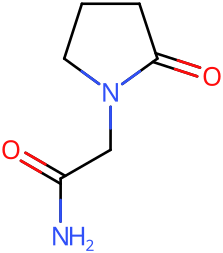
Piracetam Stats & Data
GMZVRMREEHBGGF-UHFFFAOYSA-NPharmacology
DrugBankDescription
Piracetam is a nootropic drug in the racetams group, with chemical name 2-oxo-1-pyrrolidine acetamide. It shares the same 2-oxo-pyrrolidone base structure with pyroglutamic acid and is a cyclic derivative of the neurotransmitter γ-aminobutyric acid (GABA). However its mechanism of action differ from that of endogenous GABA. Piracetam has neuroprotective and anticonvulsant properties and is reported to improve neural plasticity . Its efficacy is documented in cognitive disorders and dementia, vertigo, cortical myoclonus, dyslexia, and sickle cell anemia although the clinical application in these conditions is not yet established. Piracetam has effects on the vascular system by reducing erythrocyte adhesion to the vascular endothelium, hindering vasospasms and facilitating microcirculation . Originally marketed by UCB Pharma in 1971, piracetam was the first nootropic drug to modulate cognitive function without causing sedation or stimulation . It is not approved for any medical or dietary use by the FDA. In the UK, piracetam is prescribed mainly for myoclonus, but is used off-label for other conditions such as learning difficulties in children, memory loss or other cognitive defects in the elderly, and sickle-cell vaso-occlusive crises . Evidence to support its use for many conditions is unclear.
Mechanism of Action
Piracetam interacts with the polar heads in the phospholipids membrane and the resulting mobile drug-lipid complexes are thought to reorganize the lipids and influence membrane function and fluidity . Such interaction has been reported in a study that investigated the effects of neuronal outgrowth induced by beta amyloid peptides; while amyloid peptides cause lipid disorganization within the cell membranes leading to neuronal death, piracetam demonstrated to decrease the destabilizing effects of amyloid peptide . The authors suggest that piracetam induces a positive curvature of the membrane by occupying the polar groups in the phospholipids to counteract the negative curvature induced by amyloid peptides, which in turn would decrease the likelihood of membrane fusion . This mechanism of action is thought to improve membrane stability, allowing the membrane and transmembrane proteins to maintain and recover the three-dimensional structure or folding for normal function such as membrane transport, chemical secretion, and receptor binding and stimulation . Through restored membrane fluidity, piracetam promotes restored neurotransmission such as glutamatergic and cholinergic systems, enhances neuroplasticity and mediates neuroprotective and anticonvulsant effects at the neuronal level . It is also demonstrated that piracetam also improves the fluidity of platelet membranes.
Pharmacodynamics
Piracetam is known to mediate various pharmacodynamic actions: **Neuronal effects**: Piracetam modulates the cholinergic, serotonergic, noradrenergic, and glutamatergic neurotransmission although the drug does not display high affinity to any of the associated receptors (Ki >10μM). Instead, piracetam increases the density of postsynaptic receptors and/or restore the function of these receptors through stabilizing the membrane fluidity . In the forebrain of aging mice, the density of NMDA receptors was increased by approximately 20% following 14 days of piracetam treatment. Based on the findings of various animal and human studies, the cognitive processses including learning, memory, attention and consciousness were enhanced from piracetam therapy without inducing sedation and psychostimulant effects . Piracetam mediate neuroprotective effects against hypoxia-induced damage, intoxication, and electroconvulsive therapy . In two studies involving alcohol-treated rats with evidences of withdrawal-related neuronal loss, piracetam was shown to reduce the extent of neuronal loss and increase the numbers of synapses in the hippocampus by up to 20% relative to alcohol-treated or alcohol-withdrawn rats . This suggests that piracetam is capable in promoting neuroplasticity when recoverable neural circuits are present .
Metabolism
As large proportion of total piracetam administered is excreted as unchanged drug, there is no known major metabolism of piracetam .
Absorption
Piracetam displays a linear and time-dependent pharmacokinetic properties with low intersubject variability over a large range of doses. Piracetam is rapidly and extensively absorbed following oral administration with the peak plasma concentration is reached within 1 hour after dosing in fasted subjects. Following a single oral dose of 3.2 g piracetam, the peak plasma concentration (Cmax) was 84 µg/mL. Intake of food may decrease the Cmax by 17% and increase the time to reach Cmax (Tmax) from 1 to 1.5 hours. Tmax in the cerebrospinal fluid is achieved approximately 5 hours post-administration . The absolute bioavailability of piracetam oral formulations is close to 100% and the steady state plasma concentrations are achieved within 3 days of dosing .
Indication
Indicated in adult patients suffering from myoclonus of cortical origin, irrespective of aetiology, and should be used in combination with other anti-myoclonic therapies .
Half-life
The plasma half life of piracetam is approximately 5 hours following oral or intravenous administration. The half life in the cerebrospinal fluid was 8.5 hours .
Protein Binding
Piracetam is not reported to be bound to plasma proteins .
Elimination
Piracetam is predominantly excreted via renal elimination, where about 80-100% of the total dose is recovered in the urine. Approximately 90% of the dose of piracetam is excreted in the urine as unchanged drug .
Volume of Distribution
Vd is approximately 0.6L/kg. Piracetam may cross the blood-brain barrier as it was measured in the cerebrospinal fluid following intravenous administration . Piracetam diffuses to all tissues except adipose tissues, crosses placental barrier and penetrates the membranes of isolated red blood cells .
Receptor Profile
Receptor Actions
Adverse effects, although rare and of short duration are limited to anxiety, insomnia, drowsiness, headaches and agitation. It may be safe for up to 18 months in humans at doses of 3.2g daily with one year-long study in ambulatory patients with Alzheimer's using 8g daily reporting no side effects. However, a possibility for adverse drug-drug interactions persists for piracetam due to it interacting with blood in an anti-clotting manner. Therefore, caution should be taken when pairing piracetam with pharmaceutical blood thinning agents such as Warfarin or potent nutraceutical options and individuals prone to brain hemorrhaging are discouraged from using piracetam. Patients with renal insufficiency should also not use piracetam.
Addiction & dependence
The chronic use of piracetam can be considered as not addictive with a low potential for abuse. It does not seem to be capable of causing psychological dependence among certain users. Tolerance to many of the effects of piracetam develops with prolonged and repeated use.
Toxicity (DrugBank)
The cases of overdose with piracetam is rare. The highest reported overdose with piracetam was oral intake of 75g which was associated with diarrhea and abdominal pain; the signs were most likely related to the extreme high dose of sorbitol contained in the used formulation. In cases of acute, significant overdosage, stomach emptying by gastric lavage or induced emesis is recommended as there are no known antidotes for piracetam . Management for an overdose will most likely be symptomatic treatment and may include hemodialysis, where the extraction efficacy of the dialyser is 50 to 60% for the drug . Oral LD50 in a mouse acute toxicity study was 2000 mg/kg .
Tolerance & Pharmacokinetics
drugs.wikiTolerance Decay
No robust evidence of rapid pharmacodynamic tolerance in typical nootropic dosing; some users report stable effects over weeks, others report diminishing returns. Data quality is low and largely anecdotal.
Experience Report Analysis
ErowidDemographics
Gender Distribution
Age Distribution
Reports Over Time
Effect Analysis
ErowidEffects aggregated from 25 experience reports (25 single-substance Erowid)
Effect Sentiment Distribution
Confidence Distribution
Each bar is the share of reports mentioning the effect; its whisker, and the band on the rows below, is the 95% interval: where the share could plausibly be with other reports of the same kind.
Positive Effects 6
Adverse Effects 1
Show 2 neutral or unclassified mentions
Also reported in combinations. In the 59 Piracetam reports where another drug was taken too, 3 (5.1%) mention hospital, emergency services or an overdose, 0 (0.0%) a seizure and 2 (3.4%) psychosis. In the 25 single-substance reports: 0.0%, 0.0% and 0.0%. These are not in the figures above: they cannot be put down to Piracetam alone, and a mention is not always something that happened to the writer.
Dosage Distribution
Dose distribution from experience reports, one dose per report (the first listed). Doses above Q3 + 3×IQR, far above what people typically take, are left out of the median and range and listed under each route: most are real heavy doses or overdoses, not mistakes.
Real-World Dose Distribution
ErowidFrom 158 of 166 recorded dose entries: those that state a weight (mg, g or µg), in routes with at least five of them. Values above Q3 + 3×IQR, far above what people typically take, are left out; they can include real heavy doses and overdoses, not only mistakes.
Oral (n=152)
Common Combinations
Most co-occurring substances, as a share of all 84 reports filed under Piracetam; whiskers are 95% intervals
Form / Preparation
Most common forms and preparations, as a share of the 26 reports that give one; whiskers are 95% intervals
Body-Weight Dosing
Dose per kg of body weight, one dose per report (the first listed), from reports giving a weight of 30–250 kg. Doses above Q3 + 3×IQR, far above what people typically take, are left out of the median and range and listed under each route.
1 report gave a dose above the typical range (144 mg/kg), so it is not in the figures above. Listing a dose here does not mean it is safe.
Show the report
Redose Patterns
Redosing behavior across 56 reports
Legal Status
| Country | Status | Notes |
|---|---|---|
| United States | Piracetam is an uncontrolled substance |
Harm Reduction
drugs.wikiPiracetam is almost entirely renally excreted unchanged; dose accumulation is possible in renal impairment and the drug is dialyzable, so individuals with reduced kidney function should consult a clinician and consider dose reduction. It exhibits antiplatelet and hemorheologic effects (e.g., reduced platelet aggregation; lower fibrinogen and von Willebrand factor levels), so caution is warranted with concurrent anticoagulant or antiplatelet therapy and around surgeries or active bleeding conditions. Oral bioavailability is near 100% with Tmax around 1 hour (CSF ~5 h), and steady state in about 3 days; acute ‘stimulant-like’ effects are usually mild, with many benefits reported only after several days of regular dosing. Common side effects include nervousness, insomnia, agitation, and headache; taking doses earlier in the day and splitting the total daily amount may reduce sleep disruption. Some users report racetam-associated headaches that improve with ensuring adequate dietary choline or adding a choline source; this is anecdotal and excessive choline can cause GI upset. Clinical use spans cognitive disorders, vertigo, cortical myoclonus, dyslexia, and sickle cell disease, but evidence quality varies by indication and it is not FDA-approved in the United States. High therapeutic doses (e.g., up to 24 g/day) are used for cortical myoclonus under medical supervision; such dosing outside clinical oversight increases the likelihood of adverse effects (e.g., insomnia, agitation) without proven added benefit in healthy users. Piracetam crosses the placenta; safety in pregnancy and lactation is not established—avoid unless prescribed. Because piracetam products are often purchased online in some regions, product quality can vary; use reputable sources and be cautious of mislabeling—general drug checking practices improve safety even when the risk of adulteration is perceived to be low. Do not substitute piracetam for established treatments (e.g., for epilepsy or cognitive disorders) without clinician guidance; rodent data suggest complex interactions with antiepileptics, but clinical anticonvulsant efficacy is limited. Start low, assess individual sensitivity over several days, and avoid combining with strong stimulants until individual effects are known.
References
Data Sources
Cited References
- Ahmed & Oswald 2010 - Piracetam AMPA receptor modulation
- ChemSpider: Piracetam
- Erowid Piracetam Vault: FAQ
- Malykh & Sadaie 2010 - Piracetam and piracetam-like drugs
- Winblad 2005 - Piracetam pharmacological properties
- DrugBank Article: Piracetam and mitochondrial dysfunction
- DrugBank Article: Piracetam efficacy
- DrugBank Article: Piracetam anticonvulsant properties
Additional references
- DrugBank: Piracetam overview (PK, vascular effects, elimination)
- Drugs-Forum Wiki: Piracetam (community dosing practices; onset over days; therapeutic ranges)
- Bluelight thread: ‘Piracetam’ (user dosing experiences; choline anecdotes; insomnia)
- Bluelight archive post listing brand names; dosing and onset notes
- Erowid/DrugsData project overview (general drug checking and purity considerations)