
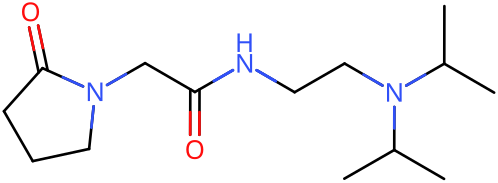
Pramiracetam Stats & Data
CC(C)N(CCNC(=O)CN1CCCC1=O)C(C)CZULJGOSFKWFVRX-UHFFFAOYSA-NPharmacology
DrugBankDescription
Pramiracetam has been previously approved in some eastern European countries under the brand names Pramistar, Neupramir, and Remen. It was also previously approved in the United States with orphan drug designation . Pramiracetam has been studied for the use in Alzheimer's disease and as an adjunct treatment to restore cognitive functioning post-electroconvulsive therapy in severe depression .
Receptor Profile
Receptor Actions
Receptor Binding
Toxicity
PsychonautWikiThe toxicity and long-term health effects of pramiracetam use do not seem to have been studied in any scientific context and the exact toxic dosage is unknown. This is because pramiracetam has very little history of human usage. Anecdotal evidence from people who have tried pramiracetam within the community suggest that there do not seem to be any negative health effects attributed to simply trying this drug at low to moderate doses by itself and using it sparingly (but nothing can be completely guaranteed). There are anecdotal reports of users experiencing painful chemical burns caused by ingesting pramiracetam powder sublingually. Other routes of administration do not seem to cause the same effects.
Addiction & dependence
The chronic use of Pramiracetam can be considered as not addictive with a low potential for abuse. It does not seem to be capable of causing psychological dependence among certain users. Tolerance to many of the effects of Pramiracetam develops with prolonged and repeated use.
Effect Profile
Curated + 1 ReportsModerate stimulation and focus with mild anxiety/jitters, low euphoria
Tolerance & Pharmacokinetics
drugs.wikiTolerance Decay
Experience Report Analysis
ErowidDemographics
Gender Distribution
Too few reports for a chart: gender is known from 4 reports, and a split is drawn only from 20 reports or more. Counts are shown instead. Why 20?
- Male 4 of 4
Age Distribution
Reports Over Time
Real-World Dose Distribution
ErowidFrom 8 of 8 recorded dose entries: those that state a weight (mg, g or µg), in routes with at least five of them. Values above Q3 + 3×IQR, far above what people typically take, are left out; they can include real heavy doses and overdoses, not only mistakes.
Oral (n=8)
References
Data Sources
Cited References
- Chang et al. (1985) - Pharmacokinetics of Oral Pramiracetam in Normal Volunteers
- Malykh & Sadaie (2010) - Piracetam and piracetam-like drugs: from basic science to novel clinical applications to CNS disorders
- Nootropics Expert: Pramiracetam
- Chang et al. (1985) - Pharmacokinetics of Oral Pramiracetam in Normal Volunteers