
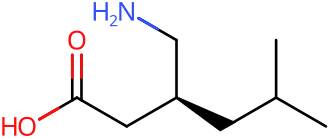
Pregabalin Stats & Data
NCC(CC(C)C)CC(=O)[O-].[H+]AYXYPKUFHZROOJ-UHFFFAOYSA-NPharmacology
DrugBankDescription
Pregabalin is structurally similar to gamma-aminobutyric acid (GABA) - an inhibitory neurotransmitter. It may be used to manage neuropathic pain, postherpetic neuralgia, and fibromyalgia among other conditions. Although as per the FDA Label the mechanism of action has not been definitively defined, there is evidence that pregabalin exerts its effects by binding to the α2δ subunit of voltage-dependent calcium channels. Pregabalin is marketed by Pfizer under the trade name Lyrica and Lyrica Cr (extended release). It may have dependence liability if misused but the risk appears to be highest in patients with current or past substance use disorders.
Mechanism of Action
Although the mechanism of action has not been fully elucidated, studies involving structurally related drugs suggest that presynaptic binding of pregabalin to voltage-gated calcium channels is key to the antiseizure and antinociceptive effects observed in animal models. By binding presynaptically to the alpha2-delta subunit of voltage-gated calcium channels in the central nervous system, pregabalin modulates the release of several excitatory neurotransmitters including glutamate, substance-P, norepinephrine, and calcitonin gene related peptide. In addition, pregabalin prevents the alpha2-delta subunit from being trafficked from the dorsal root ganglia to the spinal dorsal horn, which may also contribute to the mechanism of action. Although pregabalin is a structural derivative of the inhibitory neurotransmitter gamma-aminobutyric acid (GABA), it does not bind directly to GABA or benzodiazepine receptors.
Pharmacodynamics
Although the structure of pregabalin is similar to gamma-aminobutyric acid (GABA), it does not bind to GABA receptors. Instead, it binds the alpha2-delta subunit of presynaptic voltage-gated calcium channels in the central nervous system. Pregabalin does not modulate dopamine receptors, serotonin receptors, opiate receptors, sodium channels or cyclooxygenase activity.
Metabolism
Less than 2% of pregabalin is metabolized and it is excreted virtually unchanged in the urine.
Absorption
After oral dosing administered in the fasted state, pregabalin absorption is rapid, and extensive. A31165 Pregabalin oral bioavailability is reported to be ≥90% regardless of the dose. Cmax is attained within 1.5 hours after single or multiple doses, and steady state is attained within 24-48 hours with repeated administration. Both Cmax and AUC appear to be dose proportional. Food decreases the rate of pregabalin absorption and as a result, lowers the Cmax by an estimated 25-30% and increases the Tmax to approximately 3 hours. However, the effect of food does not appear to impact the total absorption of pregabalin in a way that is clinically relevant. As a result, pregabalin can be administered with or without food.
Indication
Pregabalin is indicated for the management of neuropathic pain associated with diabetic peripheral neuropathy, postherpetic neuralgia, fibromyalgia, neuropathic pain associated with spinal cord injury, and as adjunctive therapy for the treatment of partial-onset seizures in patients 1 month of age and older.
Half-life
The elimination half life of pregabalin is 6.3 hours.
Protein Binding
Pregabalin is not plasma protein bound.
Elimination
Pregabalin is almost exclusively eliminated in the urine. Further, based on preclinical studies, pregabalin does not appear to undergo racemization to the R enantiomer in the body.
Volume of Distribution
After oral administration of pregabalin, the reported apparent volume of distribution is roughly 0.5 L/kg. Although pregabalin is not very lipophilic, it is able to cross the blood brain barrier(BBB). System L transporters facilitate the transport of large amino acids across the BBB and it has been confirmed that pregabalin is a substrate. This information suggests that system L transporters are responsible for pregabalin uptake into the BBB. In rat models, pregabalin has been shown to cross the placenta.
Clearance
In young healthy subjects the mean renal clearance is estimated to be 67.0 to 80.9 mL mL/min. Given pregabalin's lack of plasma protein binding, this clearance rate suggests that renal tubular reabsorption is involved.
Receptor Profile
Receptor Actions
Receptor Binding
History & Culture
1988–1990
Pregabalin emerged from research conducted at Northwestern University in Evanston, Illinois. In 1988, medicinal chemist Richard Silverman enlisted the help of Dr. Ryszard Andruszkiewicz, a visiting scholar from the Technical University of Gdańsk, to synthesize a series of 3-alkyl-GABA and 3-alkyl-glutamate analogs. The research aimed to investigate these compounds' inhibition of GABA aminotransferase and glutamate decarboxylase. Among the compounds synthesized, the S-isomer of 3-isobutyl-GABA demonstrated exceptional anticonvulsant properties, proving to be one of the most effective compounds that Parke-Davis had ever evaluated. This compound would eventually become known as pregabalin. In 1990, a license agreement was signed between Warner-Lambert (Parke-Davis's parent company) and Northwestern University, and a patent application was filed.
2000–2007
Following Pfizer's acquisition of Warner-Lambert in 2000, the pharmaceutical company gained exclusive rights to continue developing pregabalin. Under the trade name Lyrica, pregabalin entered the European market in September 2004. The United States Food and Drug Administration granted approval in December 2004, with the drug reaching the US market in September 2005. At the time of its introduction, pregabalin became the first medication approved for treating both diabetic peripheral neuropathy and postherpetic neuralgia. Subsequent regulatory approvals expanded the drug's therapeutic applications. European regulators approved pregabalin for generalized anxiety disorder in 2006, while the FDA approved it for fibromyalgia treatment in 2007, making it the first drug granted FDA approval specifically for this condition.
2005–present
Pregabalin achieved remarkable commercial success following its market introduction. During its first full year of sales, the drug attained "blockbuster" status with $1.2 billion in global revenue. Northwestern University initially received a 6% royalty on net sales, with portions shared between Silverman and Andruszkiewicz. Through investment and continued revenue, the university's earnings from pregabalin grew to approximately $1.4 billion, making it a substantial contributor to Northwestern's endowment.
2017–present
As pregabalin use expanded globally, concerns about its safety profile emerged. Data from England and Wales documented a steep upward trajectory in death certificates mentioning pregabalin through 2017, despite the drug having been on the market for only a relatively short period. These safety concerns contributed to increased regulatory scrutiny in multiple countries during the late 2010s, with several nations implementing stricter prescribing controls and controlled substance classifications.
Subjective Effects
Physical
The physical effects of pregabalin can be broken down into several components which progressively intensify proportional to dosage.
- Sedation: Pregabalin produces mild sedation and improves sleep onset latency modestly, while sleep quality is also improved. However, it is not an overly sedating drug when taken in the daytime.
- Pain relief: Pregabalin is effective against certain types of chronic pain, but not against acute pain.
- Muscle spasms: Somewhat paradoxically, since pregabalin is used as an adjunct treatment for epilepsy, pregabalin, especially in higher doses, can produce muscle spasms. Anecdotally, seizures have been reported in overdose.
- Respiratory depression
- Dizziness
- Motor control loss
- Seizure suppression
Cognitive
Pregabalin's headspace is comparable to a more clear-headed alcohol or benzodiazepine intoxication, although it can take a more dissociative turn at very high dosages.
- Amnesia: Compared to benzodiazepines, pregabalin is only mildly amnesiac if not combined with other depressants. With chronic usage or high dosages, one should expect more "tip of the tongue" moments and impaired short-term memory (e.g., walking into a room and forgetting what you were supposed to do there). Total blackouts do not seem to occur except in combination with other drugs.
- Motivation enhancement: Like kratom, pregabalin can be mildly sedative yet increase motivation in a stimulant-like fashion.
- Anxiety suppression
- Thought deceleration
- Disinhibition
- Information processing suppression
- Empathy, love and sociability enhancement
- Euphoria
Sensory
- Internal hallucinations: At high dosages, one may experience dream-like states and hypnagogia or "nodding."
Forked from Subjective Effect Documentation by Josie Kins, September 2015. Via dose.wiki (CC0).
Pregabalin likely has a low toxicity relative to dose. However, it is potentially lethal when mixed with depressants like alcohol or opioids.
Liver injury risk
Low concern (rare serious cases reported)
Toxicity (DrugBank)
In a systematic review that included 38 randomized controlled trials, there were 20 identified adverse effects that were significantly associated with pregabalin, most of which involve the central nervous system and cognition. The identified adverse effects include vertigo, dizziness, balance disorder, incoordination, ataxia, blurred vision, diplopia, amblyopia, somnolence, confusional state, tremor, disturbance in attention, abnormal thinking, asthenia, fatigue, euphoria, edema, peripheral edema, dry mouth, and constipation . The most common symptoms of pregabalin toxicity (dose range includes 800 mg/day and single doses up to 11,500 mg) include somnolence, confusion, restlessness, agitation, depression, affective disorder and seizures. Since there is no antidote for pregabalin overdose, patients should receive general supportive care. If appropriate, gastric lavage or emesis may help eliminate unabsorbed pregabalin (healthcare providers should take standard precautions to maintain the airway). Pregabalin pharmacokinetic properties suggest that extra-corporeal elimination methods including haemodialysis, may be useful in situations of severe toxicity. However, there are cases where patients have presented with very high serum levels of pregabalin and have been successfully managed with supportive care alone.
Tolerance & Pharmacokinetics
drugs.wikiNo tolerance chart. Our decay curves for these drugs were estimates, and a curve can make tolerance look longer-lasting than it is, which is the dangerous direction.
How fast tolerance to these drugs fades after a break has not been measured well enough to draw, so don't count on a dose you used to take still being safe: after time off, start with a much smaller amount and don't use alone. Mixing sedatives with each other, with alcohol or with opioids sharply raises the risk of a fatal overdose. If you've been using regularly, don't stop suddenly: withdrawal from benzodiazepines, alcohol or GHB/GBL can cause seizures or delirium, so get medical help to cut down gradually.
Sources: FRANK: benzodiazepines · Alcohol and Drug Foundation: GHB · FDA 2020: benzodiazepine boxed warning · FDA 2019: gabapentinoids and breathing · NHS: alcohol use disorder
Cross-Tolerances
Demographics
Gender Distribution
Age Distribution
Reports Over Time
Effect Analysis
Erowid + BluelightEffects aggregated from 117 experience reports (87 single-substance Erowid + 30 Bluelight)
Effect Sentiment Distribution
Confidence Distribution
Each bar is the share of reports mentioning the effect; its whisker, and the band on the rows below, is the 95% interval: where the share could plausibly be with other reports of the same kind.
Positive Effects 45
Adverse Effects 31
Show 11 more adverse effects
Show 20 neutral or unclassified mentions
Also reported in combinations. In the 49 Pregabalin reports where another drug was taken too, 4 (8.2%) mention hospital, emergency services or an overdose, 4 (8.2%) a seizure and 0 (0.0%) psychosis. In the 87 single-substance reports: 8.0%, 9.2% and 1.1%. These are not in the figures above: they cannot be put down to Pregabalin alone, and a mention is not always something that happened to the writer.
Dose-Response Correlation
How effect frequency changes across dose levels. Whiskers, and the numbers' hover text, give each figure's 95% interval.
Not drawn, too few reports (a dose tier needs 20): Oral Common (n=10), Oral Strong (n=13). Why 20?
Dosage Distribution
Dose distribution from experience reports, one dose per report (the first listed). Doses above Q3 + 3×IQR, far above what people typically take, are left out of the median and range and listed under each route: most are real heavy doses or overdoses, not mistakes.
Real-World Dose Distribution
ErowidFrom 158 of 168 recorded dose entries: those that state a weight (mg, g or µg), in routes with at least five of them. Values above Q3 + 3×IQR, far above what people typically take, are left out; they can include real heavy doses and overdoses, not only mistakes.
Oral (n=145)
Insufflated (n=8)
Common Combinations
Most co-occurring substances, as a share of all 136 reports filed under Pregabalin; whiskers are 95% intervals
Form / Preparation
Most common forms and preparations, as a share of the 68 reports that give one; whiskers are 95% intervals
Body-Weight Dosing
Dose per kg of body weight, one dose per report (the first listed), from reports giving a weight of 30–250 kg. Doses above Q3 + 3×IQR, far above what people typically take, are left out of the median and range and listed under each route.
Redose Patterns
Redosing behavior across 90 reports
Legal Status
| Country | Status | Notes |
|---|---|---|
| Australia | Schedule 4 | Listed as a Schedule 4 prescription-only medicine under the Poisons Standard. Legal to possess only with a valid prescription from a registered medical practitioner. |
| Canada | Prescription-only | Regulated as a prescription-only medication. Available through licensed pharmacies with a valid prescription from a healthcare provider. |
| Finland | Controlled substance | Classified as a controlled substance as of June 1, 2023, due to concerns about misuse and dependence potential. |
| Germany | Prescription-only (Anlage 1 AMVV) | Regulated as a prescription medicine according to Anlage 1 of the Arzneimittelverschreibungsverordnung (AMVV). Not scheduled as a controlled narcotic but requires medical prescription for legal possession and dispensing. |
| Norway | Prescription Schedule B | Listed in prescription schedule B alongside benzodiazepines and opioid painkillers. Rescheduled from the less restrictive schedule C due to documented recreational use, tolerance development, and addiction concerns. |
| Sweden | Schedule V (Controlled substance) | Classified as a controlled substance under Schedule V since July 24, 2018. Requires prescription for legal possession and is subject to stricter monitoring than standard prescription medications. |
| Switzerland | Abgabekategorie B | Listed as an 'Abgabekategorie B' pharmaceutical under Swiss regulations, meaning dispensing requires a valid medical prescription. |
| Turkey | Green prescription substance | Regulated under the 'green prescription' system, which applies to medications with abuse potential. Illegal to sell or possess without a valid prescription. |
| United Kingdom | Class C | Controlled under the Misuse of Drugs Act 1971 as a Class C drug, effective April 1, 2019. Also listed as Schedule 2 under the Misuse of Drugs Regulations. Possession without a valid prescription is a criminal offense. |
| United States | Schedule V | Classified under Schedule V of the Controlled Substances Act, indicating low potential for abuse relative to Schedule IV substances such as benzodiazepines. Illegal to sell without a DEA license and illegal to possess without a valid prescription. |
Harm Reduction
drugs.wiki— Receptor/PK: Pregabalin binds α2δ‑1/α2δ‑2 subunits of voltage‑gated Ca2+ channels; it is not a GABA-A/B agonist. Oral bioavailability is high (≥90%), shows linear PK, Tmax ≈ 1.5 h fasting, and the drug is excreted renally largely unchanged; dose reduction is required in CKD. Evidence: pharmacology reviews and drug databases.
— Respiratory risk with depressants: On its own, severe respiratory depression is uncommon, but gabapentinoids plus opioids/other depressants are repeatedly over‑represented in ED overdose cohorts; intubation/antidotes were frequently needed in polysubstance cases. Treat the combo as high risk.
— Rapid tolerance/redose trap: Many users report that same‑day redoses add little desired effect but increase dyscoordination and blackout‑type sedation; spacing uses by ≥1–2 weeks is commonly reported to restore effects. This pattern is harm‑reduction relevant to limit escalation.
— Withdrawal & dependence: Abrupt cessation after days–weeks of frequent/high‑dose use can produce anxiety/insomnia, autonomic signs, dysphoria, and in severe cases confusion or psychotic features; tapering is strongly preferred. Case series and large user communities document multi‑week courses when heavily dependent.
— Seizure caution with tramadol: Community and trip-report data include convulsions when pregabalin was combined with tramadol; avoid the combo and other seizure‑threshold‑lowering agents, especially during withdrawal.
— Driving/coordination: Dizziness, ataxia, diplopia, and delayed reaction times are common at recreational doses; do not drive or operate machinery during the day of use and while residual sedation persists.
— Route of administration: Oral is efficient; intranasal/rectal routes are anecdotal and offer no proven advantage, with additional local risks. Avoid IV due to insoluble fillers and embolic risk.
— Mixing with opioids: If someone uses both despite warnings, reduce usual opioid dose substantially, avoid concurrent benzodiazepines/alcohol, have an awake sober observer, and place the person in recovery position if heavily sedated; naloxone should be available for opioid users. This reflects the observed overdose patterns in polysubstance cases.
— Renal harm‑reduction: Because elimination is renal and unchanged, people with eGFR reduction accumulate drug; they should use lower/fewer doses and longer spacing. Seek medical dosing advice if any kidney disease is present.
References
Data Sources
Cited References
- Bockbrader et al. 2010 - Clinical pharmacokinetics of pregabalin
- Bobes et al. 2012 - Pregabalin for discontinuation of long-term benzodiazepine use
- Case series - Pregabalin dependence and withdrawal
- Eroglu et al. 2009 - Gabapentin receptor and excitatory synaptogenesis
- Erowid: Pregabalin experience reports
- FDA warning - Gabapentinoid breathing problems
- Field et al. 2006 - Alpha-2-delta subunit as molecular target for pregabalin
- Guglielmo et al. 2012 - Pregabalin for alcohol dependence critical review
- High-dose pregabalin abuse case report
- Hindmarch et al. 2005 - Effects on sleep quality compared to alprazolam
- MHRA Drug Safety Update - Severe respiratory depression
- Misuse and abuse qualitative study in Jordan
- Pregabalin poisoning and recreational use review
- Systematic review of pregabalin abuse potential
- TalkToFrank - Recreational effects and harm
- Wood et al. 2010 - Significant pregabalin toxicity with supportive care
- Pregabalin – pharmacology & half-life
- Bluelight: Lyrica (Pregabalin) megathread
- Pregabalin onset and dosing anecdotes (Erowid experience 'A Mellow Tranquility')
Additional references
- Overdose cohorts show frequent polysubstance (incl. pregabalin) with sedation/intubation need
- Bluelight ‘Biology, Pharmacology & Drugs 101’ (α2δ binding, PK overview; HR emphasis on depressant combos)
- Drugs‑Forum wiki: pregabalin overview, solubility, effects, adverse effects, combinations
- Erowid Experience Vaults – Pregabalin combinations (incl. tramadol seizure report)
- Bluelight Lyrica/pregabalin discussion thread (withdrawal/tolerance anecdotes, mixing cautions)
- DrugBank DB00230 (PK, renal excretion, labeling warnings)
- PubChem CID 5486971 (chemical identity)
- Gabapentinoids + opioids: clinical discussion with cohort link (respiratory depression risk)
- User taper methods (water titration) and severe withdrawal reports