
Promethazine Stats & Data
PWWVAXIEGOYWEE-UHFFFAOYSA-NPharmacology
DrugBankDescription
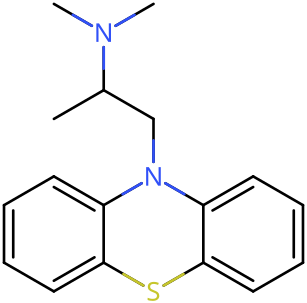
Promethazine, originally known as 3,277 R.P., is an N-dimethylaminopropyl derivative of phenothiazine that was developed in France in 1946. Promethazine antagonizes a variety of receptors, allowing it to be used for a number of indications including allergic reactions, pain, sedation, nausea, and vomiting. Promethazine was granted FDA approval before 29 March 1951.
Mechanism of Action
Promethazine is a an antagonist of histamine H1, post-synaptic mesolimbic dopamine, alpha adrenergic, muscarinic, and NMDA receptors. The antihistamine action is used to treat allergic reactions. Antagonism of muscarinic and NMDA receptors contribute to its use as a sleep aid, as well as for anxiety and tension. Antagonism of histamine H1, muscarinic, and dopamine receptors in the medullary vomiting center make promethazine useful in the treatment of nausea and vomiting.
Pharmacodynamics
Promethazine is is a histamine H1 antagonist that can be used for it's ability to induce sedation, reduce pain, and treat allergic reactions. Promethazine's effects generally last 4-6h but can last up to 12h. Patients should be counselled regarding CNS and respiratory depression, reduce seizure threshold, and bone marrow depression.
Metabolism
Promethazine is predominantly metabolized to promethazine sulfoxide, and minorly to desmethylpromethazine and a hydroxy metabolite. Hydroxylation of promethazine is predominantly mediated by CYP2D6.
Absorption
A 25mg dose of intramuscular promethazine reaches a Cmax of 22ng/mL. Intravenous promethazine reaches a Cmax of 10.0ng/mL, with a Tmax of 4-10h, and an AUC of 14,466ng\*h/mL. Oral promethazine is only 25% bioavailable due to first pass metabolism. Oral promethazine reaches a Cmax of 2.4-18.0ng/mL, with a Tmax of 1.5-3h, and an AUC of 11,511ng\*h/mL.
Indication
Promethazine tablets and suppositories are indicated to treat rhinitis, allergic conjunctivitis, allergic reactions to blood or plasma, dermographism, anaphylactic reactions, sedation, nausea, vomiting, pain, motion sickness, and allergic skin reactions. Promethazine cough syrup with phenylephrine and codeine is indicated to relieve cough and upper respiratory symptoms, and nasal congestion associated with allergy or the common cold.
Half-life
The elimination half life of promethazine is approximately 12-15h.
Protein Binding
Promethazine is 93% protein bound in serum, mostly to albumin.
Elimination
An intravenous dose of promethazine is 0.64% eliminated in the urine as the unchanged parent drug, 0.02-2.02% in the urine as desmethylpromethazine, 10% in the urine as promethazine sulfoxide.
Volume of Distribution
The volume of distribution of promethazine is approximately 970L or 30L/kg.
Clearance
The intravenous clearance of promethazine is approximately 1.14L/min. The renal clearance of promethazine is 5.9mL/min and the renal clearance of promethazine sulfoxide is 90.4mL/min.
Measured Affinities
Guide to PHARMACOLOGYMeasured binding and functional data for promethazine, curated by the IUPHAR/BPS Guide to PHARMACOLOGY. Each row cites the paper it came from. Lower concentrations mean tighter binding — a value in the sub-nanomolar range indicates a very potent interaction.
| Target | Action | Measure | Value | Concentration | Species | Source |
|---|---|---|---|---|---|---|
| H1 receptor HRH1 | Antagonist | pKi | 9.62 | 0.24 nM | Human | PMID 16782354 |
Reading this. pKi, pEC50 and pIC50 are negative log molar values, so a higher number means a tighter interaction; the concentration column converts them for you. Values from non-human species are laboratory measurements and do not translate directly to human effect. Receptor affinity is not a dose — it describes what a molecule binds, not how much of it is safe to take.
Receptor data from the IUPHAR/BPS Guide to PHARMACOLOGY (v2026.2), licensed CC BY-SA 4.0. Matched to this substance by InChIKey.
It is strongly recommended that one use harm reduction practices when using this substance.
Carcinogenicity
No indication of carcinogenicity to humans (not listed by IARC).
Toxicity (DrugBank)
The intraperitoneal LD50 in rats is 170mg/kg and in mice is 160mg/kg. The subcutaneous LD50 in rats is 400mg/kg and in mice is 240mg/kg. The oral LD50 in mice is 255mg/kg. Patients experiencing an overdose of promethazine may present with mild central nervous system and cardiovascular depression, hypotension, respiratory depression, unconciousness, hyperreflexia, hypertonia, ataxia, athetosis, extensor-plantar reflexes, convulsions, dry mouth, flushing, gastrointestinal symptoms, and fixed, dilated pupils. Treat overdoses with symptomatic and supportive treatment, which may include activated charcoal, sodium sulfate, magnesium sulfate, controlled ventilation, diazepam, intravenous fluids, vasopressors, norepinephrine, phenylephrine, anticholinergic antiparkinsonian agents, diphenhydramine, barbiturates, or oxygen.
Tolerance & Pharmacokinetics
drugs.wikiTolerance Decay
Experience Report Analysis
ErowidDemographics
Gender Distribution
Age Distribution
Reports Over Time
Effect Analysis
ErowidEffects aggregated from 12 experience reports (12 single-substance Erowid)
Effect Sentiment Distribution
Confidence Distribution
Each bar is the share of reports mentioning the effect; its whisker, and the band on the rows below, is the 95% interval: where the share could plausibly be with other reports of the same kind.
Too few reports for bars: these effects come from 12 single-substance Erowid reports, and a bar is drawn only from 20 reports or more. With fewer, a percentage cannot tell a common effect from a rare one. Counts are shown instead. Why 20?
Positive Effects 2
Adverse Effects 0
Also reported in combinations. In the 23 Promethazine reports where another drug was taken too, 3 (13.0%) mention hospital, emergency services or an overdose, 1 (4.3%) a seizure and 0 (0.0%) psychosis. In the 12 single-substance reports: 2, 1 and 0. These are not in the figures above: they cannot be put down to Promethazine alone, and a mention is not always something that happened to the writer.
Dosage Distribution
Dose distribution from experience reports, one dose per report (the first listed). Doses above Q3 + 3×IQR, far above what people typically take, are left out of the median and range and listed under each route: most are real heavy doses or overdoses, not mistakes.
Real-World Dose Distribution
ErowidFrom 45 of 56 recorded dose entries: those that state a weight (mg, g or µg), in routes with at least five of them. Values above Q3 + 3×IQR, far above what people typically take, are left out; they can include real heavy doses and overdoses, not only mistakes.
Oral (n=44)
Common Combinations
Most co-occurring substances, as a share of all 35 reports filed under Promethazine; whiskers are 95% intervals
Form / Preparation
Most common forms and preparations, as a share of the 21 reports that give one; whiskers are 95% intervals
Body-Weight Dosing
Dose per kg of body weight, one dose per report (the first listed), from reports giving a weight of 30–250 kg. Doses above Q3 + 3×IQR, far above what people typically take, are left out of the median and range and listed under each route.
Redose Patterns
Redosing behavior across 22 reports