
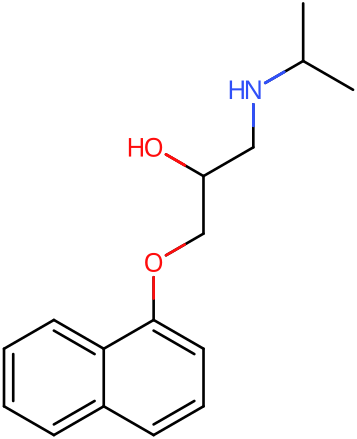
Propranolol Stats & Data
AQHHHDLHHXJYJD-UHFFFAOYSA-NPharmacology
DrugBankDescription
Propranolol is a racemic mixture of 2 enantiomers where the S(-)-enantiomer has approximately 100 times the binding affinity for beta adrenergic receptors. Propranolol is used to treat a number of conditions but most commonly is used for hypertension. Propranolol was granted FDA approval on 13 November 1967.
Mechanism of Action
Propranolol is a nonselective β-adrenergic receptor antagonist. Blocking of these receptors leads to vasoconstriction, inhibition of angiogenic factors like vascular endothelial growth factor (VEGF) and basic growth factor of fibroblasts (bFGF), induction of apoptosis of endothelial cells, as well as down regulation of the renin-angiotensin-aldosterone system.
Pharmacodynamics
Propranolol is a beta-adrenergic receptor antagonist used to treat hypertension. Propranolol has a long duration of action as it is given once or twice daily depending on the indication. When patients abruptly stop taking propranolol, they may experience exacerbations of angina and myocardial infarctions.
Metabolism
Propranolol undergoes side chain oxidation to α-naphthoxylactic acid, ring oxidation to 4’-hydroxypropranolol, or glucuronidation to propranolol glucuronide. It can also be N-desisopropylated to become N-desisopropyl propranolol. 17% of a dose undergoes glucuronidation and 42% undergoes ring oxidation.
Absorption
Patients taking doses of 40mg, 80mg, 160mg, and 320mg daily experienced Cmax values of 18±15ng/mL, 52±51ng/mL, 121±98ng/mL, and 245±110ng/mL respectively. Propranolol has a Tmax of approximately 2 hours, though this can range from 1 to 4 hours in fasting patients. Taking propranolol with food does not increase Tmax but does increase bioavailability.
Indication
Propranolol is indicated to treat hypertension. Propranolol is also indicated to treat angina pectoris due to coronary atherosclerosis, atrial fibrillation, myocardial infarction, migraine, essential tremor, hypertrophic subaortic stenosis, pheochromocytoma, and proliferating infantile hemangioma.
Half-life
The elimination half life of propranolol is approximately 8 hours. The plasma half life of propranolol is 3 to 6 hours.
Protein Binding
Approximately 90% of propranolol is protein bound in plasma. Other studies have reported ranges of 85-96%.
Elimination
91% of an oral dose of propranolol is recovered as 12 metabolites in the urine.
Volume of Distribution
The volume of distribution of propranolol is approximately 4L/kg or 320L.
Clearance
The clearance of propranolol is 2.7±0.03L/h/kg in infants <90 days and 3.3±0.35L/h/kg in infants >90 days. Propranolol clearance increases linearly with hepatic blood flow. Propanolol has a clearance in hypertensive adults of 810mL/min.
Receptor Profile
Receptor Actions
Receptor Binding
Measured Affinities
Guide to PHARMACOLOGYMeasured binding and functional data for propranolol, curated by the IUPHAR/BPS Guide to PHARMACOLOGY. Each row cites the paper it came from. Lower concentrations mean tighter binding — a value in the sub-nanomolar range indicates a very potent interaction.
| Target | Action | Measure | Value | Concentration | Species | Source |
|---|---|---|---|---|---|---|
| β3-adrenoceptor Adrb3 | Antagonist | pKi | 6.4 | 398.11 nM | Rat | PMID 14744619 |
| β2-adrenoceptor ADRB2 | Antagonist | pKi | — | — | Human | — |
| β3-adrenoceptor ADRB3 | Antagonist | pKi | — | — | Human | — |
| β3-adrenoceptor Adrb3 | Antagonist | pKi | — | — | Mouse | PMID 14744619 |
Reading this. pKi, pEC50 and pIC50 are negative log molar values, so a higher number means a tighter interaction; the concentration column converts them for you. Values from non-human species are laboratory measurements and do not translate directly to human effect. Receptor affinity is not a dose — it describes what a molecule binds, not how much of it is safe to take.
Receptor data from the IUPHAR/BPS Guide to PHARMACOLOGY (v2026.2), licensed CC BY-SA 4.0. Matched to this substance by InChIKey.
History & Culture
1962–1967
Propranolol was developed by Scottish scientist James W. Black during the 1960s, representing a landmark achievement as the first beta-blocker to be effectively used in the treatment of coronary artery disease and hypertension. The compound was patented in 1962 and received approval for medical use in 1964, with the United States Food and Drug Administration granting formal approval on November 13, 1967. The drug was first brought to market in 1965 under the brand name Inderal by ICI Pharmaceuticals, now known as AstraZeneca. The trade name was created as a quasi-anagram of "Alderlin," the brand name of pronethalol, an earlier beta-blocker that propranolol replaced. Both names serve as a tribute to Alderley Park, the ICI research headquarters where the compounds were originally developed. Propranolol has since been recognized as a foundational cardiovascular medication, earning a place on the World Health Organization's List of Essential Medicines and becoming widely available as a generic formulation.
Beyond its medical applications, propranolol has gained recognition for its use in managing performance-related anxiety. A 1987 survey conducted by the International Conference of Symphony and Opera Musicians found that 27% of interviewed members reported using beta blockers such as propranolol for musical performances. The drug's ability to suppress sympathetic nervous system–mediated anxiety symptoms has made it popular among musicians, actors, and public speakers. Propranolol has also been employed as a performance-enhancing substance in precision sports requiring high accuracy, including archery, shooting, golf, and snooker. This use attracted significant attention during the 2008 Summer Olympics when North Korean shooter Kim Jong-su, who had won silver in the 50-metre pistol event and bronze in the 10-metre air pistol competition, tested positive for propranolol and was subsequently stripped of both medals.
Ingestion of greater than 1 g of propranolol in 24 hours can potentially be lethal and lead to profound bradycardia, bradyarrhythmia, hypotension, bronchospasm. When suspecting a beta-blocker overdose, a patient should always receive glucagon immediately. Glucagon has shown to be very effective in reversing beta-blocker overdose, increasing heart rate, and myocardial contractility.
Liver injury risk
Low concern (rare serious cases reported)
Toxicity (DrugBank)
Symptoms of overdose include hypotension, hypoglycemic seizure, restlessness, euphoria, insomnia. Patients with asthma may develop bronchospasm. In case of overdose, monitor vital signs, mental status, and blood glucose. Treat hypotension with intravenous fluids, bradycardia with atropine, and isoproterenol and aminophylline for bronchospasm. If patients do not respond to intravenous fluids, follow up with glucagon 50-150µg/kg intravenously, then 1-5mg/hour, followed by catecholamines. Dialysis will not be useful as propranolol is highly protein bound.
Tolerance & Pharmacokinetics
drugs.wikiTolerance Decay
Clinically meaningful tolerance is not typical; some cardiovascular responses (e.g., heart rate reduction) may attenuate modestly with chronic therapy over weeks.
Experience Report Analysis
ErowidDemographics
Gender Distribution
Too few reports for a chart: gender is known from 16 reports, and a split is drawn only from 20 reports or more. Counts are shown instead. Why 20?
- Male 13 of 16
- Not Specified 1 of 16
- Female 2 of 16
Age Distribution
Reports Over Time
Effect Analysis
ErowidEffects aggregated from 8 experience reports (8 single-substance Erowid)
Effect Sentiment Distribution
Confidence Distribution
Each bar is the share of reports mentioning the effect; its whisker, and the band on the rows below, is the 95% interval: where the share could plausibly be with other reports of the same kind.
Too few reports for bars: these effects come from 8 single-substance Erowid reports, and a bar is drawn only from 20 reports or more. With fewer, a percentage cannot tell a common effect from a rare one. Counts are shown instead. Why 20?
Positive Effects 0
Adverse Effects 2
Also reported in combinations. In the 8 Propranolol reports where another drug was taken too, 1 mentions hospital, emergency services or an overdose, 0 a seizure and 1 psychosis (too few reports for percentages). In the 8 single-substance reports: 1, 0 and 0. These are not in the figures above: they cannot be put down to Propranolol alone, and a mention is not always something that happened to the writer.
Real-World Dose Distribution
ErowidFrom 30 of 32 recorded dose entries: those that state a weight (mg, g or µg), in routes with at least five of them. Values above Q3 + 3×IQR, far above what people typically take, are left out; they can include real heavy doses and overdoses, not only mistakes.
Oral (n=28)
Form / Preparation
Most common forms and preparations, as a share of the 7 reports that give one
Too few reports for bars: these forms come from 7 reports, and a bar is drawn only from 20 reports or more. With fewer, a percentage cannot tell a common effect from a rare one. Counts are shown instead. Why 20?
- Pill / Tablet 6 of 7
Redose Patterns
Redosing behavior across 11 reports
Too few reports for a chart: redosing is known from 11 reports, and a split is drawn only from 20 reports or more. Counts are shown instead. Why 20?
- Single dose 11 of 11
- Redosed 0 of 11
Legal Status
| Country | Status | Notes |
|---|---|---|
| Canada | Prescription medication | Legally marketed as a prescription medication. Multiple brand name and generic formulations have been available since the early 1980s, including products under the Detensol and Apo-propranolol labels. |
| Germany | Prescription medication | Legally marketed as a prescription medication. Available in both single-ingredient and combination formulations, such as DOCITEREN (propranolol combined with hydrochlorothiazide and triamterene), which has been marketed since 2006. |
| United States | Prescription medication (FDA approved) | FDA approval was granted on November 13, 1967. Available as both brand name products (such as Hemangeol oral solution) and numerous generic formulations. Not classified as a controlled substance. |
Harm Reduction
drugs.wikiPropranolol is a non-selective beta-1/beta-2 blocker used for cardiovascular indications, migraine prophylaxis, essential tremor, thyrotoxicosis, infantile hemangioma, and off-label for performance anxiety. It is contraindicated in asthma/COPD and in patients with baseline bradycardia or higher-degree heart block due to risk of bronchospasm and conduction block. It can exacerbate peripheral vasospasm and is generally avoided in vasospastic (Prinzmetal) angina. In diabetes, propranolol may blunt adrenergic warning signs of hypoglycemia (e.g., tremor, palpitations), so glucose monitoring and education are essential. During acute cocaine toxicity, non-selective beta-blockers are generally avoided because of potential unopposed alpha-adrenergic vasoconstriction; tachycardia and hypertension should be managed with alternatives per emergency protocols. In known or suspected pheochromocytoma, do not start beta-blockade until adequate alpha-blockade is established; otherwise severe hypertension can occur. Combining propranolol with potent AV-nodal–blocking drugs (verapamil, diltiazem; digoxin; amiodarone) substantially increases risks of bradycardia, heart block, and hypotension; if used, it requires close monitoring and is often avoided. Propranolol can reduce responsiveness to epinephrine in anaphylaxis; this does not contraindicate epinephrine, but emergency teams may give glucagon as an adjunct if refractory. Abrupt discontinuation after chronic use can precipitate rebound tachycardia, angina, or myocardial infarction; taper gradually with prescriber guidance. Overdose can cause profound bradycardia, hypotension, hypoglycemia, seizures, and wide QRS from sodium-channel blockade; emergency care may involve glucagon, high-dose insulin-euglycemia therapy, vasopressors, sodium bicarbonate for QRS widening, and lipid emulsion in refractory cases. IV propranolol should only be used with continuous ECG and blood-pressure monitoring; non-medical IV use is hazardous. Lipophilicity means CNS effects (fatigue, sleep disturbance, vivid dreams/nightmares) are more likely than with hydrophilic beta-blockers; mood changes and depressive symptoms are reported but causality is mixed. Hepatic impairment and CYP2D6 inhibitors can raise levels; start low and titrate cautiously. During breastfeeding, transfer into milk is low and adverse infant effects are unlikely; this is considered compatible with lactation. Food increases oral bioavailability; dose timing consistency helps avoid variability in effect.
References
Cited References
- Archer et al. 2025: Beta-blockers for anxiety disorders
- FDA Label: Propranolol hydrochloride
- Kalam et al. 2020: Clinical Pharmacokinetics of Propranolol
- Kornischka et al. 2024: Propranolol for PTSD and phobias
- Srinivasan 2019: Propranolol 50-Year Historical Perspective
- Steenen et al. 2016: Propranolol for anxiety disorders meta-analysis
- DrugBank: Propranolol absorption and distribution
- DrugBank: Beta-blocking agents, non-selective
Additional references
- StatPearls: Propranolol
- StatPearls: Beta Blockers (class effects, asthma/Raynaud, hypoglycemia masking)
- StatPearls: Beta-Blocker Toxicity (overdose management)
- StatPearls: Cocaine (unopposed alpha discussion)
- StatPearls: Diltiazem (beta-blocker interaction → bradyarrhythmias; avoid IV combination)
- StatPearls: Atenolol (AAFP guidance on tapering beta-blocker before clonidine discontinuation)
- NCBI PDQ/StatPearls: Pheochromocytoma (alpha before beta to avoid crisis)
- StatPearls: Perioperative Management of Pheochromocytoma
- DrugBank: Propranolol
- DrugBank article: Epinephrine + nonselective beta-blocker can exaggerate alpha effects
- StatPearls: Anaphylaxis (beta-blocker use may blunt epinephrine response; use glucagon adjunct)
- LactMed: Propranolol (breastfeeding)
- StatPearls: Prinzmetal (vasospastic) Angina — avoid non-selective beta-blockers