
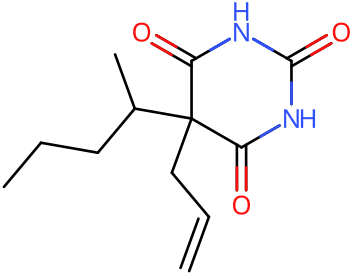
Secobarbital Stats & Data
KQPKPCNLIDLUMF-UHFFFAOYSA-NPharmacology
DrugBankDescription
Secobarbital (marketed by Eli Lilly and Company under the brand names Seconal and Tuinal) is a barbiturate derivative drug with anaesthetic, anticonvulsant, sedative and hypnotic properties. It is commonly known as quinalbarbitone in the United Kingdom.
Mechanism of Action
Secobarbital binds at a distinct binding site associated with a Cl- ionopore at the GABAA receptor, increasing the duration of time for which the Cl- ionopore is open. The post-synaptic inhibitory effect of GABA in the thalamus is, therefore, prolonged.
Pharmacodynamics
Secobarbital, a barbiturate, is used for the induction of anesthesia prior to the use of other general anesthetic agents and for induction of anesthesia for short surgical, diagnostic, or therapeutic procedures associated with minimal painful stimuli. Little analgesia is conferred by barbiturates; their use in the presence of pain may result in excitation.
Indication
For the Short-term treatment of intractable insomnia for patients habituated to barbiturates
Elimination
Barbiturates are metabolized primarily by the hepatic microsomal enzyme system, and the metabolic products are excreted in the urine and, less commonly, in the feces.
Receptor Profile
Receptor Actions
Receptor Binding
History & Culture
1914–1959
Secobarbital was first developed in Germany in 1914 as part of ongoing barbiturate research. Eli Lilly and Company subsequently patented the compound in the United States in 1934 and later introduced it to the American pharmaceutical market in 1959 under the brand name Seconal. The drug was initially indicated for the treatment of insomnia. Eli Lilly also marketed a combination product called Tuinal, which contained both secobarbital and amobarbital.
1960–1989
Secobarbital became widely abused for recreational purposes throughout the 1960s, 1970s, and 1980s. The drug's distinctive bright orange-red bullet-shaped capsule, marketed by Eli Lilly under the proprietary name Pulvule, gave rise to numerous street nicknames including "reds," "red devils," "red dillies," "seccies," "Cardinals," "ruby slippers," and "red hearts." A less common nickname, "dolls," was partly responsible for the title of Jacqueline Susann's novel Valley of the Dolls, whose main characters use secobarbital and similar drugs. Among barbiturates, secobarbital carries a particularly high risk of abuse and addiction, and accidental overdoses were commonly associated with the drug during this period. Several notable figures allegedly died by suicide or accidental overdose involving secobarbital, including actresses Carole Landis, Judy Garland, and Lupe Vélez, playwright Tennessee Williams, table tennis champion Ruth Aarons, and journalist Dorothy Kilgallen. The drug was also associated with several significant historical events. In 1969, secobarbital was allegedly used to sedate Black Panther leader Fred Hampton before he was killed during a police raid on December 4th. Following the 1978 mass deaths at Jonestown, approximately 1,000 pills of Seconal were recovered at the Peoples Temple settlement along with substantial quantities of other sedatives and analgesics. Prescription use began declining in the early 1980s as benzodiazepines emerged as safer alternatives for sedation and sleep, and secobarbital's high abuse potential became a primary factor in its diminishing medical role.
1998–present
Secobarbital has found contemporary application as an agent in medical-assisted dying and palliative sedation. In the Netherlands, individuals seeking euthanasia may orally consume 100 mL of concentrated syrup containing either 15 grams of pentobarbital or 15 grams of secobarbital. In the United States, secobarbital and pentobarbital became the most commonly prescribed drugs under physician aid-in-dying laws, beginning with Oregon in 1998, followed by Washington in 2008 and Vermont in 2013. Canada authorized secobarbital for physician-assisted dying in 2017.
1998–2022
Ranbaxy Pharmaceuticals obtained the rights to market Seconal from Eli Lilly in 1998 and maintained the brand until September 2008. During Marathon Pharmaceuticals' subsequent ownership of the brand, the company substantially increased the drug's price. By February 2015, when Marathon sold the rights to Valeant Pharmaceuticals, the average retail price per 100 mg capsule had risen from approximately one dollar to over thirty dollars. Bausch Health, the company formerly known as Valeant, ceased manufacturing Seconal in January 2022.
Secobarbital likely has moderate toxicity relative to dose. However, secobarbital is potentially lethal when mixed with depressants like alcohol or opioids. Secobarbital has a higher risk of death or serious adverse effects associated with concurrent depressant use than other drugs such as benzodiazepines. There have been studies linking the use of barbiturates, particularly phenobarbital, with the development of cancer. It is strongly recommended that one use harm reduction practices when using this drug.
Carcinogenicity
No indication of carcinogenicity to humans (not listed by IARC).
Overdose
Barbiturate overdose may occur when a barbiturate is taken in extremely heavy quantities or concurrently with other depressants. This is particularly dangerous with other GABAergic depressants such as benzodiazepines and alcohol since they work in a similar fashion but bind to distinct allosteric sites on the GABAA receptor, thus their effects potentiate one another.
Toxicity (DrugBank)
Symptoms of an overdose typically include sluggishness, incoordination, difficulty in thinking, slowness of speech, faulty judgment, drowsiness or coma, shallow breathing, staggering, and in severe cases coma and death.
Tolerance & Pharmacokinetics
drugs.wikiNo tolerance chart. Our decay curves for these drugs were estimates, and a curve can make tolerance look longer-lasting than it is, which is the dangerous direction.
How fast tolerance to these drugs fades after a break has not been measured well enough to draw, so don't count on a dose you used to take still being safe: after time off, start with a much smaller amount and don't use alone. Mixing sedatives with each other, with alcohol or with opioids sharply raises the risk of a fatal overdose. If you've been using regularly, don't stop suddenly: withdrawal from benzodiazepines, alcohol or GHB/GBL can cause seizures or delirium, so get medical help to cut down gradually. With barbiturates, you get used to the effects much more than to a dangerous dose, so the gap between a dose that works and one that kills shrinks the more you use. Stopping suddenly after regular use can cause convulsions and delirium.
Sources: FRANK: benzodiazepines · Alcohol and Drug Foundation: GHB · FDA 2020: benzodiazepine boxed warning · FDA 2019: gabapentinoids and breathing · NHS: alcohol use disorder · Phenobarbital label: drug abuse and dependence
Experience Report Analysis
ErowidDemographics
Gender Distribution
Too few reports for a chart: gender is known from 2 reports, and a split is drawn only from 20 reports or more. Counts are shown instead. Why 20?
- Male 2 of 2
Reports Over Time
Legal Status
| Country | Status | Notes |
|---|---|---|
| Canada | Schedule IV CDSA | Controlled under the Controlled Drugs and Substances Act. Available by prescription with appropriate controls for Schedule IV substances. |
| Germany | Anlage III BtMG | Listed in Anlage III of the Betäubungsmittelgesetz (Narcotics Act). Requires a special narcotic prescription form (Betäubungsmittelrezept) for medical dispensing. |
| Russia | Schedule III | Classified as a Schedule III controlled substance under Russian drug control legislation. |
| Switzerland | Verzeichnis B | Specifically named controlled substance under Verzeichnis B of Swiss narcotics legislation. Medicinal use is permitted with appropriate authorization. |
| United Kingdom | Class B | Controlled as secobarbitone under the Misuse of Drugs Act 1971. Class B substances carry penalties of up to 5 years imprisonment for possession and up to 14 years for supply. |
| United States | Schedule II | Controlled under the Controlled Substances Act. Schedule II classification indicates high abuse potential with accepted medical use under severe restrictions. Marketed as Seconal Sodium for treatment of intractable insomnia. |