
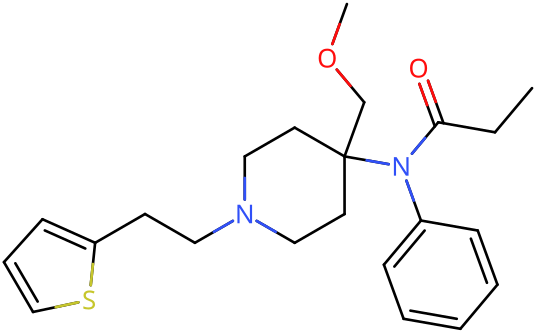
Sufentanil Stats & Data
COCC1(CCN(CCc2cccs2)CC1)N(C(=O)CC)c1ccccc1GGCSSNBKKAUURC-UHFFFAOYSA-NPharmacology
DrugBankDescription
Sufentanil is an opioid analgesic that is used as an adjunct in anesthesia, in balanced anesthesia, and as a primary anesthetic agent. It is administered by the intravenous, epidural and sublingual routes. Also known as _Dsuvia_, the sublingual form is used for the management of acute pain in adults that is severe to warrant the use of an opioid analgesic in certified medically supervised healthcare settings, including hospitals, surgical centers, and emergency departments . Consideration may be made in the future for the use of the sublingual form in the US military in cases where analgesia is required immediately . The sublingual form, manufactured by AcelRx Pharmaceuticals, Inc. (AcelRx), was approved on November 2, 2018 . This route of administration is intended to be a simple, effective, non-invasive analgesic option to enable healthcare professionals to rapidly manage acute pain without difficult intravenous or epidural administration , .
Mechanism of Action
Sufentanil is a synthetic, potent opioid with highly selective binding to μ-opioid receptors . These receptors are widely distributed in the human brain, spinal cord, and other tissues , . In general, opioids decrease cAMP (affecting neural signaling pathways), decrease neurotransmitter release, and cause membrane hyperpolarization, all of which contribute to the relief of painful symptoms . Opiate receptors are coupled with G-protein receptors and function as both positive and negative regulators of synaptic neural transmission via G-proteins that activate effector proteins. Binding of the opiate receptor leads to the exchange of GTP for GDP on the G-protein complex. As the effector system is adenylate cyclase and cAMP, located at the inner surface of the plasma membrane, opioids decrease intracellular cAMP by inhibiting adenylate cyclase. The release of nociceptive neurotransmitters such as substance P, GABA, dopamine, acetylcholine, and noradrenaline is then inhibited . Opioids close N-type voltage-operated calcium channels (OP2-receptor agonist), also preventing neurotransmitter release . Sufentanil and other opioids open calcium-dependent inwardly rectifying potassium channels, resulting in hyperpolarization and reduced neuronal excitability , .
Pharmacodynamics
**Effect on the Central Nervous System (CNS)** In clinical settings, sufentanil exerts its principal pharmacologic effects on the central nervous system. Its primary therapeutic actions are analgesia and sedation. Sufentanil may increase pain tolerance and decrease the perception of pain. This drug depresses the respiratory centers, depresses the cough reflex, and constricts the pupils , . When used in balanced general anesthesia, sufentanil has been reported to be as much as 10 times as potent as fentanyl. When administered intravenously as a primary anesthetic agent with 100% oxygen, sufentanil is approximately 5 to 7 times as potent as fentanyl . High doses of intravenous sufentanil have been shown to cause muscle rigidity, likely as a result of an effect on the substantia nigra and the striate nucleus in the brain. Sleep-inducing (hypnotic) activity can be demonstrated by EEG alterations . **Effects on the Respiratory System** Sufentanil may cause respiratory depression . **Effects on the Cardiovascular System** Sufentanil causes peripheral vasodilation which may result in orthostatic hypotension or syncope. Bradycardia may also occur . Clinical signs or symptoms of histamine release and/or peripheral vasodilation may include pruritus, flushing, red eyes and sweating and/or orthostatic hypotension .
Metabolism
The liver and small intestine are the major sites of biotransformation . Sufentanil is rapidly metabolized to a number of inactive metabolites, with oxidative N- and O-dealkylation being the major routes of elimination .
Absorption
Bioavailability of a single sublingual tablet was 52%, decreasing to 35% with repeat dosing . After epidural administration of incremental doses totaling 5 to 40 mcg sufentanil during labor and delivery, maternal and neonatal sufentanil plasma concentrations were at or near the 0.05 to 0.1 ng/mL limit of detection, and were slightly higher in mothers than in their infants .
Indication
The indications for this drug are as follows: 1. As an analgesic adjunct in the maintenance of balanced general anesthesia in patients who are intubated and ventilated. 2. As a primary anesthetic agent for the induction and maintenance of anesthesia with 100% oxygen in patients undergoing major surgical procedures, in patients who are intubated and ventilated, such as cardiovascular surgery or neurosurgical procedures in the sitting position, to provide favorable myocardial and cerebral oxygen balance or when extended postoperative ventilation is anticipated. 3. For epidural administration as an analgesic combined with low dose (usually 12.5 mg per administration) bupivacaine usually during labor and vaginal delivery 4. The sublingual form is indicated for the management of acute pain in adults that is severe to warrant the use of an opioid analgesic in certified medically supervised healthcare settings, including hospitals, surgical centers, and emergency departments.
Half-life
The elimination half-life is 164 minutes in adults when administered intravenously (IV). The elimination half-life of sufentanil is shorter (e.g. 97 +/- 42 minutes) in infants and children, and longer in neonates (e.g. 434 +/- 160 minutes) compared to that of adolescents and adults . After a single administration of a 15 microgram sufentanil sublingual tablet, mean terminal phase half-lives in the range of 6-10 hours have been observed. After multiple administrations, a longer average terminal half-life of up to 18 hours was measured, owing to the higher plasma concentrations of sufentanil achieved after repeated dosing and due to the possibility to quantify these concentrations over a longer time period .
Protein Binding
Plasma protein binding of sufentanil, related to the alpha acid glycoprotein concentration, was approximately 93% in healthy males, 91% in mothers and 79% in neonates .
Elimination
Approximately 80% of the administered dose is excreted within 24 hours and only 2% of the dose is eliminated as unchanged drug .
Volume of Distribution
Sufentanil has a distribution time of 1.4 minutes and redistribution time of 17.1 minutes . The central volume of distribution after intravenous application of sufentanil is approximately 14 L and the volume of distribution at steady state is approximately 350 L .
Clearance
The total plasma clearance after single intravenous administration is about 917 l/min . The clearance of sufentanil in healthy neonates is approximately one-half that in adults and children. The clearance rate of sufentanil can be further reduced by up to a third in neonates with cardiovascular disease .
Receptor Profile
Receptor Actions
Receptor Binding
Measured Affinities
Guide to PHARMACOLOGYMeasured binding and functional data for sufentanil, curated by the IUPHAR/BPS Guide to PHARMACOLOGY. Each row cites the paper it came from. Lower concentrations mean tighter binding — a value in the sub-nanomolar range indicates a very potent interaction.
| Target | Action | Measure | Value | Concentration | Species | Source |
|---|---|---|---|---|---|---|
| μ receptor OPRM1 | Full agonist | pKi | 9.9 | 0.126 nM | Human | PMID 21215785 |
| μ receptor Oprm1 | Full agonist | pKi | 9.1 | 0.794 nM | Rat | PMID 2843777 |
Reading this. pKi, pEC50 and pIC50 are negative log molar values, so a higher number means a tighter interaction; the concentration column converts them for you. Values from non-human species are laboratory measurements and do not translate directly to human effect. Receptor affinity is not a dose — it describes what a molecule binds, not how much of it is safe to take.
Receptor data from the IUPHAR/BPS Guide to PHARMACOLOGY (v2026.2), licensed CC BY-SA 4.0. Matched to this substance by InChIKey.
Recreational use of sufentanil by individuals without opioid tolerance is extremely dangerous due to its potency. It is potentially fatal at heavy dosages and even those with opiate tolerances are at high risk for overdoses. Once the sufentanil is in the user's system, it is extremely difficult to stop its course because of the nature of absorption. Because of the extremely high strength of pure sufentanil powder, it is very difficult to dilute appropriately, and often the resulting mixture may be far too strong and, therefore, very dangerous. It is also potentially lethal when mixed with depressants like alcohol or benzodiazepines.
LD50
LD50: 18.7 mg/kg (parenteral-intravenous, mouse)
Carcinogenicity
No indication of carcinogenicity to humans (not listed by IARC).
Effect Profile
CuratedStrong euphoria and sedation with moderate itching/nausea, mild pain relief
Tolerance & Pharmacokinetics
drugs.wikiNo tolerance chart. Our decay curves for opioids were estimates, and a curve can make tolerance look longer-lasting than it is, which is the dangerous direction.
Opioid tolerance drops fast when you stop, and even a few days off can be enough, so a dose that used to be normal can now stop your breathing. Overdose deaths rise sharply after prison, detox or leaving treatment, and tolerance also falls during a hospital stay. After any break, start with a much smaller amount, try a test dose first, don't use alone, and keep naloxone within reach. Alcohol, benzodiazepines, gabapentinoids and other sedatives make an opioid overdose much more likely.
Sources: FRANK: heroin · National Harm Reduction Coalition · WHO: opioid overdose · Merrall et al. 2010 · Binswanger et al. 2007 · Strang et al. 2003 · FDA 2019: gabapentinoids and breathing
Legal Status
| Country | Status | Notes |
|---|---|---|
| Switzerland | Sufentanil is a controlled substance specifically named under Verzeichnis A. | Medicinal use is permitted. |