
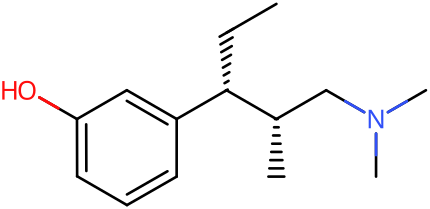
Tapentadol Stats & Data
CCC(C(C)CN(C)C)c1cccc(O)c1KWTWDQCKEHXFFR-SMDDNHRTSA-NPharmacology
DrugBankDescription
Opioid analgesic for treatment of moderate to severe pain. FDA approved on Nov 20, 2008.
Mechanism of Action
Tapendadol causes large increases in levels of extracellular norepinephrine (NE) due to a dual mechanism of action involving mu opioid receptor (MOR) agonism as well as noradrenaline reuptake inhibition.
Pharmacodynamics
Tapentadol is a centrally-acting synthetic analgesic that is 18 times less potent than morphine in binding mu-opioid receptors. It also increases norepinephrine concentrations in the brains of rats via inhibition of norepinephrine reuptake. Selective mu-opioid antagonists like naloxone can block analgesia from tapentadol. It also has not effect on the QT interval.
Metabolism
97% of the dose is metabolized mostly via conjugation with glucuronic acid to produce glucuronides. Tapentadol is also metabolized into N-desmethyl tapentadol (13%) by CYP2C9 and CYP 2C19. CYP2D6 is involved in the formation of the metabolite, hydroxy tapentadol (2%). All metabolites are inactive.
Absorption
Bioavailability, immediate release (IR), 86 mg: 32%; Bioavailability, extended release (ER), 86 mg: 32%; Cmax, IR: 64.2 ng/mL; Cmax, ER: 22.5 ng/mL; T max, IR: 1.5 hours; T max, ER: 5.0 hours; Tapentadol accumulates following multiple repeat doses.
Indication
The immediate-release formulation of tapentadol is indicated for the relief of moderate to severe acute pain. The long-acting formulation serves as a continuous, around-the-clock analgesic that is indicated for the relief of moderate to severe chronic pain or neuropathic pain associated with diabetic peripheral neuropathy.
Elimination
Tapentadol and its metabolites are excreted almost exclusively (99%) via the kidneys. Approximately 70% (55% O-glucuronide and 15% sulfate of tapentadol) is excreted in conjugated form. A total of 3% of drug was excreted in urine as unchanged drug.
Volume of Distribution
Following IV administration, volume of distribution is 540 ± 98 L.
Receptor Profile
Receptor Actions
Receptor Binding
Measured Affinities
Guide to PHARMACOLOGYMeasured binding and functional data for tapentadol, curated by the IUPHAR/BPS Guide to PHARMACOLOGY. Each row cites the paper it came from. Lower concentrations mean tighter binding — a value in the sub-nanomolar range indicates a very potent interaction.
| Target | Action | Measure | Value | Concentration | Species | Source |
|---|---|---|---|---|---|---|
| μ receptor OPRM1 | Agonist | pKi | 6.8 | 158.49 nM | Human | PMID 17656655 |
| NET SLC6A2 | Inhibition | pKi | 5.06 | 8,710 nM | Human | PMID 17656655 |
Reading this. pKi, pEC50 and pIC50 are negative log molar values, so a higher number means a tighter interaction; the concentration column converts them for you. Values from non-human species are laboratory measurements and do not translate directly to human effect. Receptor affinity is not a dose — it describes what a molecule binds, not how much of it is safe to take.
Receptor data from the IUPHAR/BPS Guide to PHARMACOLOGY (v2026.2), licensed CC BY-SA 4.0. Matched to this substance by InChIKey.
History & Culture
1980s–2003
Tapentadol was developed by the German pharmaceutical company Grünenthal during the late 1980s. The research team, led by chemist Helmut Buschmann, used tramadol as their starting point—a compound the same company had created in 1962. Their objective was to design a molecule with specific pharmacological improvements: strong activation of the μ-opioid receptor, potent inhibition of norepinephrine reuptake, minimal serotonergic activity, and importantly, direct activity without requiring metabolic conversion. The resulting compound was tapentadol. In 2003, Grünenthal entered a partnership with Johnson & Johnson subsidiaries (Johnson & Johnson Pharmaceutical Research and Development and Ortho-McNeil Pharmaceutical) to further develop and commercialize the drug. Under this agreement, Johnson & Johnson obtained exclusive marketing rights in the United States, Canada, and Japan, while Grünenthal retained rights for other markets.
2008–2011
The United States Food and Drug Administration granted approval for tapentadol on November 20, 2008. The following year, the Drug Enforcement Administration classified it as a Schedule II controlled substance, and the drug entered the American market under the brand name Nucynta. Notably, tapentadol was reported to be the first new molecular entity within the oral centrally acting analgesics class to receive FDA approval in over 25 years. European regulatory approval followed in 2010, the same year Grünenthal expanded its partnership with Johnson & Johnson to include marketing rights in approximately 80 additional countries. In 2011, an extended-release formulation (Nucynta ER) was released in the United States for managing moderate to severe chronic pain, with subsequent FDA approval for treating neuropathic pain associated with diabetic peripheral neuropathy.
2015–2018
Following annual sales reaching approximately $166 million, Johnson & Johnson divested its rights to market tapentadol in the United States to Depomed in January 2015 for $1 billion. The drug's manufacturing facility was located in Puerto Rico, and when Hurricane Maria struck the island in 2017, production was severely disrupted, resulting in significant supply shortages. In January 2018, Depomed sold the manufacturing operations and licensed the drug to Collegium Pharmaceutical in an arrangement involving $10 million upfront with minimum annual royalty payments of $135 million over the following four years. This sequence of corporate transitions and natural disaster compounded supply difficulties, leaving many patients dependent on the medication to seek alternative treatment options.
Tapentadol has a low toxicity relative to dose. As with all opioids, long-term effects can vary but can include diminished libido, apathy and memory loss. It is also potentially lethal when mixed with depressants like alcohol or benzodiazepines and generally has a wider range of substances which it is dangerous to combine with in comparison to other opioids. Tapentadol is known to lower the seizure threshold. It should not be taken during benzodiazepine withdrawals as this can potentially cause seizures.
Toxicity (DrugBank)
Oral, rabbit: LD50 = 3200 mg/kg; Oral, mouse: LD50 = 300 mg/kg; Oral, rat: LD50: 980 mg/kg; The most common reasons for discontinuation due to adverse events were dizziness, nausea, vomiting, somnolence, and headache.
Effect Profile
Curated + 19 ReportsStrong euphoria and pain relief with moderate sedation and itching/nausea
Tolerance & Pharmacokinetics
drugs.wikiNo tolerance chart. Our decay curves for opioids were estimates, and a curve can make tolerance look longer-lasting than it is, which is the dangerous direction.
Opioid tolerance drops fast when you stop, and even a few days off can be enough, so a dose that used to be normal can now stop your breathing. Overdose deaths rise sharply after prison, detox or leaving treatment, and tolerance also falls during a hospital stay. After any break, start with a much smaller amount, try a test dose first, don't use alone, and keep naloxone within reach. Alcohol, benzodiazepines, gabapentinoids and other sedatives make an opioid overdose much more likely.
Sources: FRANK: heroin · National Harm Reduction Coalition · WHO: opioid overdose · Merrall et al. 2010 · Binswanger et al. 2007 · Strang et al. 2003 · FDA 2019: gabapentinoids and breathing
Cross-Tolerances
Experience Report Analysis
ErowidDemographics
Gender Distribution
Age Distribution
Reports Over Time
Effect Analysis
ErowidEffects aggregated from 19 experience reports (19 single-substance Erowid)
Effect Sentiment Distribution
Confidence Distribution
Each bar is the share of reports mentioning the effect; its whisker, and the band on the rows below, is the 95% interval: where the share could plausibly be with other reports of the same kind.
Too few reports for bars: these effects come from 19 single-substance Erowid reports, and a bar is drawn only from 20 reports or more. With fewer, a percentage cannot tell a common effect from a rare one. Counts are shown instead. Why 20?
Positive Effects 7
Adverse Effects 3
Show 4 neutral or unclassified mentions
Dosage Distribution
Dose distribution from experience reports, one dose per report (the first listed). Doses above Q3 + 3×IQR, far above what people typically take, are left out of the median and range and listed under each route: most are real heavy doses or overdoses, not mistakes.
Real-World Dose Distribution
ErowidFrom 31 of 34 recorded dose entries: those that state a weight (mg, g or µg), in routes with at least five of them. Values above Q3 + 3×IQR, far above what people typically take, are left out; they can include real heavy doses and overdoses, not only mistakes.
Oral (n=25)
Insufflated (n=6)
Form / Preparation
Most common forms and preparations, as a share of the 16 reports that give one
Too few reports for bars: these forms come from 16 reports, and a bar is drawn only from 20 reports or more. With fewer, a percentage cannot tell a common effect from a rare one. Counts are shown instead. Why 20?
- Pill / Tablet 12 of 16
- Ground / Crushed 3 of 16
Body-Weight Dosing
Dose per kg of body weight, one dose per report (the first listed), from reports giving a weight of 30–250 kg. Doses above Q3 + 3×IQR, far above what people typically take, are left out of the median and range and listed under each route.
Redose Patterns
Redosing behavior across 20 reports
Opioid Equivalence (MME)
NIH HEAL 2024 & CDC 2022Tapentadol 33 mg oral ≈ 10 mg Morphine oral
Legal Status
| Country | Status | Notes |
|---|---|---|
| United States | FDA-approved controlled substance (Narcotic) | Approved by the FDA on November 20, 2008, with the extended-release formulation receiving approval on August 26, 2011. Classified as a narcotic analgesic with recognized high potential for misuse and abuse. Due to addiction risks, tapentadol is reserved for patients for whom alternative treatment options are inadequate or unavailable. |
Harm Reduction
drugs.wikiJustification for harm-reduction additions (with sources): 1) Dual MOR–NRI pharmacology and weak SRI: authoritative summaries and reviews confirm tapentadol is a \u0003bc-opioid agonist that primarily inhibits norepinephrine reuptake, with only weak serotonin reuptake effects; this underpins both analgesia and specific interaction risks. This supports flagging serotonergic combinations as risky yet less central than with tramadol. 2) No active metabolites; Phase II (UGT1A9/UGT2B7) predominance; limited CYP involvement: multiple reviews show glucuronidation as the main pathway and that the major glucuronide is inactive; this reduces CYP-mediated interaction variability. This justifies advising caution with strong UGT modulators rather than CYP phenotypes. 3) IR onset/peak/duration around 20–60 min onset, 1–2 h peak, ~4–6 h total, and ER Cmax near ~5 h with longer cover: PK summaries support the provided duration guidance, important to discourage redosing too early (overlap/stacking). 4) High misuse liability but variable relative abuse prevalence: postmarketing analysis in U.S. treatment entrants reported lower prescription-adjusted abuse prevalence for tapentadol vs several Schedule II comparators; nonetheless, it remains a high-risk opioid. This supports the “High” addiction potential wording without overstating. 5) Serotonin-syndrome risk exists especially with co-administered serotonergic drugs or overdose: case literature documents probable SS with tapentadol overdose and reviews/labels warn about SS when combined with serotonergic agents; this warrants listing serotonergic polypharmacy as dangerous/unsafe. 6) Seizure caution: regulators and case series flag increased seizure risk, particularly with history of seizures or with co-administered threshold-lowering drugs; this justifies the “caution” entry. 7) MAOI contraindication (14 days): repeatedly stated in clinical reviews; given tapentadol’s NRI component, MAOIs can precipitate hypertensive crises/serotonin toxicity; this belongs under “dangerous.” 8) Partial agonists/mixed agonist–antagonists: reviews for PR (ER) note potential for precipitating withdrawal or reducing efficacy; users on buprenorphine may need careful planning. This supports listing these as unsafe. 9) CNS depressant co-use: class-typical risk necessitates strong warnings about alcohol/benzodiazepines/etc., with emphasis on respiratory depression and death; safety reviews reinforce this. 10) Overdose management nuance: naloxone will reverse the opioid component but not the NRI/SRI features; emergency care and prolonged monitoring (esp. ER products) are necessary. This is critical HR knowledge. 11) Tablet manipulation: do not crush/chew ER; dose dumping markedly increases overdose risk; although the specific label text is not cited here due to domain constraints, the ER pharmacokinetics and safety reviews justify the warning to leave ER intact. 12) Injection/insufflation risks: community and HR sources consistently warn that injecting crushed tablets carries severe harm from insoluble excipients (embolism, infections); HR guidance is to avoid non-oral ROAs for tablet products. While examples are often drawn from other opioids, the excipient risk generalizes.
References
Cited References
- Mayo Clinic: Tapentadol
- Pain Medicine - Tapentadol abuse liability study
- Post-marketing case report
- PsychonautWiki: Tapentadol
- Singh et al. (2013) - Tapentadol hydrochloride: A novel analgesic
- Tapentadol: A Review of Experimental Pharmacology Studies
- Times of India - Tapentadol abuse in India
- TripSit: Drug combinations
- Tzschentke et al. (2007) - Tapentadol HCl: novel mu-opioid receptor agonist
Additional references
- DrugBank: Tapentadol overview
- Tapentadol IR: new treatment option for acute pain (review)
- Patient considerations in the use of tapentadol
- Pharmacological rationale for tapentadol therapy (PK/ER data)
- Review of post-marketing safety data
- Abuse potential—postmarketing evaluation (Pain Medicine)
- Probable tapentadol-associated serotonin syndrome after overdose (case)
- Mu-opioid and \u0003b12-adrenoceptor contributions (preclinical mechanism)