
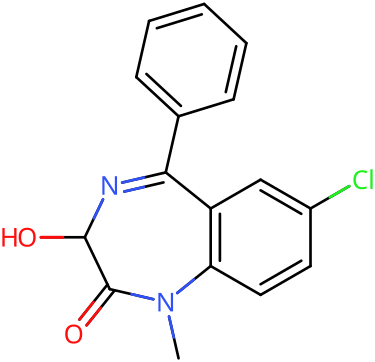
Temazepam Stats & Data
SEQDDYPDSLOBDC-UHFFFAOYSA-NPharmacology
DrugBankDescription
Temazepam, like many other similar and related benzodiazepines, acts as a gamma-aminobutyric acid (GABA) modulator and is capable of eliciting a variety of actions including sedation, hypnosis, skeletal muscle relaxation, anticonvulsant activity, and anxiolytic action . Although the chemical synthesis of temazepam was established by 1965 , mainstream contemporary use of the medication did not occur until it's legitimate use as treatment for insomnia was accepted and approved later on. In particular, before temazepam saw regular prescription use in civilians it was - and still is - employed by the US military as a sedative-hypnotic medication to be taken by soldiers, pilots, etc. to obtain the necessary rest required for medical recovery or scheduled maneuvers and operations . Regardless, temazepam has become one of the most frequently prescribed medications internationally and sees millions of prescriptions every year. Unfortunately, however, given its frequent use and the inherent nature of its pharmacological effects, temazepam - like many other benzodiazepines - possesses a high potential for misuse and is genuinely capable of developing drug tolerance, physical dependence, and addiction in users.
Mechanism of Action
Gamma-Aminobutyric acid (GABA) is considered the principal inhibitory neurotransmitter in the human body . When GABA binds to GABA(a) receptors found in neuron synapses, chloride ions are conducted across neuron cell membranes via an ion channel in the receptors . With enough chloride ions conducted, the local, associated neuron membrane potentials are hyperpolarized - making it more difficult or less likely for action potentials to fire, ultimately resulting in less excitation of the neurons . Subsequently, benzodiazepines like temazepam can bind to benzodiazepine receptors that are components of various varieties of GABA(a) receptors . This binding acts to enhance the effects of GABA by increasing GABA affinity for the GABA(a) receptor, which ultimately enhances GABA ligand binding at the receptors . This enhanced ligand binding of the inhibitory neurotransmitter GABA to the receptors increases the aforementioned chloride ion conduction (perhaps reportedly via an increase in the frequency of the chloride channel opening), resulting in a hyperpolarized cell membrane that prevents further excitation of the associated neuron cells .
Pharmacodynamics
Temazepam is a benzodiazepine used as a hypnotic agent in the management of insomnia . Temazepam produces CNS depression at limbic, thalamic, and hypothalamic levels of the CNS . Temazepam increases the affinity of the neurotransmitter gamma-aminobutyric acid (GABA) for GABA receptors by binding to benzodiazepine receptors . Results are sedation, hypnosis, skeletal muscle relaxation, anticonvulsant activity, and anxiolytic action . In sleep laboratory studies, the effect of temazepam was compared to placebo during a two week period . The studies demonstrated a linear dose-response improvement in total sleep time and sleep latency with substantial drug-placebo differences apparent for total sleep time and for sleep latency at higher doses of temazepam . Regardless, REM sleep was ultimately unchanged but slow wave sleep was decreased . Moreover, a transient syndrome, known as "rebound insomnia", wherein the symptoms that led to treatment with temazepam in the first place recur in an enhanced form, may happen on withdrawal of temazepam treatment .
Metabolism
First-pass metabolism of temazepam is minimal at approximately 5-8% of an administered dose . Nevertheless, temazepam is principally metabolized in the liver where most of the unchanged drug is directly conjugated to glucuronide and excreted in the urine . In particular, the primary metabolite present in the blood is the O-conjugate of temazepam FDA Label, F3718, L5539. Less than 5% of the drug is demethylated to oxazepam and subsequently eliminated as the glucuronide . Regardless, the glucuronides of temazepam have no demonstrable CNS activity and it is believed that no active metabolites are formed in general FDA Label, F3718, L5539. Since temazepam mainly undergoes Phase II conjugation reactions, it is proposed that it is devoid of CYP450 interactions.
Absorption
Studies demonstrate that between 90 to 100% of an orally administered temazepam dose is absorbed, making the medication very well absorbed . The oral administration of 15 to 45 mg temazepam resulted in rapid absorption with significant blood levels achieved in 30 minutes and peak levels at 2-3 hours . In particular, direct studies following the oral ingestion of 30 mg of temazepam revealed measurable plasma concentrations were obtained 10-20 minutes after dosing with peak plasma levels ranging between 666-982 ng/mL (with a mean of 865 ng/mL) presenting approximately 1.2-1.6 hours (with a mean of 1.5 hours) after the dosing . Finally, a dose-proportional relationship was established for the area under the plasma concentration/time curve over the 15 to 30 mg dose range .
Indication
Temazepam is specifically indicated only for the short-term management of insomnia , . Furthermore, such management is generally predominantly associated with the symptomatic relief of transient and short-term insomnia characterized by difficulty in falling asleep, frequent nocturnal awakenings and/or early morning awakenings . In particular, the official prescribing information for temazepam typically specifies that the instructions issued for dispensed prescriptions of the medication should indicate specifically that patients are only expected to use the therapy for short periods of time - usually 7-10 days in general FDA Label, F3718. Subsequently, treatment with temazepam should usually not exceed 7 to 10 consecutive days and nor should it be prescribed in quantities exceeding a one-month supply . Some regional prescribing information also notes that temazepam may be used for premedication prior to minor surgery or other related procedures .
Half-life
The terminal half-life determined for temazepam is recorded as being between 3.5-18 hours, with a mean of 9 hours .
Protein Binding
It has been recorded that about 96% of unchanged temazepam is bound to plasma proteins .
Elimination
Following a single dose, 80-90% of the dose appears in the urine, predominantly as the O-conjugate metabolite, and 3-13% of the dose appears in the faeces . Less than 2% of the dose is excreted unchanged or as N-desmethyltemazepam in the urine .
Volume of Distribution
The volume of distribution documented for temazepam is 1.3-1.5 L/kg body weight - and in particular, 43-68 L/kg for the unbound fraction .
Clearance
Studies regarding the clearance of temazepam have recorded the values of 1.03 ml/min/kg and 31 ml/min/kg for the clearance of total temazepam and the clearance of unbound temazepam, respectively .
Receptor Profile
Receptor Actions
Receptor Binding
History & Culture
1962–1981
Temazepam was patented in 1962, with its chemical synthesis established by the mid-1960s. While the compound entered medical use in 1969, its specific application as a treatment for insomnia was not fully recognized until 1981. By the late 1980s, temazepam had become one of the most popular and widely prescribed hypnotics on the market. As of 2021, it remained the 208th most commonly prescribed medication in the United States, with over 2 million prescriptions issued annually.
Before temazepam saw regular prescription use among civilians, it was employed by the United States military as a sedative-hypnotic medication for service members requiring rest for medical recovery or scheduled operations. The United States Air Force continues to use temazepam as one of the approved "no-go pills" to help aviators and special-duty personnel obtain sleep in support of mission readiness. Personnel must complete ground tests before receiving authorization to use the medication in operational situations, and a twelve-hour restriction is imposed on subsequent flight operations.
1987–2004
By 1987, temazepam had become the most widely abused legal prescription drug in the United Kingdom. Its use among street-drug users was typically part of a polydrug abuse pattern, though many individuals entering treatment facilities reported temazepam as their primary substance of concern. The practice of combining heroin with other substances—most frequently temazepam, diazepam, and alcohol—contributed significantly to increases in drug-related deaths in Glasgow and Edinburgh between 1990 and 1992. The severity of the temazepam abuse epidemic received considerable public attention. The BBC series Panorama produced an episode titled "Temazepam Wars" documenting the crisis in Paisley, Scotland, and its associated criminal activity. The phenomenon was also referenced in popular culture through the 1995 Black Grape song "Temazi Party." In response to widespread intravenous abuse of gel-filled capsule formulations, several countries implemented regulatory changes. Australia withdrew temazepam capsules from the market in March 2004, leaving only tablet formulations available. Finland similarly removed the Normison brand from shelves after the liquid contained within gelatin capsules was linked to a significant increase in intravenous use, and temazepam remains more tightly controlled in Finland than other benzodiazepines.
Temazepam has accumulated numerous street names reflecting its widespread recreational use across different regions. Common terms include "jellies," "eggs," "green eggs," "mazzies," "tems," "beans," "king kong pills," "Edinburgh eccies," "norries," "rugby balls," "terminators," "knockouts," "green devils," "blackout," and "vitamin T." Regional variations exist, with "oranges" being a common term in Australia and New Zealand, while "resties" is used in North America. The term "king kong pills" was formerly applied to barbiturates before becoming more commonly associated with temazepam.
Temazepam had the highest rate of drug intoxication, including overdose, among common benzodiazepines in cases with and without combination with alcohol in a 1985 study. Temazepam and nitrazepam were the two benzodiazepines most commonly detected in overdose-related deaths in an Australian study of drug deaths. A 1993 British study found temazepam to have the highest number of deaths per million prescriptions among medications commonly prescribed in the 1980s (11.9, versus 5.9 for benzodiazepines overall, taken with or without alcohol). Temazepam has a fatal toxicity index (FTI) that is higher than some tricyclic antidepressants, and has also caused overdose and death without combining it with other CNS depressants, which is almost unheard of amongst the benzodiazepine class of drugs.
LD50
LD50: 1963 mg/kg (oral, mice) (L1338)LD50: 1833 mg/kg (oral, rat) (L1338)LD50: >2400 mg/kg (oral, rabbit) (L1338)
Carcinogenicity
Group 3: Not classifiable as to its carcinogenicity to humans
Liver injury risk
Ambiguous (limited data)
Overdose
Benzodiazepine overdose may occur when a benzodiazepine is taken in extremely heavy quantities or concurrently with other depressants. This is particularly dangerous with other GABAergic depressants such as barbiturates and alcohol since they work in a similar fashion, but bind to distinct allosteric sites on the GABAA receptor, thus their effects potentiate one another.
Addiction & dependence
Temazepam is extremely physically and psychologically addictive. Temazepam is considered to be significantly more addictive than other benzodiazepines. Tolerance will develop to the sedative-hypnotic effects within a couple of days of continuous use.
Effect Profile
Curated + 18 ReportsStrong anxiolysis and euphoria with strong cognitive impairment, mild sedation
Tolerance & Pharmacokinetics
drugs.wikiNo tolerance chart. Our decay curves for these drugs were estimates, and a curve can make tolerance look longer-lasting than it is, which is the dangerous direction.
How fast tolerance to these drugs fades after a break has not been measured well enough to draw, so don't count on a dose you used to take still being safe: after time off, start with a much smaller amount and don't use alone. Mixing sedatives with each other, with alcohol or with opioids sharply raises the risk of a fatal overdose. If you've been using regularly, don't stop suddenly: withdrawal from benzodiazepines, alcohol or GHB/GBL can cause seizures or delirium, so get medical help to cut down gradually.
Sources: FRANK: benzodiazepines · Alcohol and Drug Foundation: GHB · FDA 2020: benzodiazepine boxed warning · FDA 2019: gabapentinoids and breathing · NHS: alcohol use disorder
Cross-Tolerances
Experience Report Analysis
ErowidDemographics
Gender Distribution
Age Distribution
Reports Over Time
Effect Analysis
ErowidEffects aggregated from 18 experience reports (18 single-substance Erowid)
Effect Sentiment Distribution
Confidence Distribution
Each bar is the share of reports mentioning the effect; its whisker, and the band on the rows below, is the 95% interval: where the share could plausibly be with other reports of the same kind.
Too few reports for bars: these effects come from 18 single-substance Erowid reports, and a bar is drawn only from 20 reports or more. With fewer, a percentage cannot tell a common effect from a rare one. Counts are shown instead. Why 20?
Positive Effects 3
Adverse Effects 2
Show 1 neutral or unclassified mention
Also reported in combinations. In the 14 Temazepam reports where another drug was taken too, 3 mention hospital, emergency services or an overdose, 1 a seizure and 1 psychosis (too few reports for percentages). In the 18 single-substance reports: 1, 0 and 0. These are not in the figures above: they cannot be put down to Temazepam alone, and a mention is not always something that happened to the writer.
Dosage Distribution
Dose distribution from experience reports, one dose per report (the first listed). Doses above Q3 + 3×IQR, far above what people typically take, are left out of the median and range and listed under each route: most are real heavy doses or overdoses, not mistakes.
1 report gave a dose above the typical range (180 mg), so it is not in the figures above. It mentions hospital, emergency services or an overdose. Listing a dose here does not mean it is safe.
Show the report
- 180 mg · another drug taken too · mentions hospital, emergency services or an overdose
Real-World Dose Distribution
ErowidFrom 36 of 45 recorded dose entries: those that state a weight (mg, g or µg), in routes with at least five of them. Values above Q3 + 3×IQR, far above what people typically take, are left out; they can include real heavy doses and overdoses, not only mistakes.
Oral (n=28)
Insufflated (n=6)
Common Combinations
Most co-occurring substances, as a share of all 32 reports filed under Temazepam; whiskers are 95% intervals
Form / Preparation
Most common forms and preparations, as a share of the 22 reports that give one; whiskers are 95% intervals
Body-Weight Dosing
Dose per kg of body weight, one dose per report (the first listed), from reports giving a weight of 30–250 kg. Doses above Q3 + 3×IQR, far above what people typically take, are left out of the median and range and listed under each route.
Redose Patterns
Redosing behavior across 27 reports
Benzodiazepine Equivalence
Temazepam - 20mg ~=10mg Diazepam.
Legal Status
| Country | Status | Notes |
|---|---|---|
| Australia | Schedule 4 | Designated as a prescription-only medicine under Australian scheduling regulations. Cannot be legally obtained without a valid prescription from a registered medical practitioner. |
| Austria | Prescription only (AMG/SMG) | Permitted for medical use under the Arzneimittelgesetz (Medicines Act). Possession or sale without a valid prescription constitutes an offense under the Suchtmittelgesetz (Addictive Substances Act). |
| Canada | Schedule IV (CDSA) | Controlled under Schedule IV of the Controlled Drugs and Substances Act. Requires a prescription for lawful possession. Available in various generic and brand formulations through licensed pharmacies. |
| Germany | Anlage III BtMG | Listed in Anlage III of the Betäubungsmittelgesetz (Narcotics Act) since August 1, 1986. Prescriptions must be written on special narcotic prescription forms, except for preparations containing 20 mg or less per dosage unit. |
| Hong Kong | Schedule 1 | Classified as a Schedule 1 controlled substance. Subject to strict regulatory controls on possession, prescribing, and dispensing. |
| Ireland | Schedule 3 | Added to Schedule 3 of the Misuse of Drugs Act 1977 on November 22, 1993. Possession without authorization and unauthorized supply are criminal offenses. |
| Netherlands | List 2 (Opiumwet) | Controlled under List II of the Opium Law. Available through prescription for approved medical indications. Preparation, possession, delivery, and transport without authorization are prohibited, though possession of small quantities for personal use is typically not prosecuted. |
| Portugal | Schedule IV | Classified as a Schedule IV controlled substance under national drug legislation. Available for medical use with appropriate prescription. |
| Russia | Schedule III | Designated as a Schedule III controlled substance since 2013. Subject to regulatory controls on medical prescribing and distribution. |
| South Africa | Schedule 5 | Listed as a Schedule 5 controlled substance. Possession and supply are regulated under national pharmaceutical and narcotics legislation. |
| Sweden | Schedule IV (List IV) | Classified as a prescription medication under List IV (Schedule 4) of the Narcotics Drugs Act of 1968. Legal only with valid medical prescription. |
| Switzerland | Verzeichnis B | Specifically listed under Verzeichnis B (Schedule B) of controlled substances regulations. Medicinal use is permitted with appropriate prescription from authorized practitioners. |
| Thailand | Schedule II (Psychotropic Substances Act) | Listed in Schedule II of the Psychotropic Substances Act. Subject to controls on importation, manufacture, possession, and distribution. |
| United Kingdom | Class C | Controlled as a Class C substance under the Misuse of Drugs Act 1971. Possession without prescription carries a maximum penalty of 2 years imprisonment and/or a fine. Unauthorized supply is punishable by up to 5 years imprisonment and/or a fine. Medical professionals must follow specific protocols for prescribing and disposal. |
| United States | Schedule IV | Assigned to Schedule IV of the Controlled Substances Act by the DEA, indicating accepted medical use with lower abuse potential compared to Schedule III substances. Possession without valid prescription and unlicensed sale are federal offenses. Several states require specially encoded prescriptions due to historical misuse concerns. |
Harm Reduction
drugs.wiki- Combining temazepam with alcohol, opioids, or GHB/GBL greatly increases the risk of unpredictable deep sedation, respiratory depression, aspiration, and fatal overdose; multiple harm‑reduction teams flag benzodiazepine + depressant combos as particularly high risk. Keep clear separation and avoid co‑use; if opioids are involved, ensure naloxone availability and avoid using alone.
- Avoid injecting or snorting. Former gel‑filled capsules (“jellies”) led to injection attempts; reports note this formulation was withdrawn in many places due to harms. Temazepam is very poorly water‑soluble (~0.164 mg/mL), so solutions are prone to precipitation and excipient emboli, raising risks of vascular injury, abscess, and tissue necrosis. Oral use is the safer route.
- Expect amnesia and blackouts at higher doses or with redosing. To reduce harm: pre‑measure a single dose; secure the remainder; avoid online purchases/activities, driving, cooking, or important decisions while under the influence. Next‑day impairment is common; do not drive or operate machinery until fully alert.
- Tolerance builds quickly with nightly use (often within 2–4 weeks). Dependence and medically significant withdrawal (including seizures) can occur; any long‑term user should taper gradually under medical supervision rather than stopping abruptly.
- People with respiratory disease, sleep apnoea, or when combined with other sedatives are at higher risk of hypoventilation/airway obstruction; the primary serious risk with benzodiazepines is respiratory depression in vulnerable contexts or polydrug use. Use the lowest effective dose, avoid co‑depressants, and do not use alone.
- In pregnancy and breastfeeding, prescribed benzodiazepines may be used only when clinically justified; misuse/polydrug use increases risks (e.g., infant sedation/apnoea). Discuss with a clinician; avoid non‑medical use.
- Drug testing: urine immunoassays typically detect temazepam for ~1–2 days (longer after injecting); hair tests may reflect longer‑term use. Be aware that various benzos and metabolites can cross‑react.
- Street names for temazepam include “duck eggs” and “jellies”; be wary of non‑pharmaceutical sources due to mislabeling and unknown potency. Prefer known pharmaceutical tablets/capsules if prescribed.
References
Data Sources
Cited References
Additional references
- Bluelight: Benzo Guide v.1 (temazepam onset/half‑life, solubility, notes)
- Bluelight: All the basics of Benzodiazepines (half‑life and equivalence context)
- TripSit Wiki: Drug combinations (alcohol/opioids/GHB with benzos)
- TripSit Wiki: Benzodiazepines (blackouts, avoid driving)
- DrugWise: Benzodiazepines overview (withdrawal dangers, dependence)
- DrugWise: Testing (urine detection windows incl. temazepam)
- Drugs-Forum Wiki: Temazepam (synonyms/brands; jellies injection note)
- EUDA (formerly EMCDDA): Misuse of benzodiazepines among high‑risk opioid users
- EUDA drug profile: Benzodiazepines (street terms incl. ‘duck eggs’ for temazepam)
- NCBI/Books: Benzodiazepines—respiratory depression risk in clinical use (context for vulnerable groups)
- NCBI/WHO: Guidelines on substance use in pregnancy (benzodiazepines incl. temazepam)
- Erowid Temazepam Vault (general overview; user experiences)
- DrugBank: Temazepam (DB00231)