
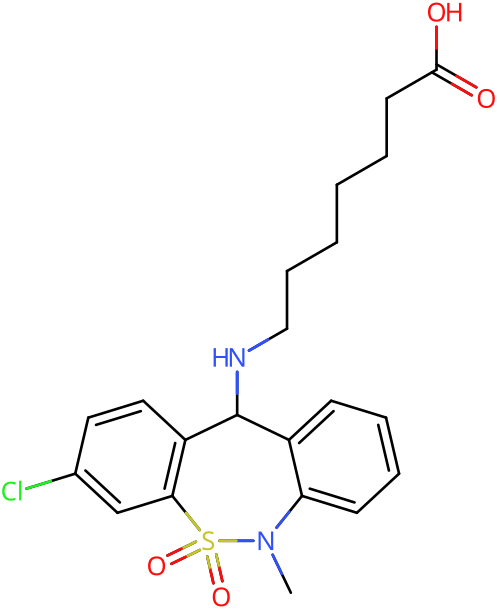
Tianeptine Stats & Data
O=C([O-])CCCCCCNC1c2ccccc2N(C)S(=O)(=O)c2cc(Cl)ccc12.[H+]JICJBGPOMZQUBB-UHFFFAOYSA-NPharmacology
DrugBankDescription
Tianeptine is a drug used primarily in the treatment of major depressive disorder and has been studied in the treatment of irritable bowel syndrome (IBS) . Structurally, it is classified as a tricyclic antidepressant (TCA), however, it possesses different pharmacological properties than typical tricyclic antidepressants . Tianeptine was discovered and patented by The French Society of Medical Research in the 1960s . Currently, tianeptine is approved in France and manufactured and marketed by Laboratories Servier SA; it is also marketed in several other European countries under the trade name “Coaxil” as well as in Asia (including Singapore) and Latin America as “Stablon” and “Tatinol” but it is not available in Australia, Canada, New Zealand, the U.K. or the U.S.
Mechanism of Action
Recent studies suggest that tianeptine acts as a full agonist at the mu-type opioid receptor (MOR) , . The mu opioid receptors are currently being studied as effective targets for antidepressant therapies . It is believed that the clinical effects of tianeptine are owed to its modulation of these receptors . In addition to its actions on the opioid receptor, previous studies have owed its action to its effect on the serotonin receptor , , dopamine (D2/3) receptors , and glutamate receptors , , as discussed below: Tianeptine has challenged the monoaminergic hypothesis of depression, as well as the widely supported monoaminergic mechanisms whereby the action of most known antidepressants have been explained . Specifically, this drug is thought to persistently alter glutamate receptor bursting of the hippocampal CA3 commissural associational synapse . Current research suggests that tianeptine produces its antidepressant effects through the modulation of glutamate receptor activity (for example, AMPA receptors and NMDA receptors) and affect the release of brain-derived neurotrophic factor (BDNF), which impacts neural plasticity . More recent studies by support the role of tianeptine in the modulation of glutaminergic activity in the amygdala, the emotional region of the brain associated with memories .
Pharmacodynamics
Analyses in large-scale epidemiologic surveys have shown that the anxiety disorders are widely comorbid with major depression. This makes antidepressant with anxiolytic properties particularly unique and attractive . Tianeptine is effective in reducing depressive symptoms in mild to severe major depressive disorder and also alleviates anxious symptoms associated with depression without the need for coadministration of an anti-anxiety medication . These findings, however, are met with controversial data. In a study of healthy volunteers, Tianeptine-treated subjects were less accurate at identifying facial expressions, suggesting a lack of improvement in the psychomotor symptoms of depression. The tianeptine group also showed reduced memory and reduced attentional vigilance to various stimuli .
Metabolism
Tianeptine is metabolized primarily by beta-oxidation of its heptanoic side chain . The metabolism of tianeptine was studied after a one-time oral administration of radioisotopically (14C) labeled compound to healthy male volunteers. After 1 week, approximately 66% of the dose was eliminated by the kidneys (55% elimination during the first 24 hr). After 24h, unchanged drug 3% of the drug was found unchanged in the urine. Three major metabolites result from beta-oxidation of Tianeptine. The metabolite profiles of tianeptine in feces and plasma were found to be qualitatively similar to that in urine .
Absorption
Well absorbed, approximately 99% bioavailability .
Indication
Used primarily in the treatment of major depressive disorder and anxiety . It is currently being studied for fibromyalgia pain treatment .
Elimination
Eliminated with bile as glucuronide and glutamine conjugates .
Receptor Profile
Receptor Actions
History & Culture
1960s–1983
Tianeptine was developed and patented by the French Society of Medical Research during the 1960s. Following clinical development, it was introduced for therapeutic use in France in 1983, becoming available through Laboratories Servier SA. The drug subsequently gained approval across numerous European countries under the trade name Coaxil, and expanded into Asian markets including Singapore as well as Latin American countries where it was marketed as Stablon and Tatinol.
2001–2020
Following its widespread availability as a prescription antidepressant, tianeptine's potential for recreational misuse began attracting regulatory attention in the early 2000s. In 2001, Singapore's Ministry of Health implemented restrictions limiting tianeptine prescribing exclusively to psychiatrists. French pharmacovigilance monitoring identified 141 cases of recreational use between 1989 and 2004, representing approximately 1 to 3 cases per 1000 individuals treated with the medication, with an additional 45 cases documented between 2006 and 2011. Abuse patterns in Russia proved particularly concerning, with some individuals dissolving and injecting tianeptine tablets intravenously to achieve opioid-like effects or mitigate opioid withdrawal symptoms. Because the tablets contain silica that does not fully dissolve, inadequately filtered injections frequently resulted in blocked capillaries, leading to thrombosis and severe tissue necrosis. These complications prompted Russia to classify tianeptine as a Schedule III controlled substance. In March 2020, Italy became the first European country to prohibit tianeptine entirely, classifying it as a Class I controlled substance by ministerial decree.
2018–present
Unlike most countries where tianeptine remained a prescription medication, in the United States the compound was never approved for medical use and remained unregulated at the federal level. This regulatory gap allowed tianeptine to be sold as a dietary supplement and through convenience stores, earning it the colloquial designation "gas station heroin" due to its ready availability and opioid-like effects at high doses. The Centers for Disease Control and Prevention characterized tianeptine as an "emerging public health risk," noting substantial increases in exposure-related calls to poison control centers. The Food and Drug Administration issued multiple warnings about the dangers of recreational tianeptine use, including a notice in January 2024, though the compound remains outside the Drug Enforcement Administration's controlled substance framework. Individual states began implementing their own controls starting with Michigan, which in April 2018 became the first to classify tianeptine sodium as a Schedule II controlled substance. Oklahoma followed in November 2019, Alabama in March 2021, Tennessee in July 2022, and Ohio in December 2022—with Ohio's governor specifically referencing its widespread availability as "gas-station heroin" when signing the legislation. Kentucky enacted restrictions in March 2023, followed by Florida in September 2023.
Subjective Effects
Physical
- Stimulation
- Physical euphoria: More pronounced feelings of euphoria have been reported at doses near or above 100 mg. These feelings are extremely similar to that of a typical opioid.
- Bronchodilation: Tianeptine increases the reuptake of serotonin, which has been found to combat bronchoconstriction.
- Muscle relaxation
- Headaches
- Dizziness
- Constipation
- Physical fatigue
Cognitive
- Motivation enhancement
- Anxiety suppression: Tianeptine has been found to be especially useful in mitigating the effects of panic attacks.
- Cognitive euphoria: More pronounced feelings of euphoria have been reported at doses near or above 100 mg. These feelings feel extremely similar to that of a typical opioid.
- Focus enhancement: In addition to enhancing the ability to focus, tianeptine also improves the retention of short-term memories, stimulates quicker learning, and improves reaction time.
- Thought acceleration or Thought deceleration
- Rejuvenation
- Cognitive fatigue: Although rare, some users may experience adverse effects in terms of cognition such as the impairment of thought processes.
Sensory
- Internal hallucinations: One may experience a state of semi-consciousness and hypnagogia during heavy dosage nodding which results in dream-like states and up to level 3 imagery. This is often accompanied by ill-defined geometry.
Forked from Subjective Effect Documentation by Josie Kins, July 2016. Via dose.wiki (CC0).
The toxicity and long-term health effects of recreational tianeptine use have not been studied in any scientific context, and the exact toxic dosage is unknown. Anecdotal evidence suggests that there are no negative health effects attributed to simply trying the drug by itself at low to moderate doses and using it very sparingly (but nothing can be completely guaranteed). Independent research should always be done to ensure that a combination of two or more substances is safe before consumption. It is strongly recommended that one use harm reduction practices when using this substance.
Toxicity (DrugBank)
There are several published case reports of tianeptine intoxication and death . An overdose of tianeptine can lead to opiod-like effects and lead to respiratory failure and death, due to its direct effect on the _mu_ opioid receptor . In addition, cardiotoxicity can result from an overdose of this medication .
Effect Profile
Curated + 9 ReportsModerate euphoria with moderate itching/nausea, mild sedation and pain relief
Tolerance & Pharmacokinetics
drugs.wikiNo tolerance chart. Our decay curves for opioids were estimates, and a curve can make tolerance look longer-lasting than it is, which is the dangerous direction.
Opioid tolerance drops fast when you stop, and even a few days off can be enough, so a dose that used to be normal can now stop your breathing. Overdose deaths rise sharply after prison, detox or leaving treatment, and tolerance also falls during a hospital stay. After any break, start with a much smaller amount, try a test dose first, don't use alone, and keep naloxone within reach. Alcohol, benzodiazepines, gabapentinoids and other sedatives make an opioid overdose much more likely.
Sources: FRANK: heroin · National Harm Reduction Coalition · WHO: opioid overdose · Merrall et al. 2010 · Binswanger et al. 2007 · Strang et al. 2003 · FDA 2019: gabapentinoids and breathing
Experience Report Analysis
ErowidDemographics
Gender Distribution
Too few reports for a chart: gender is known from 17 reports, and a split is drawn only from 20 reports or more. Counts are shown instead. Why 20?
- Male 13 of 17
- Not Specified 2 of 17
- Female 2 of 17
Age Distribution
Reports Over Time
Effect Analysis
ErowidEffects aggregated from 9 experience reports (9 single-substance Erowid)
Effect Sentiment Distribution
Confidence Distribution
Each bar is the share of reports mentioning the effect; its whisker, and the band on the rows below, is the 95% interval: where the share could plausibly be with other reports of the same kind.
Too few reports for bars: these effects come from 9 single-substance Erowid reports, and a bar is drawn only from 20 reports or more. With fewer, a percentage cannot tell a common effect from a rare one. Counts are shown instead. Why 20?
Positive Effects 3
Adverse Effects 0
Also reported in combinations. In the 8 Tianeptine reports where another drug was taken too, 0 mention hospital, emergency services or an overdose, 0 a seizure and 1 psychosis (too few reports for percentages). In the 9 single-substance reports: 0, 0 and 0. These are not in the figures above: they cannot be put down to Tianeptine alone, and a mention is not always something that happened to the writer.
Real-World Dose Distribution
ErowidFrom 19 of 21 recorded dose entries: those that state a weight (mg, g or µg), in routes with at least five of them. Values above Q3 + 3×IQR, far above what people typically take, are left out; they can include real heavy doses and overdoses, not only mistakes.
Oral (n=19)
Form / Preparation
Most common forms and preparations, as a share of the 8 reports that give one
Too few reports for bars: these forms come from 8 reports, and a bar is drawn only from 20 reports or more. With fewer, a percentage cannot tell a common effect from a rare one. Counts are shown instead. Why 20?
- Pill / Tablet 4 of 8
- Powder / Crystals 2 of 8
- Capsule 2 of 8
Body-Weight Dosing
Dose per kg of body weight, one dose per report (the first listed), from reports giving a weight of 30–250 kg. Doses above Q3 + 3×IQR, far above what people typically take, are left out of the median and range and listed under each route.
1 report gave a dose above the typical range (8.269 mg/kg), so it is not in the figures above. Listing a dose here does not mean it is safe.
Show the report
Redose Patterns
Redosing behavior across 11 reports
Too few reports for a chart: redosing is known from 11 reports, and a split is drawn only from 20 reports or more. Counts are shown instead. Why 20?
- Single dose 10 of 11
- Redosed 1 of 11
Legal Status
| Country | Status | Notes |
|---|---|---|
| Canada | Uncontrolled | Legal to possess without any license or prescription. Not scheduled under federal controlled substances legislation. |
| Germany | Prescription medicine (Anlage 1 AMVV) | Classified as a prescription-only medicine under Anlage 1 of the Arzneimittelverschreibungsverordnung (AMVV). Not a controlled narcotic under the Betäubungsmittelgesetz, but requires a valid prescription for legal possession. |
| Russia | Schedule III | Classified as a Schedule III controlled substance since 2010. Possession, distribution, and production without authorization is prohibited. |
| Sweden | Controlled | Not approved as a prescription medicine in Sweden, and is therefore classified as a controlled substance. Possession without authorization is illegal. |
| Switzerland | Uncontrolled | Not listed under controlled substance categories Buchstabe A, B, C, or D. Generally considered legal to possess. |
| Turkey | Prescription only (green prescription) | Designated as a 'green prescription' substance, indicating controlled distribution through pharmacies. Illegal when sold or possessed without a valid prescription. |
| United Kingdom | Illegal (Psychoactive Substances Act) | Illegal to produce, supply, or import under the Psychoactive Substances Act 2016, which came into effect on May 26, 2016. The Act does not criminalize personal possession but prohibits all commercial activity. |
| United States | Federally uncontrolled (state restrictions apply) | Not scheduled at the federal level under the Controlled Substances Act. However, individual states have begun implementing controls. Michigan became the first state to classify tianeptine sodium salt as a Schedule II controlled substance in March 2018. Many nootropics vendors have voluntarily ceased distribution due to documented abuse potential. |
References
Cited References
- Abuse & dependence review (Lauhan et al. 2018)
- Behavioral effects require μ-opioid receptor (Samuels et al. 2017)
- Bluelight: free-acid vs salts discussion (2023)
- Bluelight: MME discussion (2023)
- Bluelight: potentiation thread (2022)
- Drugs-Forum: recreational use experiences (2012)
- Erowid Experience Vault: Tianeptine reports
- FDA consumer warning (2024)
- Gas station heroin narrative review (Wagner et al. 2023)
- IV toxicity case report (2017)
- Mississippi withdrawal cases (2022)
- Mu-opioid receptor agonist discovery (Gassaway et al. 2014)
- Neurobiological properties review (McEwen et al. 2010)
- Opioid-system mechanisms review (2023)
- Pain Therapy narrative review (2023)
- PBS NewsHour FDA warning coverage (2023)
- Pharmacology and use review (ResearchGate 2018)
- Reddit: community experiences (r/QuittingTianeptine)
- Reddit: dosage discussion (r/researchchemicals 2023)
- Reddit: high-dose habit report (r/QuittingTianeptine 2024)
- Reddit: social media analysis (PMC 2021)
- Severe withdrawal case management (2023)
- UIC Pharmacy FAQ on tianeptine misuse (2024)
- VICE article on Reddit withdrawal support