
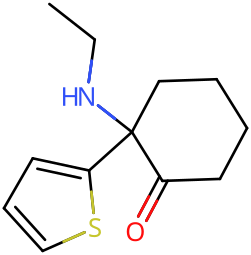
Tiletamine Stats & Data
CCNC1(CCCCC1=O)c1cccs1QAXBVGVYDCAVLV-UHFFFAOYSA-NPharmacology
DrugBankDescription
This drug is a dissociative anesthetic agent that falls under the drug category of _NMDA receptor antagonists_. Tiletamine is chemically similar to another dissociative anesthetic, ketamine. Tiletamine hydrochloride, the salt form, exists as odorless white crystals.
Receptor Profile
Receptor Actions
Effect Profile
Curated + 7 ReportsStrong dissociative depth with strong motor impairment, moderate mania, low insight
Tolerance & Pharmacokinetics
drugs.wikiTolerance Decay
Tolerance to dissociatives can develop rapidly over a single session and decays over ~7–14 days; values reflect anecdotal community observations and general dissociative patterns rather than controlled human data.
Cross-Tolerances
Experience Report Analysis
ErowidDemographics
Gender Distribution
Too few reports for a chart: gender is known from 13 reports, and a split is drawn only from 20 reports or more. Counts are shown instead. Why 20?
- Male 9 of 13
- Not Specified 4 of 13
Age Distribution
Reports Over Time
Effect Analysis
ErowidEffects aggregated from 7 experience reports (7 single-substance Erowid)
Effect Sentiment Distribution
Confidence Distribution
Each bar is the share of reports mentioning the effect; its whisker, and the band on the rows below, is the 95% interval: where the share could plausibly be with other reports of the same kind.
Too few reports for bars: these effects come from 7 single-substance Erowid reports, and a bar is drawn only from 20 reports or more. With fewer, a percentage cannot tell a common effect from a rare one. Counts are shown instead. Why 20?
Positive Effects 1
Adverse Effects 0
Show 1 neutral or unclassified mention
Also reported in combinations. In the 6 Tiletamine reports where another drug was taken too, 1 mentions hospital, emergency services or an overdose, 0 a seizure and 1 psychosis (too few reports for percentages). In the 7 single-substance reports: 1, 0 and 1. These are not in the figures above: they cannot be put down to Tiletamine alone, and a mention is not always something that happened to the writer.
Real-World Dose Distribution
ErowidFrom 7 of 14 recorded dose entries: those that state a weight (mg, g or µg), in routes with at least five of them. Values above Q3 + 3×IQR, far above what people typically take, are left out; they can include real heavy doses and overdoses, not only mistakes.
Insufflated (n=7)
Common Combinations
Most co-occurring substances, as a share of all 13 reports filed under Tiletamine
Too few reports for bars: these combinations come from 13 reports, and a bar is drawn only from 20 reports or more. With fewer, a percentage cannot tell a common effect from a rare one. Counts are shown instead. Why 20?
- THC 3 of 13
- Zolazepam 3 of 13
Form / Preparation
Most common forms and preparations, as a share of the 10 reports that give one
Too few reports for bars: these forms come from 10 reports, and a bar is drawn only from 20 reports or more. With fewer, a percentage cannot tell a common effect from a rare one. Counts are shown instead. Why 20?
- Liquid 4 of 10
- Powder / Crystals 4 of 10
Redose Patterns
Redosing behavior across 10 reports
Too few reports for a chart: redosing is known from 10 reports, and a split is drawn only from 20 reports or more. Counts are shown instead. Why 20?
- Single dose 8 of 10
- Redosed 2 of 10
Harm Reduction
drugs.wikiEvidence-informed harm reduction points and context: (1) Commercial veterinary products (Telazol/Zoletil) contain equimolar zolazepam with tiletamine. After reconstitution, Telazol solution is strongly acidic (pH ≈2.2–2.8), which helps explain reports of intense nasal burn and potential injection-site irritation; this also means sterile, isotonic preparation and low-volume IM administration reduce local irritation. (2) Clean, pure tiletamine HCl (without zolazepam) has circulated on the grey market; user reports consistently describe substantially higher potency than ketamine by weight and a harsher hangover. (3) Numerous community reports describe coarse tremor, disequilibrium, and lingering neurologic symptoms after repeated dosing over hours–days; spacing sessions and avoiding redosing during the active/offset phase is prudent. (4) Dissociative powders are frequently mis-sold or adulterated; drug checking services routinely find dissociatives sold as other drugs (and vice versa), so reagent tests are insufficient to confirm identity and submitting samples for laboratory GC/MS where available is advised. (5) There is little human pharmacokinetic data for tiletamine; extrapolating animal or vet-product data directly to human non-medical use is unreliable. (6) Reagent reference data for tiletamine are scarce/inconsistent; color tests may be misleading, reinforcing the value of professional analysis. (7) If using any veterinary formulation, account for zolazepam: additive sedation and paradoxical interactions with alcohol and GABAergic drugs are possible and can prolong recovery. (8) As with other dissociatives, avoid combining with CNS depressants (alcohol, opioids, benzos) due to increased risk of loss of airway reflexes, emesis with aspiration, and blackouts.
References
Data Sources
Cited References
- Bluelight: Tiletamine first time trip report
- CAHMA: Safer using tiletamine
- Cayman Chemical - Tiletamine hydrochloride analytical standard
- DrugBank: Tiletamine
- Drugs-Forum: Tiletamine info and experiences
- Erowid: Tiletamine vault
- Erowid: Experience - The strangest trip I've ever had
- Erowid: Experience - Trick or treat
- HKMJ - Abuse of Telazol clinical case report
- PMC Case report: Movement disorder from tiletamine vape abuse
- PMC: Comparison of psychopharmacological effects of tiletamine and ketamine in rodents
- PsychonautWiki: Disconnective effects
- PsychonautWiki: Dissociatives
- PubMed: Pharmacokinetics in polar bears (half-life 1.8 h)
- Reddit: Tiletamine retrospective review
- ScienceDirect: Tiletamine overview and potency vs ketamine
- TripSit: Tiletamine factsheet
- Virbac - Zoletil prescribing information
- Zoetis - Telazol full prescribing information
- Pharmacokinetics in polar bears – half-life 1.8 h
- Abuse of Telazol: clinical case report
- Abuse liability of tiletamine–zolazepam (review)
Additional references
- Erowid Pharm Sheets – Tiletamine/Zolazepam (Telazol): composition, reconstitution pH, veterinary context
- Bluelight – Tiletamine thread (potency anecdotes, IM ranges, cautionary reports)
- Bluelight – Esoteric Tiletamine thread (experiences incl. Telazol presence of zolazepam; hangover)
- Reddit – Be careful with Tiletamine (tremor/shakiness after repeated use)
- Reddit – Tiletamine: pros & cons (high potency vs ketamine; lingering tremor after several days of use)
- TripSit – Drug Combination Chart announcement/HR framing (avoid depressant + dissociative mixes)
- Saferparty Zürich – frequent mislabeling of dissociatives (examples with ketamine sold as other drugs)
- Saferparty Zürich – mislabeling examples reinforcing the need for drug checking
- Bluelight – Tiletamine reagent results (lack of clear community consensus on reagent color)