
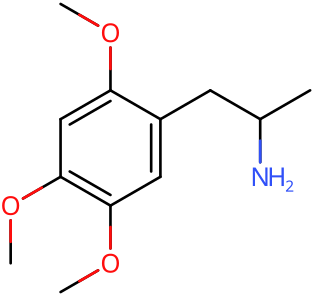
TMA-2 Stats & Data
CC(CC1=CC(=C(C=C1OC)OC)OC)NTVSIMAWGATVNGK-UHFFFAOYSA-NReceptor Profile
Receptor Actions
History & Culture
TMA-2 was first synthesized by Hungarian chemist Viktor Bruckner in 1933, but its psychoactive properties remained unrecognized for nearly three decades. Alexander Shulgin independently synthesized the compound in 1962 and conducted the first documented self-experiments to evaluate its effects. His 1964 publication described the experience as bearing similarities to mescaline, though notably lacking in chromatic visual phenomena, producing less gastrointestinal distress, and demonstrating a tendency to provoke anxiety and restlessness. The discovery of TMA-2's potency proved pivotal in the development of psychedelic phenethylamine research. Shulgin noted that simply relocating a single methoxy group from the original TMA configuration to the 2,4,5-arrangement produced an unexpected tenfold increase in effectiveness. This finding prompted systematic exploration of all six possible trimethoxy arrangements on the amphetamine backbone, yielding the compounds subsequently designated TMA-3 through TMA-6. The 2,4,5-methoxy pattern also occurs naturally in certain essential oils, with structural parallels found in the asarone compounds—α-asarone, β-asarone, and γ-asarone (also called euasarone)—establishing TMA-2 as one of the "essential amphetamines" with botanical connections. Despite its early synthesis, TMA-2 saw only minimal human use throughout the 20th century. Scattered references in early 1970s counter-culture publications describe the compound as rarely manufactured and considerably more expensive than LSD, suggesting extremely limited availability. The 1991 publication of Shulgin's comprehensive work PiHKAL brought renewed attention to the compound, yet it has remained something of an obscurity within the psychedelic community—occasionally sought as a novelty rather than a substance of particular interest. In contemporary contexts, TMA-2 is seldom encountered through conventional illicit markets and is primarily obtained through online vendors offering grey-area research chemicals.
Toxicity
PsychonautWikiToxicity studies in rats have been showed TMA-2 doses of 80 mg/kg induced frequent clonic convulsions. A dose of 120 mg/kg was associated with fatal toxic effects. It was estimated that the LD50 of mice to be 180mg/kg. The toxicity and long-term health effects of recreational TMA-2 use do not seem to have been studied in any scientific context and the exact toxic dose is unknown. This is because TMA-2 has very little history of human usage.
Effect Profile
Curated + 22 ReportsStrong visuals, auditory effects, and headspace with strong body load
Strong stimulation with strong anxiety/jitters, moderate focus, mild euphoria
Tolerance & Pharmacokinetics
drugs.wikiTolerance Decay
Acute tolerance develops within hours like other serotonergic psychedelics; functional tolerance typically halves over ~3 days and largely resolves within ~7–14 days. Cross‑tolerance with other classical psychedelics is expected via 5‑HT2A downregulation; ratios are rough heuristic values from general psychedelic literature, not TMA‑2 specific measurements.
Cross-Tolerances
Experience Report Analysis
ErowidDemographics
Gender Distribution
Age Distribution
Reports Over Time
Effect Analysis
ErowidEffects aggregated from 22 experience reports (22 single-substance Erowid)
Effect Sentiment Distribution
Confidence Distribution
Each bar is the share of reports mentioning the effect; its whisker, and the band on the rows below, is the 95% interval: where the share could plausibly be with other reports of the same kind.
Positive Effects 12
Adverse Effects 4
Show 2 neutral or unclassified mentions
Also reported in combinations. In the 10 TMA-2 reports where another drug was taken too, 0 mention hospital, emergency services or an overdose, 0 a seizure and 2 psychosis (too few reports for percentages). In the 22 single-substance reports: 0.0%, 0.0% and 4.5%. These are not in the figures above: they cannot be put down to TMA-2 alone, and a mention is not always something that happened to the writer.
Dosage Distribution
Dose distribution from experience reports, one dose per report (the first listed). Doses above Q3 + 3×IQR, far above what people typically take, are left out of the median and range and listed under each route: most are real heavy doses or overdoses, not mistakes.
Real-World Dose Distribution
ErowidFrom 42 of 45 recorded dose entries: those that state a weight (mg, g or µg), in routes with at least five of them. Values above Q3 + 3×IQR, far above what people typically take, are left out; they can include real heavy doses and overdoses, not only mistakes.
Oral (n=36)
Insufflated (n=6)
Common Combinations
Most co-occurring substances, as a share of all 32 reports filed under TMA-2; whiskers are 95% intervals
Form / Preparation
Most common forms and preparations, as a share of the 25 reports that give one; whiskers are 95% intervals
Body-Weight Dosing
Dose per kg of body weight, one dose per report (the first listed), from reports giving a weight of 30–250 kg. Doses above Q3 + 3×IQR, far above what people typically take, are left out of the median and range and listed under each route.
Redose Patterns
Redosing behavior across 26 reports
Legal Status
| Country | Status | Notes |
|---|---|---|
| Austria | Illegal (SMG) | Prohibited under the Suchtmittelgesetz (Narcotics Act). Possession, production, and sale are illegal. |
| Belgium | Illegal | Added to the list of illegal psychotropic substances on November 8, 2004. |
| Canada | Schedule III (CDSA) | Listed as 2,4,5-trimethoxyamphetamine in Schedule III of the Controlled Drugs and Substances Act. Possession and sale are prohibited. |
| Finland | Controlled | Classified as a controlled substance under Finnish drug legislation. |
| Germany | Anlage I BtMG | Controlled under Anlage I of the Betäubungsmittelgesetz (Narcotics Act) since October 10, 1999. Manufacturing, possession, import, export, purchase, sale, procurement, and dispensing without a license are illegal. |
| Greece | Controlled | Became a controlled substance on February 18, 2003. |
| Ireland | Schedule 1 | Controlled as a positional isomer of TMA (a UN-listed substance) under the Misuse of Drugs Act, similar to UK scheduling. |
| Italy | Tabella I | Added to Tabella I (list of prohibited plants and substances) by Ministry of Health decree on January 11, 2005. |
| Portugal | Controlled | Control measures enacted in January 2005 alongside 2C-I, 2C-T-2, and 2C-T-7. |
| Slovakia | Grade 2 | Added to Grade 2 (corresponding to Schedule II of the 1971 UN Convention on Psychotropic Substances) in October 2009. |
| Sweden | Class I | Placed into Class I (most restrictive category) as of March 16, 2004. |
| Switzerland | Controlled (Verzeichnis D) | Specifically named as a controlled substance under Verzeichnis D of Swiss controlled substances legislation. |
| Turkey | Illegal | Classified as a controlled drug under Turkish law. Possession, production, supply, and import are prohibited. |
| United Kingdom | Class A | Controlled as a Class A drug under the Misuse of Drugs Act 1971. Covered by the generic phenethylamine definition as a positional isomer of the UN-controlled drug TMA. Class A classification carries the most severe penalties. |
| United States | Schedule I | Controlled as a positional isomer of TMA, which is explicitly listed as a Schedule I hallucinogen under the Controlled Substances Act. Manufacturing, possession, and distribution are prohibited. |
Harm Reduction
drugs.wikiPotency and margin: PiHKAL and Erowid note active oral range roughly 20–40 mg with some users sensitive at ~10–20 mg; Shulgin cautioned the psychoactive-to-adverse dose margin may be relatively narrow, so conservative titration is prudent. Effects duration is long (often 8–12 h) with residual stimulation or difficulty sleeping for some users, so plan set/setting and sleep accordingly. Qualitative reports mention GI upset, tremor, peripheral tingling/numbness, and occasional light-headedness; at 40 mg some noted intestinal cramps/diarrhea and sleep difficulty later in the day—avoid strenuous activity early in the come-up and stay hydrated. Animal data cited by Erowid describe bradycardia and hypothermia at high doses, so people with cardiovascular or thermoregulation vulnerabilities should be extra cautious. Cross-tolerance is expected with other 5‑HT2A psychedelics (e.g., LSD, mescaline), reducing effect intensity if taken again within days; spacing experiences by at least one to two weeks minimizes tolerance and psychological strain. Combining with MAOIs can unpredictably intensify and prolong effects and has a poor safety margin; lithium with serotonergic psychedelics has credible reports of seizures and severe adverse reactions—do not combine. Because TMA-2 is rare in current markets and has occasionally been confused with other phenethylamines, use multi-reagent testing; Project Response color testing has reported green→brown shifts—use Marquis/Mandelin/Mecke and a lab if possible. Use an accurate scale; for fine measurement or sub-milligram precision, use volumetric dosing to avoid weighing error. Legal controls vary; EU Council (2003) urged Member States to control TMA‑2, and many countries have scheduled it or control it as a TMA isomer—check local law before possession, ordering, or travel.
References
Cited References
- Bluelight: TMA-2 Discussion Thread
- Bruckner (1933) - First Synthesis
- Drugs-Forum: TMA-2 Information
- EMCDDA: Risk Assessment Report - TMA-2
- Erowid: TMA-2 Basics
- Erowid: TMA-2 Experience Reports
- Erowid: TMA-2 Vault
- Kolaczynska et al. (2019) - Receptor Interaction Profiles
- PiHKAL Entry #158: TMA-2
- Shulgin (1964) - Psychotomimetic Amphetamines
- Wikipedia: 2,4,5-Trimethoxyamphetamine
- Wikipedia: Trimethoxyamphetamines
- Drug Users Bible: TMA-2
- IsomerDesign PiHKAL: TMA-2
- PiHKAL Mirror: Pihkal
Additional references
- Erowid TMA-2 Dosage
- Erowid PiHKAL #158 (TMA-2) qualitative timeline
- Erowid TMA-2 Basics (safety notes; animal bradycardia/hypothermia citations)
- Isomer Design #158 (names, identifiers)
- Project Response color test (via Isomer Design)
- EU Council Decision on 2C‑I/2C‑T‑2/2C‑T‑7/TMA‑2 controls (2003)
- Erowid LSD Interactions (lithium danger; used as general psychedelic interaction precedent)
- TripSit — Psychedelics HR (general cautions; mental health)
- Psychedelic Chemistry (Rhodium archive): cross‑tolerance notes among LSD/mescaline and likely hallucinogenic amphetamines
- TripSit volumetric dosing tool (measurement harm reduction)