
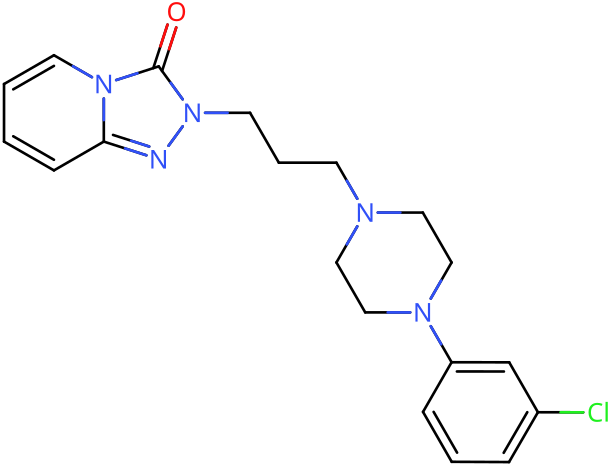
Trazodone Stats & Data
Clc1cccc(c1)N1CCN(CCCn2nc3ccccn3c2=O)CC1PHLBKPHSAVXXEF-UHFFFAOYSA-NPharmacology
DrugBankDescription
Trazodone is triazolopyridine derivative from the serotonin receptor antagonists and reuptake inhibitors (SARIs) class of antidepressants. It is used in adults and has been shown to be comparable in efficacy to other drugs such as tricyclic antidepressants (TCAs), selective serotonin reuptake inhibitors (SSRIs), and serotonin-norepinephrine receptor inhibitor (SNRIs) in the treatment of depression. A unique feature of this drug is that it does not promote the anxiety symptoms, sexual symptoms, or insomnia, which are commonly associated with SSRI and SNRI therapy. Trazodone acts on various receptors, including certain histamine, serotonin, and adrenergic receptors, distinguishing it from other antidepressants that cover a narrow range of neurotransmitters. It was initially granted FDA approval in 1981.
Mechanism of Action
The mechanism of action of trazodone is not fully understood, however, it is known to inhibit the reuptake of serotonin and block both histamine and alpha-1-adrenergic receptors. Despite the fact that trazodone is frequently considered a selective serotonin reuptake inhibitor, several reports have shown that other mechanisms including antagonism at serotonin 5-HT1a, 5-HT1c, and 5-HT2 receptor subtypes may occur. The strongest antagonism of trazodone is reported to occur at the serotonin 5-HT21c receptors, preventing serotonin uptake. In addition to acting on serotonin receptors, trazodone has been shown to inhibit serotonin transporters. The antidepressant effects of trazodone result from the inhibition of receptor uptake, which normally decreases circulating neurotransmitters, contributing to depressive symptoms.
Pharmacodynamics
Trazodone treats depressed mood and other depression-related symptoms and shows benefit in the treatment of insomnia due to its sedating effects. It is known to prolong the cardiac QT-interval. Memory, alertness, and cognition may be decreased by trazodone, especially in elderly patients due to its central nervous system depressant effects. A note on priapism Trazodone has been associated with the occurrence of priapism, a painful and persistent incidence of penile tissue erection that is unrelievable and can cause permanent neurological damage if left untreated. Patients must be advised to seek immediate medical attention if priapism is suspected.
Metabolism
Trazodone is heavily metabolized and activated in the liver by CYP3A4 enzyme to the active metabolite, m-chlorophenylpiperazine (mCPP). The full metabolism of trazodone has not been well characterized. Some other metabolites that have been identified are a dihydrodiol metabolite and carboxylic acid.
Absorption
Trazodone is rapidly absorbed in the gastrointestinal tract after oral administration, with a bioavailability ranging from 63-91% and an AUC0−t of 18193.0 ng·h/mL. Food may impact absorption in a variable fashion, and may sometimes lead to decreases in the Cmax of trazodone. In the fed state in 8 healthy volunteers, the Cmax was measured to be 1.47 +/- 0.16 micrograms/mL, and in the fasted state, was measured at 1.88 +/- 0.42 micrograms/mL. The average Tmax after a single dose of 300 mg was 8 hours. Food may increase absorption by up to 20%.
Indication
Trazodone is indicated for the treatment of major depressive disorder (MDD). It has been used off-label for adjunct therapy in alcohol dependence, and off-label to treat anxiety and insomnia. It may also be used off-label to treat symptoms of dementia, Alzheimer’s disease, schizophrenia, eating disorders, and fibromyalgia due to its effects on various neurotransmitter receptors.
Half-life
The plasma elimination half-life was markedly prolonged (13.6 versus 6 hours) elderly volunteers in the fasted state when compared with younger volunteers. Another study of 8 healthy individuals taking a single dose of trazodone indicated a terminal elimination half-life of 7.3 +/- 0.8 hr. A two-phase pattern of trazodone elimination has been reported. Initially, the half-life is reported to range from 3 to 6 hours and the second phase of elimination to range from 5 to 9 hours.
Protein Binding
The plasma protein binding of trazodone is 89-95% according to in vitro studies.
Elimination
Less than 1% of an oral dose is excreted unchanged in the urine. In a pharmacokinetic study, about 60-70% of radiolabeled was excreted urine within 48 hours. Approximately 9-29% was found to be excreted in feces over a range of 60 to 100 hours. According to the FDA medical review, the kidneys are responsible for 70 to 75% of trazodone excretion. About 21% of trazodone is reported to be excreted by the fecal route and 0.13% of the parent drug is eliminated in the urine as unchanged drug.
Volume of Distribution
A single-dose pharmacokinetic study of 8 volunteers taking trazodone determined a volume of distribution of 0.84 +/- 0.16 L/kg. The FDA medical review of trazodone reports a volume of distribution of 0.47 to 0.84 L/kg.
Clearance
A decrease in total apparent clearance (5.1 versus 10.8 L/h) was seen elderly volunteers in the fasted state when compared with younger volunteers. Another pharmacokinetic study determined the total body clearance of trazodone to be 5.3 +/- 0.9 L/hr in 8 healthy patients taking a single dose of trazodone.
Receptor Profile
Receptor Actions
Receptor Binding
Measured Affinities
Guide to PHARMACOLOGYMeasured binding and functional data for trazodone, curated by the IUPHAR/BPS Guide to PHARMACOLOGY. Each row cites the paper it came from. Lower concentrations mean tighter binding — a value in the sub-nanomolar range indicates a very potent interaction.
| Target | Action | Measure | Value | Concentration | Species | Source |
|---|---|---|---|---|---|---|
| 5-HT2A receptor HTR2A | Antagonist | pKi | 7.4 | 39.81 nM | Human | PMID 15322733 |
| 5-HT2B receptor HTR2B | Antagonist | pKi | 7.1 | 79.43 nM | Human | — |
| 5-HT2C receptor HTR2C | Antagonist | pKi | 6.6 | 251.19 nM | Human | PMID 15322733 |
| 5-HT2A receptor Htr2a | Antagonist | pKi | — | — | Rat | — |
| 5-HT2C receptor Htr2c | Antagonist | pKi | — | — | Rat | — |
Reading this. pKi, pEC50 and pIC50 are negative log molar values, so a higher number means a tighter interaction; the concentration column converts them for you. Values from non-human species are laboratory measurements and do not translate directly to human effect. Receptor affinity is not a dose — it describes what a molecule binds, not how much of it is safe to take.
Receptor data from the IUPHAR/BPS Guide to PHARMACOLOGY (v2026.2), licensed CC BY-SA 4.0. Matched to this substance by InChIKey.
History & Culture
1960s–1981
Trazodone was developed in Italy during the 1960s by Angelini Research Laboratories as a second-generation antidepressant. Its development was guided by the mental pain hypothesis, a theory derived from clinical observations proposing that major depression is associated with a decreased pain threshold. In contrast to most antidepressants available at the time, trazodone demonstrated minimal effects on muscarinic cholinergic receptors, distinguishing it pharmacologically from its predecessors. The drug was patented and marketed internationally, beginning with Italy in 1972 and West Germany in 1977. In 1981, trazodone received approval from the United States Food and Drug Administration, becoming the first antidepressant approved in the country that was neither a tricyclic nor a monoamine oxidase inhibitor. The medication has since become widely prescribed, ranking as the 21st most commonly prescribed medication in the United States by 2023 and the fifth most common antidepressant, with over 24 million prescriptions annually.
Within recreational psychedelic communities, trazodone has gained recognition as a "trip killer"—a medication employed to attenuate or terminate unwanted psychedelic experiences. By 2024, it had been recommended for this purpose 77 times on the social media platform Reddit, with suggested doses ranging from 50 to 150 mg. Among substances discussed for trip termination, trazodone ranked among the most frequently recommended, exceeded only by alprazolam, benzodiazepines as a class, and quetiapine.
The most severe reactions reported to have occurred with overdose of trazodone alone have been priapism, respiratory arrest, seizures, and ECG changes. The reactions reported most frequently have been drowsiness and vomiting. Due to trazodone's hepatic and renal metabolism, special care is necessary for patients with severe hepatic and renal impairment. Serotonin syndrome, while rare, is potentially life-threatening, presenting as a triad of mental status alteration, neuromuscular abnormality, and autonomic instability. Trazodone overdose can precipitate arrhythmias, respiratory arrest, coma, and priapism. A fatal overdose has been reported after ingesting 6.45 g of trazodone.
LD50
LD50: 96mg/kg (Intravenous, Mouse) (A308)
Carcinogenicity
No indication of carcinogenicity to humans (not listed by IARC).
Liver injury risk
Low concern (rare serious cases reported)
Tolerance & Pharmacokinetics
drugs.wikiTolerance Decay
Clinically, hypnotic efficacy may diminish over weeks if used nightly for sleep; robust, quantified tolerance models are not established. Antidepressant effects require chronic daily dosing and are not considered tolerance.
Experience Report Analysis
ErowidDemographics
Gender Distribution
Age Distribution
Reports Over Time
Effect Analysis
ErowidEffects aggregated from 42 experience reports (42 single-substance Erowid)
Effect Sentiment Distribution
Confidence Distribution
Each bar is the share of reports mentioning the effect; its whisker, and the band on the rows below, is the 95% interval: where the share could plausibly be with other reports of the same kind.
Positive Effects 3
Adverse Effects 5
Show 2 neutral or unclassified mentions
Also reported in combinations. In the 18 Trazodone reports where another drug was taken too, 2 mention hospital, emergency services or an overdose, 1 a seizure and 1 psychosis (too few reports for percentages). In the 42 single-substance reports: 9.5%, 2.4% and 0.0%. These are not in the figures above: they cannot be put down to Trazodone alone, and a mention is not always something that happened to the writer.
Dose-Response Correlation
How effect frequency changes across dose levels. Whiskers, and the numbers' hover text, give each figure's 95% interval.
Not drawn, too few reports (a dose tier needs 20): Oral Heavy (n=12). Why 20?
Dosage Distribution
Dose distribution from experience reports, one dose per report (the first listed). Doses above Q3 + 3×IQR, far above what people typically take, are left out of the median and range and listed under each route: most are real heavy doses or overdoses, not mistakes.
1 report gave a dose above the typical range (4,500 mg), so it is not in the figures above. It mentions hospital, emergency services or an overdose. Listing a dose here does not mean it is safe.
Show the report
- 4,500 mg · mentions hospital, emergency services or an overdose
Real-World Dose Distribution
ErowidFrom 94 of 101 recorded dose entries: those that state a weight (mg, g or µg), in routes with at least five of them. Values above Q3 + 3×IQR, far above what people typically take, are left out; they can include real heavy doses and overdoses, not only mistakes.
Oral (n=87)
Insufflated (n=6)
Common Combinations
Most co-occurring substances, as a share of all 60 reports filed under Trazodone; whiskers are 95% intervals
Form / Preparation
Most common forms and preparations, as a share of the 35 reports that give one; whiskers are 95% intervals
Body-Weight Dosing
Dose per kg of body weight, one dose per report (the first listed), from reports giving a weight of 30–250 kg. Doses above Q3 + 3×IQR, far above what people typically take, are left out of the median and range and listed under each route.
4 reports gave a dose above the typical range (6.012–55.147 mg/kg), so they are not in the figures above. 1 of them mentions hospital, emergency services or an overdose. Listing a dose here does not mean it is safe.
Show the reports
- 55.147 mg/kg · mentions hospital, emergency services or an overdose
- 10.02 mg/kg
- 6.299 mg/kg
- 6.012 mg/kg · another drug taken too
Redose Patterns
Redosing behavior across 51 reports
Legal Status
| Country | Status | Notes |
|---|---|---|
| Canada | Prescription only | Available as both brand name and generic prescription products. Regulated as a prescription medication under federal pharmaceutical law. Not classified as a controlled substance. |
| United States | Prescription only (FDA approved) | Granted FDA approval in 1981 for the treatment of major depressive disorder. Trazodone is not a scheduled controlled substance under the Controlled Substances Act; it is regulated as a prescription-only medication requiring a valid prescription from a licensed healthcare provider. |
Harm Reduction
drugs.wikiTrazodone is a SARI that at low doses primarily blocks 5‑HT2A/H1/alpha‑1 receptors and is sedating, while at higher antidepressant doses it also meaningfully inhibits the serotonin transporter; this dose‑dependent pharmacology explains why 25–100 mg often helps sleep but does not treat depression without daytime dosing. It should be taken after food when possible to lessen lightheadedness and orthostatic hypotension, a common early adverse effect due to alpha‑1 blockade. Clinically important risks include QT prolongation and rare torsades de pointes; combinations with other QT‑prolonging agents or in patients with cardiac disease/electrolyte derangements warrant extra caution and consideration of ECG monitoring. Priapism is a rare but serious emergency; an erection lasting more than 4 hours or painful erections require immediate ER evaluation; risk may be higher early in treatment and in those with hematologic diseases (e.g., sickle cell) or penile anatomic variants. CNS depression is additive with alcohol, benzodiazepines, Z‑drugs, opioids, and gabapentinoids; combining increases risk of respiratory depression, impaired driving, and falls—avoid or minimize and use the lowest effective doses with planned timing. Serotonin syndrome can occur when combined with MAOIs, linezolid, IV methylene blue, or other serotonergic agents (e.g., SSRIs/SNRIs/TCAs, tramadol, triptans, dextromethorphan, fentanyl, St John’s Wort); observe a 14‑day washout from MAOIs and monitor for agitation, tremor/clonus, hyperthermia, and autonomic instability. Potent CYP3A4 inhibitors (clarithromycin, azole antifungals, ritonavir) and grapefruit juice can raise trazodone exposure—leading to more sedation, hypotension, and arrhythmia risk—while CYP3A4 inducers (carbamazepine, phenytoin, rifampin, St John’s Wort) can reduce efficacy. Older adults are more susceptible to hyponatremia/SIADH and orthostatic hypotension; check sodium if confusion, headache, seizures, or falls occur, and consider dose reductions. Hepatic metabolism is primary and rare idiosyncratic liver injury has been reported; obtain baseline LFTs and recheck if clinically indicated or if symptoms (e.g., jaundice, dark urine, pruritus) develop. There are reports of increased INR with warfarin and increased digoxin levels; monitor especially after initiation or dose changes. Screen for bipolar spectrum illness before starting because antidepressant‑induced switching or mania has been reported; discontinue if mania emerges. Avoid driving, cycling, operating machinery, or engaging in safety‑critical tasks until you know your next‑day alertness; next‑morning impairment is more likely with higher doses, interactions, sleep deprivation, or when combined with other depressants. Discontinuation should be gradual to reduce rebound insomnia and withdrawal‑like symptoms (nausea, dysphoria, agitation, paresthesias).
References
Cited References
- NCBI StatPearls: Trazodone
- PLoS ONE: Dual inhibitory action of trazodone
- PsychonautWiki: Antidepressants
- PsychonautWiki: Ketamine (Trazodone interaction)
- Stahl 2009: Mechanism of Action of Trazodone
- DrugBank: Trazodone Biointeractions
- DrugBank: Trazodone Article A985
- DrugBank: Trazodone Article A181177
- DrugBank: Trazodone Salt Information