
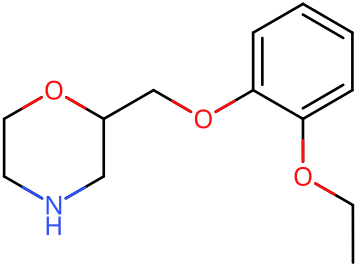
Viloxazine Stats & Data
YWPHCCPCQOJSGZ-UHFFFAOYSA-NPharmacology
DrugBankDescription
Viloxazine is a selective norepinephrine reuptake inhibitor (NRI) that was used in some European countries as an antidepressant drug. It structurally differs from conventional tri- or tetra-cyclic antidepressants and it does not produce sedative anticholinergic or adrenergic effects in man . While displaying amphetamine-like CNS stimulant effects, there is little evidence of drug dependence from viloxazine therapy. Viloxazine hydrochloride is a common active ingredient in drug formulation. It was discovered and brought to market in 1976 by Imperial Chemical Industries and in early 2000's, it was withdrawn from the market.
Mechanism of Action
Viloxazine inhibits noradrenaline uptake in rat and mouse heart tissue and has a weak effect on the uptake of 5-HT . In a docking study, the amino group of viloxazine points towards Asp75 in the drug binding pocket of the transporter and forms hydrogen bonds with Phe72, Asp75 and Phe317. The rest of the drug molecule forms hydrophobic interactions with other key residues in the binding pocket .
Pharmacodynamics
Viloxazine is a selective noradrenaline reuptake inhibitor (NRI) with minimal inhibitory effect on the reuptake of 5-HT. It is also shown to upregulate the levels of GABA-B receptors in the rat frontal cortex. It is shown to form a complex with the human norepinephrine transporter (hNET) . The S(-)-stereoisomer of viloxazine exhibits more potent pharmacological actions .
Metabolism
Viloxazine is thought to be extensively metabolized into 5-hydroxy derivative and glucuronidated phenol. Other detected metabolites include 4-hydroxy isomer and its glucuronide, together with the sulphate conjugates of the phenolic metabolites .
Absorption
Viloxazine is rapidly and almost completely absorbed following oral administration. The peak plasma concentration (Cmax) ranges between 540 and 1,600 ng/mL and the mean time to reach Cmax is approximately 86 minutes . Increase in plasma drug concentration is dose-proportional .
Indication
Indicated for the treatment of clinical depression.
Half-life
Elimination half life is approximately 3-4 hours .
Elimination
Viloxazine is rapidly eliminated via urine and about 2% of the administered dose is recovered in the feces. About 12-15% of the total drug is eliminated as unchanged parent drug .
Receptor Profile
Receptor Actions
Receptor Binding
Research conducted when the drug was first introduced recommended gastric lavage as a measure for toxic ingestion of viloxazine. However, as viloxazine is rapidly absorbed in the body, to counter the effects of the drug effectively, it is important to administer the procedure promptly after ingestion. There is no established therapeutic index of viloxazine in humans. However, clinical studies have determined safe dosage ranges. Furthermore, the literature confirms that viloxazine demonstrates significantly fewer adverse effects than other antidepressants. No deaths were reported in a study where patients were administered various doses of viloxazine ranging from 100 mg to 4 g.
Toxicity (DrugBank)
Common adverse effects are nausea and vomiting. Other side effects are dry mouth, dizziness, headache, drowsiness, sleep disturbances, bad taste, anorexia, heartburn and indigestion, constipation, diarrhoea, ataxia, tremor, dyskinesia, paraesthesia, confusion, restlessness, irritability, hypomania and mania, sweating, palpitation, tachycardia, increased and decreased blood pressure, pruritus and skin rashes .
Effect Profile
CuratedModerate stimulation and euphoria