
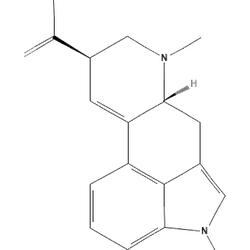
1cP-MiPLA Stats & Data
DBIYDHUGEKMIHZ-DYESRHJHSA-NReceptor Profile
Receptor Actions
History & Culture
1cP-MiPLA is a novel synthetic lysergamide that first emerged on online research chemical markets around 2020. The compound's origins remain somewhat unclear, with unverified reports attributing its initial synthesis to either Skyler Ulrich or a chemist or group operating under the name Gerstmann. It appeared alongside several other novel lysergamide derivatives, including 1cP-AL-LAD, as part of a wave of new designer psychedelics entering the grey market during this period. By 2022, the compound had been identified in Japan, indicating its spread beyond initial Western markets. Like many contemporary research chemicals, 1cP-MiPLA was developed and distributed primarily through online vendors catering to the research chemical community, with limited formal scientific investigation into its properties beyond forensic identification studies.
Toxicity
PsychonautWikiThe toxicity and long-term health effects of recreational 1cP-MiPLA use do not seem to have been studied in any scientific context and the exact toxic dose is unknown. This is because 1cP-MiPLA is a research chemical with very little history of human usage. The body of anecdotal reports suggests that there are no negative health effects attributed to simply trying the substance by itself at low to moderate doses and using it very sparingly (but nothing can be completely guaranteed). Independent research should always be done to ensure that a combination of two or more substances is safe before consumption. As with other psychedelic substances, there are relatively few physical side effects that have been reported associated with acute 1cP-MiPLA exposure.
Overdose
The LD50 of 1cP-MiPLA is unknown. Adverse psychological reactions are common especially at higher dosages. Some of these include anxiety, delusions, panic attacks and more rarely seizures.
Addiction & dependence
Although no formal studies have been conducted, it is not unreasonable to assume that as with LSD itself, 1cP-MiPLA is not habit-forming and that the desire to use it can actually decrease with use. Tolerance to the effects of 1cP-MiPLA is built almost immediately after ingestion. After that, it takes about 5-7 days for the tolerance to be reduced to half and 14 days to be back at baseline (in the absence of further consumption).
Effect Profile
CuratedStrong visuals and auditory effects with moderate headspace and body load
Tolerance & Pharmacokinetics
drugs.wikiTolerance Decay
Functional tolerance to lysergamides rises rapidly within a single session and decays over 5–14 days; acute redosing beyond ~45–60 min is typically inefficient. Cross‑tolerance is expected across serotonergic psychedelics that act via 5‑HT2A.
Cross-Tolerances
Legal Status
| Country | Status | Notes |
|---|---|---|
| Austria | Unscheduled (NPSG may apply) | Not specifically scheduled, but may fall under the Neue-Psychoaktive-Substanzen-Gesetz (New Psychoactive Substances Act) as an analogue of LSD. |
| Germany | Illegal | Controlled substance as of July 2021. Possession, production, and distribution are prohibited. |
| Russia | Schedule I | Classified as a schedule I controlled substance under Russian drug control legislation. |
| Switzerland | Controlled (Verzeichnis E) | Listed as a defined derivative of Lysergic Acid under Verzeichnis E point 263 of the controlled substances ordinance. Exempt when used for scientific or industrial purposes. |
| United States | Unscheduled | Not specifically scheduled under the Controlled Substances Act. However, may be prosecuted as an analogue of LSD under the Federal Analogue Act when intended for human consumption. |
Harm Reduction
drugs.wiki1cP‑MiPLA is a 1‑cyclopropionyl‑substituted lysergamide; by analogy to 1‑acyl LSD analogues, it is expected to hydrolyze in vivo to MiPLA and act primarily as a prodrug. Direct human pharmacokinetics are uncharacterized; assume delayed onset vs. parent amide and plan set/setting accordingly. Potency appears materially lower than LSD and highly product‑dependent; multiple user datasets report weak or threshold effects at 200 \u0000b5g and full effects at 300–800 \u0000b0g, highlighting the need to start low and titrate. Reagent tests: Ehrlich/Hofmann can ‘rule‑in’ an indole/lysergamide but cannot confirm identity or dose; only LC/MS‑based drug checking can. Some market blotters labeled as 1cP‑MiPLA have tested impure (e.g., significant iso‑isomers and unidentified byproducts), potentially reducing expected potency and altering side‑effect profile. Lysergamides produce rapid, pronounced acute tolerance—redosing after the first hour generally adds side‑effects and duration more than intensity. Like LSD, risks include anxiety/panic, vasoconstriction, hyperthermia in strenuous settings, and insomnia; a sober sitter, hydration, and temperature management reduce complication risk. Avoid if you have a history of psychosis or bipolar I; defer use during pregnancy. Leave at least 14 days between serotonergic psychedelic sessions to minimize tolerance stacking and potential HPPD risk. Never drive or engage in hazardous activities until fully baseline (often the next day).
References
Data Sources
Cited References
- Halberstadt A.L. et al. Pharmacological characterization of novel lysergamides including MiPLA. Neuropharmacology (2020)
- Tanaka R. et al. Identification of LSD analogs, 1cP-AL-LAD, 1cP-MIPLA, 1V-LSD and LSZ in sheet products. Forensic Science International (2023)
- TripSit: Drug Combinations Chart
- TripReport.net substance overview: 1cP-MiPLA
- Wagmann L. et al. Analysis of LSD analogs (1cP-MiPLA, 1cP-LSD, etc.) in seized blotters. Forensic Toxicology (2021)
Additional references
- Isomer Design – MIPLA entry (synonyms, structure)
- Halberstadt et al. Neuropharmacology 2020 – 1‑acyl LSDs act as prodrugs; reduced 5‑HT2A efficacy but in vivo activity via deacylation
- EUDA (EMCDDA) LSD drug profile – onset, duration, half‑life, dependence profile, set/setting risks
- Erowid – LSD Health & Warnings (psychosis risk, hyperthermia, tolerance, HPPD)
- Erowid – LSD Interactions (lithium seizure reports; ergotamine + ritonavir ergotism caution)
- TripSit – Drug combinations chart (general cautions for psychedelics with stimulants, MAOIs, tramadol; benzos reduce effects)
- Reddit – ‘WARNING: Very bad quality lysergamide blotters …’ (LC/MS shows 1cP‑MiPLA blotters with ~20% iso‑isomer + impurities)
- Reddit – multiple 1cP‑MiPLA reports (dose/strength variability; short duration; weak at 200 \u0000b5g; sometimes 300–800 \u0000b5g needed)
- Erowid Crew Blog – reagent testing limits; Ehrlich/Hofmann ‘rule‑in’ only, cannot confirm identity or dose