
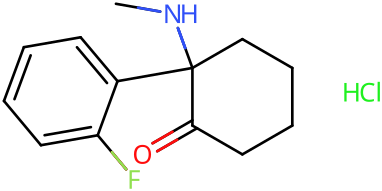
2-FDCK Stats & Data
CNC1(CCCCC1=O)c1ccccc1FPHFAGYYTDLITTB-CYBMUJFWSA-NHistory & Culture
The synthesis of 2-fluorodeschloroketamine was first described in a 2013 scientific paper as part of a broader effort to synthesize and evaluate novel anesthetic compounds based on ketamine and its structural analogues. Despite this early documentation, the compound's origins as a recreational substance remain poorly established. It first emerged on the online research chemical market around 2017, where it was marketed as a legal alternative to ketamine. Its introduction followed the successful market entry of the related analogue deschloroketamine. The compound was first formally notified to the European Monitoring Centre for Drugs and Drug Addiction (EMCDDA) in 2016, alongside 65 other new psychoactive substances. Due to its relatively recent emergence, limited scientific research has been conducted on the compound. In January 2023, the Israeli biotechnology company Clearmind Medicine Inc. announced the completion of a preclinical study examining 2-fluorodeschloroketamine in a rat model of depression, with results suggesting the compound produced longer-lasting antidepressant effects compared to ketamine.
Toxicity
PsychonautWikiThe toxicity and long-term health effects of recreational 2-Fluorodeschloroketamine use do not seem to have been studied in any scientific context and the exact toxic dosage is unknown. This is because 2-Fluorodeschloroketamine has very little history of human usage. Anecdotal evidence from people who have tried 2-Fluorodeschloroketamine within the community suggests that there do not seem to be any negative health effects attributed to simply trying this drug at low to moderate doses by itself and using it sparingly (but nothing can be completely guaranteed). It is strongly recommended that one use harm reduction practices when using this drug.
Addiction & dependence
As with other NMDA receptor antagonists, the chronic use of 2-Fluorodeschloroketamine can be considered moderately addictive with a high potential for abuse and is capable of causing psychological dependence among certain users. When addiction has developed, cravings and withdrawal effects may occur if a person suddenly stops their usage. Tolerance to many of the effects of 2-Fluorodeschloroketamine develops with prolonged and repeated use.
Effect Profile
Curated + 7 ReportsStrong dissociative depth with strong motor impairment and mania, low insight
Duration Timeline
BluelightCommunity Effects
TripSitTolerance & Pharmacokinetics
drugs.wikiTolerance Decay
Cross-Tolerances
Experience Report Analysis
ErowidDemographics
Gender Distribution
Too few reports for a chart: gender is known from 17 reports, and a split is drawn only from 20 reports or more. Counts are shown instead. Why 20?
- Male 11 of 17
- Not Specified 5 of 17
- Female 1 of 17
Age Distribution
Reports Over Time
Effect Analysis
ErowidEffects aggregated from 7 experience reports (7 single-substance Erowid)
Effect Sentiment Distribution
Confidence Distribution
Each bar is the share of reports mentioning the effect; its whisker, and the band on the rows below, is the 95% interval: where the share could plausibly be with other reports of the same kind.
Too few reports for bars: these effects come from 7 single-substance Erowid reports, and a bar is drawn only from 20 reports or more. With fewer, a percentage cannot tell a common effect from a rare one. Counts are shown instead. Why 20?
Positive Effects 3
Adverse Effects 1
Show 2 neutral or unclassified mentions
Real-World Dose Distribution
ErowidFrom 37 of 45 recorded dose entries: those that state a weight (mg, g or µg), in routes with at least five of them. Values above Q3 + 3×IQR, far above what people typically take, are left out; they can include real heavy doses and overdoses, not only mistakes.
Insufflated (n=23)
Oral (n=13)
Common Combinations
Most co-occurring substances, as a share of all 17 reports filed under 2-FDCK
Too few reports for bars: these combinations come from 17 reports, and a bar is drawn only from 20 reports or more. With fewer, a percentage cannot tell a common effect from a rare one. Counts are shown instead. Why 20?
- THC 4 of 17
- Alcohol 3 of 17
Form / Preparation
Most common forms and preparations, as a share of the 12 reports that give one
Too few reports for bars: these forms come from 12 reports, and a bar is drawn only from 20 reports or more. With fewer, a percentage cannot tell a common effect from a rare one. Counts are shown instead. Why 20?
- Powder / Crystals 7 of 12
- Liquid 3 of 12
Body-Weight Dosing
Dose per kg of body weight, one dose per report (the first listed), from reports giving a weight of 30–250 kg. Doses above Q3 + 3×IQR, far above what people typically take, are left out of the median and range and listed under each route.
Redose Patterns
Redosing behavior across 15 reports
Too few reports for a chart: redosing is known from 15 reports, and a split is drawn only from 20 reports or more. Counts are shown instead. Why 20?
- Single dose 5 of 15
- Redosed 10 of 15
Legal Status
| Country | Status | Notes |
|---|---|---|
| Austria | Illegal (NPSG) | Controlled under the Neue-Psychoaktive-Substanzen-Gesetz (New Psychoactive Substances Act). Possession, production, and sale are prohibited. |
| Belgium | Illegal (blanket ban) | Covered by blanket ban legislation on new psychoactive substances. |
| Canada | Potentially controlled (CDSA Schedule I) | Not specifically listed in the Controlled Drugs and Substances Act but may be considered controlled under Schedule I as an analogue of phencyclidine or derivative of ketamine due to structural similarity. |
| Germany | Controlled (NpSG) | Controlled under the Neue-psychoaktive-Stoffe-Gesetz (New Psychoactive Substances Act) as of July 18, 2019. Production and import with intent to market, administration to others, and trading are punishable offenses. Possession is illegal but not subject to criminal penalty. |
| Italy | Schedule I (Tabella I) | Listed as a controlled substance in Tabella I of Italian drug scheduling legislation. Production, sale, and possession are prohibited. |
| Japan | Illegal | Controlled as a designated substance under Japanese drug legislation. |
| Latvia | Illegal | Prohibited substance under national controlled substances legislation. |
| Singapore | Illegal | Controlled under national drug legislation. Singapore maintains strict drug laws with severe penalties. |
| Sweden | Illegal | Classified as a controlled substance under Swedish narcotics legislation. |
| Switzerland | Controlled (Verzeichnis E) | Specifically named as a controlled substance under Verzeichnis E of Swiss narcotics scheduling. |
| Turkey | Illegal | Classified as a controlled drug. Possession, production, supply, and import are prohibited. |
| United Kingdom | Class B | Controlled under the Misuse of Drugs Act 1971. As an N-alkyl derivative of 2-amino-2-phenylcyclohexanone with a halide substituent in the phenyl ring, it falls under the arylcyclohexylamine generic clause added by S.I. 2013/239, effective February 26, 2013. Possession, production, supply, and import are illegal. |