
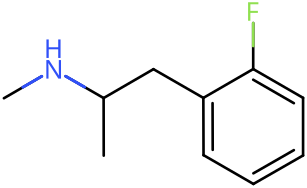
2-FMA Stats & Data
CNC(C)Cc1ccccc1FXNWIKJYFOIDUGD-UHFFFAOYSA-NInteraction Warnings
2-FMA can be potentially dangerous in combination with other stimulants as it can increase one's heart rate and blood pressure to dangerous levels.
The neurotoxic effects of MDMA may be increased when combined with amphetamines.
This combination may increase strain on the heart.
Receptor Profile
Receptor Actions
History & Culture
2-FMA emerged on the online research chemical market in August 2007, appearing alongside other fluorinated amphetamines such as 2-FA and 4-FA. That same month, forensic analysis of capsules delivered to Royal Adelaide Hospital in Australia revealed the presence of 2-FMA. The capsules appeared to have originated from Neorganics, an Israeli company that was distributing drug-containing capsules internationally under various brand names, with the 2-FMA-containing product marketed as "Sub Coca 2." Analysis found the capsules contained 2-FMA in combination with α-phthalimidopropiophenone. Despite its early appearance on the market, 2-FMA remained relatively obscure for several years. The substance was first reported to the European Monitoring Centre for Drugs and Drug Addiction in 2012, with most user reports emerging from 2013 onward. An analysis of 162 seized drug samples in Italy between September 2013 and June 2015 found 2-FMA present in only a small number of samples, indicating its limited prevalence compared to other novel psychoactive substances during this period. The compound remains unknown in clinical and research literature, with virtually no formal pharmacological studies published. At least one fatality has been reported in connection with 2-FMA, though in that case the substance appeared to have been mislabeled. A male in his early twenties who had purchased what he believed to be 4-FMA online used it in combination with 3-MMC and codeine/acetaminophen tablets. He became unresponsive within minutes of administration and could not be resuscitated by paramedics. Subsequent toxicological analysis determined the substance was actually 2-FMA rather than 4-FMA, highlighting the risks associated with mislabeled research chemicals purchased from online vendors. Within online drug communities, 2-FMA has gained some attention as a component of the "Borax Combo," a combination designed to produce effects similar to MDMA. One common formulation combines 2-FMA with 5-MAPB and 4-HO-MET, with 2-FMA serving primarily to provide the stimulant component of the mixture.
Subjective Effects
In comparison to other substituted amphetamines, 2-FMA is particularly free of side effects such as nausea, high blood pressure, anxiety and an uncomfortable offset. It is considered to be an extremely functional and effective psychoactive substance for performing general productivity tasks of any sort. However, at higher doses, it becomes less of a productivity boost and more for recreational purposes due to the intensity of its euphoria and stimulation.
Physical
The physical effects of 2-FMA can be broken down into several components which progressively intensify proportional to dosage.
- Stimulation
- Tactile enhancement
- Physical euphoria
- Dehydration
- Appetite suppression
- Increased heart rate
- Increased perspiration
Cognitive
The cognitive effects of 2-FMA can be broken down into several components which progressively intensify proportional to dosage.
- Thought acceleration
- Focus enhancement
- Anxiety suppression
- Wakefulness
- Analysis enhancement
- Motivation enhancement
- Compulsive redosing
- Cognitive fatigue: This effect can occur during the offset of this compound as a rebound effect which is usually equal in its intensity to the enhancements which occurred before it.
Forked from Subjective Effect Documentation by Josie Kins, September 2015. Via dose.wiki (CC0).
Toxicity
PsychonautWikiThe toxicity and long-term health effects of recreational 2-FMA use do not seem to have been studied in any scientific context and the exact toxic dosage is unknown. This is because 2-FMA has a very limited history of human usage. Anecdotal reports from those who have tried 2-FMA suggest that there do not seem to be any negative health effects attributed to simply trying this substance at low to moderate doses by itself or using it sparingly (but nothing can be completely guaranteed). It is strongly recommended that one use harm reduction practices when using this substance.
Addiction & dependence
As with other stimulants, the chronic use of 2-FMA can be considered moderately addictive with a high potential for abuse and is capable of causing psychological dependence among certain users. When addiction has developed, cravings and withdrawal effects may occur if a person suddenly stops their usage. Tolerance to many of the effects of 2-FMA develops with prolonged and repeated use.
Effect Profile
CuratedStrong euphoria and focus with strong anxiety/jitters, mild stimulation
Tolerance & Pharmacokinetics
drugs.wikiTolerance Decay
Cross-Tolerances
Legal Status
| Country | Status | Notes |
|---|---|---|
| Canada | Schedule I (CDSA) | Controlled since 1996 as an analogue of methamphetamine under the Controlled Drugs and Substances Act. Manufacturing, possession, and distribution are prohibited. |
| China | Controlled | Designated a controlled substance in October 2015. Production, sale, and possession are prohibited under national drug control regulations. |
| France | Not explicitly scheduled | As of December 2024, 2-FMA is not specifically listed in French drug schedules. Possession exists in a legal grey area, though this status could change. |
| Germany | Anlage I BtMG | Listed under Anlage I of the Betäubungsmittelgesetz (Narcotics Act, Schedule I) since December 13, 2014. Manufacturing, possession, import, export, purchase, sale, procurement, and dispensing without a license are illegal. Violations are punishable by fines or imprisonment up to five years. |
| Netherlands | Legal (grey area) | Currently unscheduled, though it falls within a substance group that may be subject to prohibition under recently passed New Psychoactive Substances legislation. |
| New Zealand | Schedule 3 | Controlled as an amphetamine analogue under the Misuse of Drugs Act. Possession, supply, and manufacture carry criminal penalties. |
| Switzerland | Controlled (Verzeichnis E) | Specifically named under Verzeichnis E of Swiss controlled substances regulations. Unauthorized possession and distribution are prohibited. |
| Turkey | Illegal | Classified as a controlled drug. Possession, production, supply, and importation are prohibited under Turkish drug legislation. |
| Ukraine | Narcotic (controlled) | Classified as a narcotic substance since July 2019. Possession, distribution, and production are illegal under Ukrainian law. |
| United Kingdom | Class A | Controlled under the amphetamine analogue clause of the Misuse of Drugs Act 1971. Class A substances carry the most severe penalties, including up to seven years imprisonment for possession and life imprisonment for supply. |
| United States | Unscheduled | Not specifically scheduled under the Controlled Substances Act. However, as a close structural analogue of methamphetamine, sale or possession with intent for human consumption could potentially be prosecuted under the Federal Analogue Act. |
References
Data Sources
Cited References
- Bluelight: 2-FMA Megathread
- Camilleri et al. - Chemical profiling of 2-FMA capsules, Forensic Sci Int 197:59-66 (2010)
- Erowid Experience: A Clean Productivity Stimulant
- Erowid Experience: A College Student's Best Friend
- Erowid Experience: A More Functional Adderall
- Erowid Experience: Best of The Bunch
- Qualitative study on NPS self-medication, Addict Behav 138:107468 (2023)
- Shanks et al. - In-vitro metabolism of fluorinated amphetamines, Drug Test Anal 7:203-212 (2015)
- Soh & Elliott - Identification and quantitative analysis of 2-FMA metabolites in human urine, J Anal Toxicol (2023)
- Reddit: r/tripreports – 2-FMA report emphasising insomnia & dose-response (2022)