
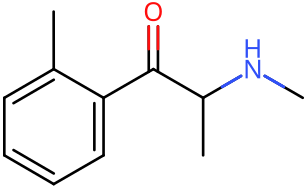
2-MMC Stats & Data
[Cl-].CNC(C)C(=O)c1ccccc1C.[H+]BNZJHCPXDZXUMH-UHFFFAOYSA-NReceptor Profile
Receptor Actions
History & Culture
2-Methylmethcathinone emerged as a novel psychoactive substance during the mid-2010s wave of synthetic cathinone proliferation. The compound was first identified by Swedish authorities in 2014, representing one of the later positional isomers of mephedrone to appear on the recreational drug market. Following its initial detection in Sweden, 2-MMC subsequently spread to other European countries, with reports of its presence emerging from Poland and Spain. As a structural relative of the more widely known mephedrone (4-MMC) and 3-methylmethcathinone (3-MMC), 2-MMC appeared during a period when cathinone derivatives were being systematically explored by clandestine chemists seeking legal alternatives to controlled stimulants. The compound has remained relatively obscure compared to its positional isomers, which gained greater prominence in both recreational use and regulatory attention.
Effect Profile
Curated + 4 ReportsStrong sensory enhancement with moderate stimulation, mild euphoria, low empathy
Moderate euphoria and focus with moderate anxiety/jitters, mild stimulation
Tolerance & Pharmacokinetics
drugs.wikiTolerance Decay
Experience Report Analysis
ErowidDemographics
Gender Distribution
Too few reports for a chart: gender is known from 4 reports, and a split is drawn only from 20 reports or more. Counts are shown instead. Why 20?
- Male 3 of 4
- Not Specified 1 of 4
Age Distribution
Reports Over Time
Effect Analysis
ErowidEffects aggregated from 4 experience reports (4 single-substance Erowid)
Effect Sentiment Distribution
Confidence Distribution
Each bar is the share of reports mentioning the effect; its whisker, and the band on the rows below, is the 95% interval: where the share could plausibly be with other reports of the same kind.
Too few reports for bars: these effects come from 4 single-substance Erowid reports, and a bar is drawn only from 20 reports or more. With fewer, a percentage cannot tell a common effect from a rare one. Counts are shown instead. Why 20?
Positive Effects 3
Adverse Effects 0
Form / Preparation
Most common forms and preparations, as a share of the 4 reports that give one
Too few reports for bars: these forms come from 4 reports, and a bar is drawn only from 20 reports or more. With fewer, a percentage cannot tell a common effect from a rare one. Counts are shown instead. Why 20?
- Powder / Crystals 4 of 4
Legal Status
| Country | Status | Notes |
|---|---|---|
| Germany | NpSG (controlled) | Controlled under the Neue-psychoaktive-Stoffe-Gesetz (New Psychoactive Substances Act). Sale, production with intent to sell, and administration to others are criminal offenses. Possession is prohibited but not subject to criminal penalties. |
| Poland | Illegal (Group I-P) | Prohibited as a psychotropic substance under Group I-P. Although not explicitly named in scheduling lists, it is controlled as an isomer of 3-MMC and mephedrone (4-MMC), which are scheduled substances. |
| United Kingdom | Class B | Controlled under the Misuse of Drugs Act 1971. Class B substances carry penalties of up to 5 years imprisonment for possession and up to 14 years for supply or production. |
| United States | Schedule I | Controlled under the Controlled Substances Act as a hallucinogenic substance. Regulated as a positional isomer of mephedrone (4-MMC), which places it automatically under Schedule I classification. |
References
Data Sources
Cited References
- Brandt et al. 2020 - Pharmacological profiling of ortho-mephedrone (2-MMC)
- Eshleman et al. 2013 - Substituted methcathinones differ in transporter and receptor interactions
- Erowid: 2-MMC Experience Reports
- EUDA: Initial Report - 2-Methylmethcathinone (2-MMC)
- NDEWS: Web Monitoring Alert - Online mentions of 2-MMC
- PsychonautWiki: 2-MMC
- Simmler et al. 2014 - Monoamine transporter and receptor interaction profiles of designer cathinones
- TripSit: 2-MMC Fact Sheet
- Eshleman et al. 2013 – Substituted cathinones as monoamine transporter substrates
- User reports compilation – r/ResearchChemicals: “2-MMC turns me into a sex fiend” (Reddit, 2024)
- Bluelight thread: “2-MMC, dopaminergic euphoria?” (2024)