
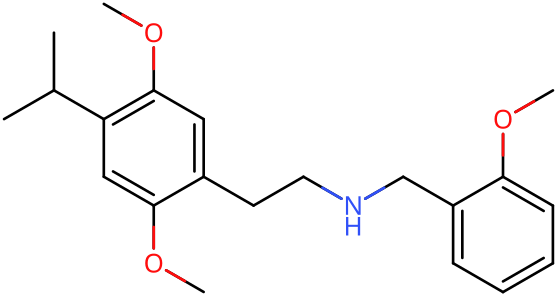
25iP-NBOMe Stats & Data
KMZZEEDFQLXSQF-UHFFFAOYSA-NReceptor Profile
Receptor Actions
History & Culture
25iP-NBOMe emerged as a novel designer drug and was first documented in the scientific literature around 2014. Like other members of the NBOMe series, it represents an N-benzyl modification of an existing 2C-x compound—in this case, 2C-iP. The substance remains relatively obscure compared to more widely encountered NBOMe compounds such as 25I-NBOMe or 25C-NBOMe, with limited information available regarding its history of human use or cultural significance.
Effect Profile
CuratedStrong visuals with strong body load, mild auditory effects, low headspace
Moderate euphoria with strong anxiety/jitters, low stimulation
Tolerance & Pharmacokinetics
drugs.wikiTolerance Decay
Acute tolerance develops rapidly after a single strong session (typical of 5‑HT2A agonists). Substantial tolerance persists for days and decays over 1–3+ weeks; precise kinetics for 25iP‑NBOMe are not characterized. Cross‑tolerance with other psychedelics is expected but unquantified; ratios are heuristic. Data quality relies on class‑level evidence and user reports, not controlled human studies.
Cross-Tolerances
Legal Status
| Country | Status | Notes |
|---|---|---|
| United Kingdom | Class A | Controlled under the Misuse of Drugs Act 1971 through the N-benzylphenethylamine catch-all clause, which covers NBOMe compounds as a structural class. Class A substances carry the most severe penalties, with possession punishable by up to 7 years imprisonment and supply by up to life imprisonment. |
Harm Reduction
drugs.wiki• Microgram potency; never eyeball. Use a 0.001 g (or better) scale and volumetric dosing. NBOMe powders are too potent for typical scales; uneven blotter loading is commonly reported.
• Do not assume oral inactivity. For NBOMes, oral bioavailability can be unreliable rather than absent; delayed effects have led to hazardous redosing. Prefer buccal administration if using at all.
• Strong peripheral vasoconstriction and sympathomimetic toxicity have been repeatedly reported with NBOMes (tachycardia, hypertension, cold or numb extremities). Risk increases steeply ≥1 mg.
• Misrepresentation on LSD-style blotter is common; NBOMe tabs are typically bitter/metallic and can numb the mouth. Test blotters: Ehrlich/Hofmann positive suggests lysergamide; NBOMes do not react with Ehrlich and show distinct Marquis reactions.
• Avoid combinations with stimulants, MAOIs, DXM, or tramadol. These increase risks of hypertension, hyperthermia, seizures, and serotonin toxicity.
• Re-dosing strongly increases unpredictability, body-load, and adverse events; wait at least 3 h before concluding inactivity when identity is uncertain.
• Severe agitation, seizures, or hyperthermia require urgent medical care. First-line in hospital is supportive care with benzodiazepines and cooling; mention suspected NBOMe to clinicians.
• Nasal dosing increases speed of onset and adverse body-load; irritation and pronounced vasoconstriction are common. Avoid dry powder insufflation.
• Keep the environment cool, avoid prolonged physical exertion, and sip fluids with electrolytes to mitigate hyperthermia risk; do not overhydrate.
• People with cardiovascular disease, Raynaud’s phenomenon, or seizure history should avoid the NBOMe class entirely due to elevated risk.
• Distinguish from LSD: LSD blotter is typically nearly tasteless and fluoresces under UV; NBOMe blotters are often bitter/metallic and may not fluoresce. Always rely on reagents/drug checking, not taste alone.
References
Data Sources
Cited References
- Bluelight: The Small & Handy 25iP-NBOMe Thread (user reports and dosing)
- Ettrup A et al. 'Structure-Activity Relationships of NBOMe 5-HT2A Agonists' Journal of Neurochemistry 2013
- King LA 'New phenethylamines in Europe' Drug Testing and Analysis 2014
- Nichols DE 'Psychedelics' Pharmacological Reviews 2016
- PiHKAL·info – 25IP-NBOMe Chemical Structure and Properties
- Poulie CBM et al. 'Correlating the Metabolic Stability of Psychedelic 5-HT2A Agonists with Anecdotal Reports of Human Oral Bioavailability' Neurochemical Research 2014
- Rickli A et al. 'Receptor interaction profiles of novel N-2-methoxybenzyl (NBOMe) derivatives of 2,5-dimethoxy-substituted phenethylamines (2C drugs)' Neuropharmacology 2015
- TripSit: 25iP-NBOMe Summary
- Wood DM et al. 'Prevalence of use and acute toxicity associated with the use of NBOMe drugs' Clinical Toxicology 2015
- Zawilska JB, Kacela M, Adamowicz P 'NBOMes–Highly Potent and Toxic Alternatives of LSD' Frontiers in Neuroscience 2020
- Nichols DE. ‘Psychedelics’ Pharmacol Rev 2016 (general NBOMe toxicity)
Additional references
- TripSit Wiki – NBOMes (dosing, oral activity nuance, harm reduction)
- Bluelight – Important NBOMe warning: unknown blotters sold as LSD (taste, testing, oral activity caveat)
- Erowid – NBOMe Series: Spotlight on NBOMes (vasoconstriction, misrepresentation on blotter)
- EUDA/EMCDDA – 25I‑NBOMe Risk Assessment (toxicity profile; hyperthermia, seizures; severe agitation)
- Saferparty.ch – 25x‑NBOMe sold as LSD (drug checking warnings; bitter taste; re‑dose hazards; 3‑hour wait)
- PubMed – Review of NBOMe acute toxicity (tachycardia, hypertension, seizures, hyperthermia)