
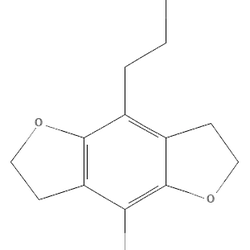
2C-B-FLY-NBOMe Stats & Data
CUFCITSPWAZWHS-UHFFFAOYSA-NReceptor Profile
Receptor Actions
History & Culture
2C-B-FLY-NBOMe was discovered in 2002 and subsequently researched by Ralf Heim at the Free University of Berlin. The compound was later investigated in greater detail by a research team at Purdue University led by pharmacologist David E. Nichols. Structurally, the substance represents a hybrid design that combines the rigid benzodifuran ring system characteristic of the FLY series with the N-benzyl substitution pattern found in NBOMe compounds.
Effect Profile
CuratedStrong visuals and headspace with strong body load, moderate auditory effects
Strong sensory enhancement with moderate stimulation, mild euphoria, low empathy
Tolerance & Pharmacokinetics
drugs.wikiTolerance Decay
Rapid 5‑HT2A desensitization produces short-term tachyphylaxis (hours–days). Functional tolerance typically halves within ~1 week and returns to near-baseline by 2–3 weeks; cross-tolerance with other classic psychedelics is expected but not fully quantified.
Cross-Tolerances
Legal Status
| Country | Status | Notes |
|---|---|---|
| United Kingdom | Class A | Controlled under the Misuse of Drugs Act 1971 through the N-benzylphenethylamine catch-all clause, which encompasses N-benzyl substituted phenethylamine derivatives. Class A substances carry the most severe penalties under UK law. |
| United States | Controlled (Vermont) | Designated as a controlled substance in the state of Vermont since January 2016. State-level scheduling; federal status may vary. |
Harm Reduction
drugs.wiki• Identity/testing: Because NBOMes are frequently sold on blotter as “acid,” always test. LSD gives a purple positive on Ehrlich reagent and typically fluoresces under UV; NBOMes do not fluoresce and have distinct reagent patterns. Marquis/Mecke are unreliable for confirming LSD but can flag NBOMe-like reactions; reagent testing cannot prove identity, only rule-in/out patterns. Use multiple reagents and, where possible, lab drug-checking.
• Oral activity nuance: NBOMes were long thought orally inactive when swallowed, but some salts show measurable oral bioavailability. Do not assume a swallowed NBOMe blotter is inactive; discard blotter after buccal/sublingual application rather than swallowing if avoiding further exposure.
• Microgram potency & volumetric dosing: Overdoses often stem from mismeasurement/static loss. Volumetric dosing substantially reduces risk: dissolve a precisely weighed amount into an appropriate solvent (e.g., high-proof ethanol or propylene glycol for poor water solubility), clearly label concentration, and measure volume for dosing.
• Route risk: Intranasal use is linked to a disproportionate number of severe cases (agitation, hyperthermia, seizures, ischemia). If used intranasally, reduce dose substantially versus buccal/sublingual and avoid co-stimulants.
• Vasoconstriction & heat risk: NBOMes can cause marked peripheral vasoconstriction (cold/numb digits, pallor/cyanosis) and hyperthermia/rhabdomyolysis at high doses. Keep ambient temperature moderate, avoid overexertion, and hydrate with electrolytes. Urgent care is indicated for chest pain, extreme agitation, limb discoloration/numbness, confusion, seizures, or hot/dry skin and altered consciousness.
• Combination risks: Avoid serotonergic combinations (e.g., MDMA, DXM) due to serotonin toxicity; avoid stimulants (cocaine/amphetamines) due to compounding vasoconstriction/arrhythmia risk; avoid tramadol due to seizures. Cannabis and dissociatives can unpredictably potentiate effects—go slowly or avoid.
• Acute management (for bystanders/clinicians): Calm, cooling, fluids and benzodiazepines are commonly used for severe agitation; antipsychotics may be used by professionals for frank psychosis but are not first-line for simple panic. Seek medical help early for hyperthermia or severe hypertension. Do not self-medicate with additional substances during a crisis.
• Mislabeling: EU and US monitoring documented NBOMes sold as LSD or 2C drugs on blotter and as powders; treat unknown “LSD-like” blotter with caution.
• Metabolism: Across NBOMe analogs studied in human liver microsomes and animals, major pathways include O-demethylation and N-debenzylation; inter-individual variability is likely. This may prolong or intensify effects in some users; titrate cautiously and avoid redosing in the same session.
• Solubility/handling: Freebase NBOMes are poorly water-soluble; solutions in high-proof ethanol or mixed PEG-400/ethanol are used by some to prepare 50–500 µg/mL standards. Label and store away from light/heat; prevent skin/mucosa exposure when handling powders or solutions.
• Tolerance/spacing: Response varies between sessions; a steep dose-response and rapid tolerance mean that redosing often adds side effects more than benefits. Space sessions by 2–3+ weeks to reduce tachyphylaxis and psychological after-load.
References
Data Sources
Cited References
- Bluelight: The Big & Dandy 2C-B-FLY-NBOMe thread
- Erowid: 2C-B-FLY vault
- Ettrup A et al. Radiosynthesis and in vivo evaluation of a series of substituted 11C-phenethylamines as 5-HT2A agonist PET tracers
- Nykodemova N et al. 2C-B-Fly-NBOMe Metabolites in Rat Urine, Human Liver Microsomes and C. elegans
- Richter LHJ et al. Tools for studying the metabolism of new psychoactive substances
- Syrova K et al. Acute pharmacological profile of 2C-B-Fly-NBOMe in male Wistar rats
- Syrová K et al. Acute pharmacological profile of 2C-B-FLY-NBOMe in male Wistar rats.
- PubMed: 36969854
Additional references
- Syrová K et al. Acute pharmacological profile of 2C‑B‑FLY‑NBOMe in male Wistar rats.
- Erowid NBOMe Series – Effects and duration pages (incl. 2C‑C‑NBOMe).
- Erowid 25I‑NBOMe Dose page – ROA, freebase vs HCl vs HPBCD note.
- Erowid: LSD Field Tests Differentiate LSD from 25I‑NBOMe (Ehrlich positive for LSD; UV fluorescence difference).
- Erowid Crew Blog – On-site drug checking; LSD vs NBOMe reagent/UV behaviors; Marquis unreliability for LSD.
- TripSit Wiki – NBOMes overview (oral activity nuance; combination cautions).
- TripSit – Quick Guide to Volumetric Dosing; volumetric calculator.
- NBOMes – Highly Potent and Toxic Alternatives of LSD (review with fatalities, hyperthermia, rhabdomyolysis).
- Postmortem detection of 25I‑NBOMe in tissues/fluids (fatal case).
- 25CN‑NBOMe metabolites in HLM/rat/C. elegans – O‑demethylation and N‑debenzylation pathways (generalizable within class).
- Erowid Psychedelic Crisis FAQ – first aid, benzodiazepines commonly used clinically for severe agitation.
- EU Drugs Agency (EMCDDA/EUDA) Joint Report on 25I‑NBOMe – mis‑selling on blotter; non‑fatal intoxications incl. insufflation.
- Erowid NBOMe Series – Dose overview and potency warnings.
- Erowid 2C‑C‑NBOMe page – vasoconstriction, seizure/rhabdomyolysis reports (NBOMe class signal).
- Bluelight ‘Big & Dandy 2C‑B‑FLY‑NBOMe’ (community reports inc. solubility/handling issues).