
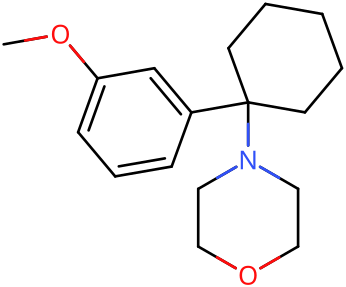
3-MeO-PCMo Stats & Data
COc1cccc(c1)C1(CCCCC1)N1CCOCC1BOGOEDFWPOXWQE-UHFFFAOYSA-NReceptor Profile
Receptor Actions
Receptor Binding
History & Culture
3-MeO-PCMo is a novel dissociative substance that emerged on the gray market as a designer drug in the mid-2010s. It became available primarily through online research chemical vendors, where it was marketed alongside other novel arylcyclohexylamines. As a relatively obscure compound, it has accumulated only a limited history of human use compared to more established dissociatives. While 3-MeO-PCMo itself lacks extensive documentation, morpholine-substituted analogues of phencyclidine have appeared in earlier pharmacological research. However, comprehensive studies on this specific compound remain scarce, and most available information derives from anecdotal reports within online psychonaut communities rather than formal scientific investigation.
Subjective Effects
Physical
- Spontaneous tactile sensations: The 3-MeO-PCMo body high is a soft, warm, motionless and pleasurable tingling sensation which is all-encompassing across the body and not location specific to any area.
- Decreased bodily weight: This creates the sensation that the body is floating and has become entirely weightless. This effect is strangely stimulating and encourages physical activities at low to moderate doses by making the body feel light and effortless to move.
- Nausea: High dose 3-MeO-PCMo trips can sometimes result in nausea and vomiting at the peak of the trip. For most people, this is surprisingly not as unpleasant as they would initially expect due to the accompanying detachment from the physical senses.
- Motor control loss: A loss of gross and fine motor control alongside of balance and coordination is prevalent within 3-MeO-PCMo and becomes especially strong at higher doses.
- Physical euphoria
- Tactile disconnection
- Tactile suppression
- Physical autonomy
Cognitive
The general head space of 3-MeO-PCMo is often described as simplistic and shallow in comparison to that of MXE and ketamine.
- Depersonalization
- Derealization
- Consciousness disconnection
- Memory suppression
- Thought deceleration
- Immersion enhancement
- Information processing suppression
- Time distortion
- Cognitive euphoria
- Introspection
- Déjà vu
- Conceptual thinking
- Anxiety suppression
- Disinhibition
- Amnesia
Sensory
- Suppression
- Distortions
- Hallucinations
- Perspective distortions
- Visual disconnection: This eventually results in the 3-MeO-PCMo equivalent of the famous 'k-hole' or, more specifically, holes, spaces and voids alongside of structures.
- Double vision: This component is prevalent at moderate to heavy doses and makes reading impossible unless one closes an eye.
- Pattern recognition suppression: This effect generally occurs at higher doses and makes one unable to recognize and interpret perceivable visual data.
- Visual acuity suppression
Forked from Subjective Effect Documentation by Josie Kins, July 2015. Via dose.wiki (CC0).
Toxicity
PsychonautWikiThe toxicity and long-term health effects of recreational 3-MeO-PCMo use do not seem to have been studied in any scientific context and the exact toxic dosage is unknown. This is because 3-MeO-PCMo has very little history of human usage. Anecdotal evidence from people who have tried 3-MeO-PCMo within the community suggest that there do not seem to be any negative health effects attributed to simply trying this drug at low to moderate doses by itself and using it sparingly (but nothing can be completely guaranteed). Independent research should always be done to ensure that a combination of two or more substances is safe before consumption. It is strongly recommended that one use harm reduction practices when using this substance to ensure the administration of the intended dose.
Effect Profile
Curated + 2 ReportsStrong dissociative depth with strong mania and motor impairment, mild insight
Duration Timeline
BluelightTolerance & Pharmacokinetics
drugs.wikiTolerance Decay
Pattern inferred from dissociative-class use; high uncertainty due to sparse PCMo-specific data. Many user reports suggest meaningful cross-tolerance within arylcyclohexylamines; long spacing between sessions (2–6 weeks) helps restore sensitivity.
Cross-Tolerances
Experience Report Analysis
ErowidDemographics
Gender Distribution
Too few reports for a chart: gender is known from 2 reports, and a split is drawn only from 20 reports or more. Counts are shown instead. Why 20?
- Male 2 of 2
Age Distribution
Reports Over Time
Legal Status
| Country | Status | Notes |
|---|---|---|
| Germany | Controlled (NpSG) | Controlled under the Neue-psychoaktive-Stoffe-Gesetz (New Psychoactive Substances Act) as of July 18, 2019. Production and import with intent to distribute, administration to others, and trading are punishable offenses. Possession is technically illegal but not subject to criminal penalties. |
| Switzerland | Controlled (Verzeichnis E) | Specifically named as a controlled substance under Verzeichnis E of Swiss narcotics legislation. Production, distribution, and possession without authorization are prohibited. |
| United Kingdom | Controlled (Psychoactive Substances Act) | Controlled under the Psychoactive Substances Act 2016, which took effect on May 26, 2016. Production, supply, and importation are illegal. Notably, 3-MeO-PCMo falls outside the generic arylcyclohexylamine definition in the Misuse of Drugs Act 1971 because its morpholine substituent is not covered by that legislation. Simple possession outside of custodial institutions is not criminalized under the PSA. |
Harm Reduction
drugs.wiki• Potency is far lower than 3‑MeO‑PCP, with many reports placing active oral and insufflated ranges in the 100–200+ mg area; always confirm identity with reagent or lab testing and start with a micro‑allergy test (1–3 mg). • Onset can lag 30–60 minutes orally; avoid redosing for at least 2 hours to prevent accidental stacking and unexpectedly strong intoxication. • Maintain a safe environment: dissociatives can impair balance and judgment while leaving users ambulatory; falls, wandering, and risk-taking behavior are documented with related analogues. • Nasal use: crystals are reported as poorly water‑soluble; insufflation may be inefficient and irritating—consider oral administration if choosing to proceed. • Hydration and bladder care matter: chronic/high‑frequency use of dissociatives has been linked to urinary tract symptoms (best practice is to limit frequency and maintain hydration). • Strong CNS depressant combinations (alcohol, GHB/GBL, opioids) markedly increase risks of unconsciousness, aspiration, and respiratory compromise—avoid these mixes. • If someone becomes severely confused, agitated, or unresponsive, seek medical care; supportive management, temperature control, and benzodiazepines for agitation are commonly used in clinical settings. • Tolerance builds quickly across the dissociative class; spacing sessions by several weeks reduces risk of escalation and adverse effects. • Due to extremely limited formal data and frequent mislabeling in the unregulated market, treat all material with caution; use drug checking services where available and avoid driving or hazardous activities for at least 12–24 hours after significant dosing.
References
Data Sources
Cited References
- Abiero et al. 2020 - 4-MeO-PCP and 3-MeO-PCMo rewarding effects (PubMed)
- Colestock et al. 2018 - Syntheses and pharmacological characterizations of 3-MeO-PCMo (PubMed)
- Drug Users Bible - 3-MeO-PCMo
- Erowid: Experience Vaults - 3-MeO-PCMo
- TripSit: Factsheet - 3-MeO-PCMo
- TripSit: Factsheet – 3-MeO-PCMo
Additional references
- Drug Users Bible – 3-MeO-PCMo field report (doses/onset, qualitative effects)
- Bluelight – The Small & Handy 3‑MeO‑PCMo Thread (community dosing timelines; solubility; onset/duration)
- Erowid – 3‑MeO‑PCP Effects & Duration (ambulatory delirium risk; dissociative HR context)
- Erowid – 3‑MeO‑PCP Dose page (dose–risk notes; redosing cautions)
- TripSit Wiki – Dissociatives (HR: driving, injury risk, bladder issues; overdose management practices)
- Drug Checking Community – supply variability and unexpected contents (general mislabeling risk)