
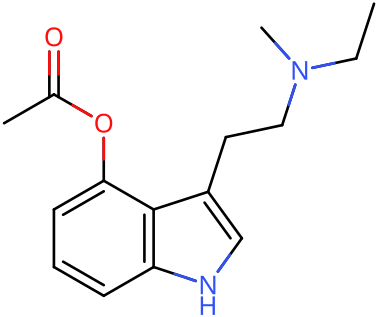
4-AcO-MET Stats & Data
CCN(C)CCc1cnc2cccc(OC(C)=O)c12OMDKHOOGGJRLLX-UHFFFAOYSA-NHistory & Culture
4-AcO-MET, also known as metacetin, is a novel synthetic tryptamine that emerged primarily through the online research chemical market. As an acetate ester of 4-HO-MET and a structural homologue of 4-AcO-DMT, it represents one of many acetylated tryptamine derivatives that have been synthesized and distributed in recent decades. The compound has very little documented history of human use compared to more established psychedelics. Unlike substances such as psilocybin or LSD, which have decades of clinical research and cultural significance, 4-AcO-MET remains relatively obscure with minimal data regarding its pharmacological properties, metabolism, or toxicity profile. Its availability has been primarily limited to online research chemical vendors, where it is marketed alongside other novel tryptamine analogues.
Subjective Effects
Physical
The physical effects of 4-AcO-MET can be broken down into three components all of which progressively intensify proportional to dosage.
- Spontaneous tactile sensations: The 'body high' of 4-AcO-MET can be described as a pleasurable, warm, soft and all-encompassing tingling sensation. This maintains a consistent presence that steadily rises with the onset and hits its limit once the peak has been reached.
- Sedation: In terms of its effects on the physical energy levels of the tripper, 4-AcO-MET is considered by most to be relaxing, stoning and mildly sedating. This sense of sedation is often accompanied by compulsive yawning.
- Nausea
Cognitive
The cognitive effects of 4-AcO-MET are described by many as somewhat relaxing, yet fast-paced in style with similarities to psychedelics such as LSD or 2C-B which tend to be cognitively energetic and stimulating.
- Enhancement of current mind state
- Connectivity of thought
- Acceleration of thought
- Feelings of fascination, importance and awe
- Time distortion
- Outrospection
- Thought loops
- Removal of cultural filter
- Conceptual thinking
- Direct communication with the subconscious
- Ego suppression, loss and death
- Feelings of interdependent opposites
- Delusions
- States of unity and interconnectedness
Sensory
- Enhancements
- Distortions
- Hallucinations
- Visual drifting: (Melting, Flowing, Breathing and morphing) - In comparison to other psychedelics, this effect can be described as highly detailed, cartoon-like in style, slow and smooth in motion and static in appearance.
- Tracers
- After images
- Texture repetition
- Colour shifting
- Scenery slicing
- Increased visual acuity
- Enhancement of colour
- Enhanced pattern recognition
4-AcO-MET and its various other forms produce a full range of high level hallucinatory states in a fashion that is more consistent and reproducible than that of many other commonly used psychedelics.
- Transformations
- Internal hallucinations: (Autonomous entities, Settings, sceneries, and landscapes, Alterations in perspective and Scenarios and plots) - This effect is very consistent in dark environments at appropriately high dosages. They can be comprehensively described through their variations as lucid in believability, interactive in style, new experiences in content, autonomous in controllability, geometry-based in style and almost exclusively of a religious, spiritual, mystical, science fiction or transcendental nature in overall theme.
Forked from Subjective Effect Documentation by Josie Kins, August 2014. Via dose.wiki (CC0).
Toxicity
PsychonautWikiThe toxicity and long-term health effects of recreational 4-AcO-MET use do not seem to have been studied in any scientific context and the exact toxic dose is unknown. This is because 4-AcO-MET is a research chemical with very little history of human usage. Anecdotal evidence suggests that there are no negative health effects attributed to simply trying the drug by itself at low to moderate doses and using it very sparingly (but nothing can be completely guaranteed). Independent research should always be done to ensure that a combination of two or more substances is safe before consumption. It is strongly recommended that one use harm reduction practices when using this substance.
Effect Profile
Curated + 20 ReportsStrong visuals, headspace, and auditory effects with moderate body load
Tolerance & Pharmacokinetics
drugs.wikiTolerance Decay
Cross-Tolerances
Demographics
Gender Distribution
Age Distribution
Reports Over Time
Effect Analysis
Erowid + BluelightEffects aggregated from 20 experience reports (7 single-substance Erowid + 13 Bluelight)
Effect Sentiment Distribution
Confidence Distribution
Each bar is the share of reports mentioning the effect; its whisker, and the band on the rows below, is the 95% interval: where the share could plausibly be with other reports of the same kind.
Rows resting on fewer than 20 reports show a count (“3 of 7”) instead of a bar. Why 20?
Positive Effects 50
Adverse Effects 24
Show 4 more adverse effects
Show 13 neutral or unclassified mentions
Also reported in combinations. In the 16 4-AcO-MET reports where another drug was taken too, 0 mention hospital, emergency services or an overdose, 0 a seizure and 2 psychosis (too few reports for percentages). In the 7 single-substance reports: 0, 0 and 0. These are not in the figures above: they cannot be put down to 4-AcO-MET alone, and a mention is not always something that happened to the writer.
Dosage Distribution
Dose distribution from experience reports, one dose per report (the first listed). Doses above Q3 + 3×IQR, far above what people typically take, are left out of the median and range and listed under each route: most are real heavy doses or overdoses, not mistakes.
1 report gave a dose above the typical range (83 mg), so it is not in the figures above. Listing a dose here does not mean it is safe.
Show the report
- 83 mg · another drug taken too
Real-World Dose Distribution
ErowidFrom 39 of 44 recorded dose entries: those that state a weight (mg, g or µg), in routes with at least five of them. Values above Q3 + 3×IQR, far above what people typically take, are left out; they can include real heavy doses and overdoses, not only mistakes.
Oral (n=38)
Common Combinations
Most co-occurring substances, as a share of all 23 reports filed under 4-AcO-MET; whiskers are 95% intervals
Form / Preparation
Most common forms and preparations, as a share of the 11 reports that give one
Too few reports for bars: these forms come from 11 reports, and a bar is drawn only from 20 reports or more. With fewer, a percentage cannot tell a common effect from a rare one. Counts are shown instead. Why 20?
- Capsule 6 of 11
- Powder / Crystals 5 of 11
Body-Weight Dosing
Dose per kg of body weight, one dose per report (the first listed), from reports giving a weight of 30–250 kg. Doses above Q3 + 3×IQR, far above what people typically take, are left out of the median and range and listed under each route.
Redose Patterns
Redosing behavior across 13 reports
Too few reports for a chart: redosing is known from 13 reports, and a split is drawn only from 20 reports or more. Counts are shown instead. Why 20?
- Single dose 11 of 13
- Redosed 2 of 13
Legal Status
| Country | Status | Notes |
|---|---|---|
| Germany | NpSG (Controlled) | Controlled under the Neue-psychoaktive-Stoffe-Gesetz (New Psychoactive Substances Act) as of July 18, 2019. Production, import with intent to market, administration to others, and trading are punishable offenses. Possession is illegal but not subject to criminal penalty. Ordering may potentially constitute incitement to place on the market. |
| Switzerland | Controlled (Verzeichnis E) | Specifically named as a controlled substance under Verzeichnis E of Swiss narcotics legislation. |
| United Kingdom | Class A | Controlled as a Class A substance under the Misuse of Drugs Act 1971. Classification stems from being an ester of 4-HO-MET, which itself is controlled under the tryptamine catch-all clause. |
| United States | Unscheduled | Not specifically scheduled under the Controlled Substances Act. However, as a structural analogue of psilocin (a Schedule I substance), sale for human consumption or use for illicit non-medical purposes could potentially be prosecuted under the Federal Analogue Act. |