
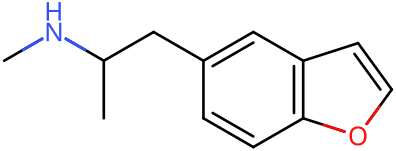
5-MAPB Stats & Data
CNC(C)Cc1ccc2occc2c1ZOVRTIPCNFERHY-UHFFFAOYSA-NReceptor Profile
Receptor Actions
History & Culture
5-MAPB emerged on the designer drug market around 2010 as part of the wave of novel benzofuran entactogens developed as alternatives to controlled substances like MDMA. The compound was first formally identified and documented by researchers in 2013, with the initial scientific literature describing its properties published in 2014. Following its appearance on the recreational market and subsequent scheduling in multiple countries, 5-MAPB has attracted interest for potential therapeutic applications. The compound has been patented by Tactogen, a pharmaceutical company exploring entactogens as candidates for development into regulated medicines.
Toxicity
PsychonautWikiThe toxicity and long-term health effects of recreational 5-MAPB use do not seem to have been studied in any scientific context and the exact toxic dosage is unknown. This is because 5-MAPB has very little history of human usage. Anecdotal evidence from people who have tried 5-MAPB within the community suggest that there do not seem to be any negative health effects attributed to simply trying this drug at low to moderate doses by itself and using it sparingly (but nothing can be completely guaranteed). 5-MAPB's notable agonism at the serotonin-2b (5-HT2b) receptor (which has been associated with cardiovalvulopathy) suggests that it would be cardiotoxic with long-term use, as seen in other 5-HT2B agonists such as fenfluramine and MDMA. It is strongly recommended that one use harm reduction practices when using this drug.
Effect Profile
Curated + 23 ReportsMild auditory effects with strong body load, low visuals and headspace
Strong sensory enhancement, empathy, and euphoria with moderate stimulation
Strong euphoria and focus with strong anxiety/jitters, mild stimulation
Duration Timeline
BluelightTolerance & Pharmacokinetics
drugs.wikiNo tolerance chart. No study has measured how long tolerance to it lasts, so this page shows what is known instead of a curve.
No study has measured tolerance to 5-MAPB in people; research so far is on cells, rodents and poisoning cases. PsychonautWiki estimates that tolerance halves in 3-7 days and is gone in 1-2 weeks, and user advice collected by drugs.wiki suggests at least 4-6 weeks between sessions; neither cites a source.
Sources: Brandt et al. 2020 · Hofer et al. 2017 · PsychonautWiki: 5-MAPB · drugs.wiki (user consensus)
Cross-Tolerances
Demographics
Gender Distribution
Age Distribution
Reports Over Time
Effect Analysis
Erowid + BluelightEffects aggregated from 23 experience reports (8 single-substance Erowid + 15 Bluelight)
Effect Sentiment Distribution
Confidence Distribution
Each bar is the share of reports mentioning the effect; its whisker, and the band on the rows below, is the 95% interval: where the share could plausibly be with other reports of the same kind.
Rows resting on fewer than 20 reports show a count (“3 of 7”) instead of a bar. Why 20?
Positive Effects 35
Adverse Effects 12
Show 14 neutral or unclassified mentions
Also reported in combinations. In the 13 5-MAPB reports where another drug was taken too, 0 mention hospital, emergency services or an overdose, 0 a seizure and 1 psychosis (too few reports for percentages). In the 8 single-substance reports: 0, 0 and 0. These are not in the figures above: they cannot be put down to 5-MAPB alone, and a mention is not always something that happened to the writer.
Real-World Dose Distribution
ErowidFrom 43 of 45 recorded dose entries: those that state a weight (mg, g or µg), in routes with at least five of them. Values above Q3 + 3×IQR, far above what people typically take, are left out; they can include real heavy doses and overdoses, not only mistakes.
Oral (n=36)
Insufflated (n=5)
Common Combinations
Most co-occurring substances, as a share of all 21 reports filed under 5-MAPB; whiskers are 95% intervals
Form / Preparation
Most common forms and preparations, as a share of the 11 reports that give one
Too few reports for bars: these forms come from 11 reports, and a bar is drawn only from 20 reports or more. With fewer, a percentage cannot tell a common effect from a rare one. Counts are shown instead. Why 20?
- Powder / Crystals 7 of 11
- Capsule 4 of 11
Redose Patterns
Redosing behavior across 13 reports
Too few reports for a chart: redosing is known from 13 reports, and a split is drawn only from 20 reports or more. Counts are shown instead. Why 20?
- Single dose 7 of 13
- Redosed 6 of 13
Legal Status
| Country | Status | Notes |
|---|---|---|
| Canada | Potentially illegal (analogue) | Not specifically listed in the Controlled Drugs and Substances Act. May be considered an analogue of Schedule I amphetamines due to structural relation to MDMA. This legal interpretation has not been tested in court. |
| China | Controlled substance | Classified as a controlled substance since October 2015. |
| Finland | Banned | Scheduled under the government decree on psychoactive substances banned from the consumer market. |
| France | Narcotic | Classified as a narcotic substance since May 9, 2018, alongside other benzofuran-derived compounds. |
| Germany | NpSG controlled | Controlled under the Neue-psychoaktive-Stoffe-Gesetz (New Psychoactive Substances Act) since November 26, 2016. Production, import for market distribution, administration to others, and trading are criminally punishable. Possession is prohibited but not subject to criminal penalty. |
| Japan | Controlled substance | Designated as a controlled substance effective August 15, 2015. |
| Luxembourg | Legal | As of July 2021, not listed among prohibited substances and remains legal for possession and personal use. |
| Switzerland | Controlled (Verzeichnis E) | Specifically named as a controlled substance under Verzeichnis E of Swiss narcotics legislation. |
| United Kingdom | Class B, Schedule 1 | Initially placed under a Temporary Class Drug order in June 2013 following ACMD recommendation. Permanently classified as a Class B, Schedule 1 substance on June 10, 2014, alongside all other benzofuran entactogens and structurally related compounds. |
| United States | Unscheduled (Analogue Act may apply) | Not specifically scheduled under federal law. However, due to structural similarity to MDA and MDMA, sales for human consumption or possession with intent to ingest could potentially be prosecuted under the Federal Analogue Act, though no such cases are known. |
Harm Reduction
drugs.wiki• Dose guidance and durations for 5‑MAPB are primarily derived from collated user reports (few formal human data); Erowid lists oral 30–70 mg common, 60–120 mg strong, and 3–6 h total duration with ~12 h after‑effects. Treat all ranges as tentative and start low.
• Reagent test every sample. Typical reactions: Marquis purple/black/brown, Mecke dark brown/black/smoky gray, Mandelin dark purple/purple‑brown, Simons dark blue. Color tones vary by batch and reagent age; lab testing provides definitive ID.
• Significant batch‑to‑batch variability has been reported by experienced users; some ‘magic’ batches were far more potent than others. This increases overdose/side‑effect risk if dosing by memory.
• Hyperthermia and hyponatremia are leading causes of severe harm with MDMA‑like drugs. Take breaks from dancing/heat, and sip isotonic fluids (roughly up to ~500 ml per hour max; do not overhydrate). Seek urgent care for confusion, severe agitation, very high temperature, or seizures.
• First‑line ED management of stimulant/empathogen toxicity uses rapid external cooling for hyperthermia plus IV benzodiazepines (e.g., lorazepam 2 mg or equivalent) for agitation; these principles apply to MDMA‑like benzofurans as well.
• Avoid MAOIs, DXM, tramadol, PMA/PMMA and poly‑stimulant combos: these elevate serotonin syndrome, seizure, and overheating risk. Use TripSit’s combination chart as a cross‑reference when evaluating combos.
• 5‑HT2B activation is linked to valvular heart disease with serotonergic agonists (e.g., fenfluramine; MDMA shows some activity). Benzofurans 5‑/6‑APB show 5‑HT2B agonism in vitro; by structural analogy, 5‑MAPB may share this liability. Space uses widely (≥4–6 weeks) and minimize lifetime exposure as a prudent precaution. [Mechanistic and clinical context for 5‑HT2B–valvulopathy risk.]
• Standard immunoassay drug screens typically do not test for 5‑MAPB unless targeted; detection windows are unknown. Do not rely on this to avoid detection.
• IM/IV routes increase infection, vascular, and dosing risks without clear benefit; if someone insists on injecting any drug, harm‑reduction groups stress sterile equipment and low‑dead‑space syringes—but oral remains the least risky ROA for this class.
• Consider volumetric dosing and accurate milligram scales to avoid measurement error, especially for non‑oral routes or boosters.
• Drug checking programs have repeatedly found unexpected contents and mislabeling in NPS; where available, use lab services for confirmation.
• Cannabis can either smooth or destabilize the experience; several users report increased confusion/anxiety when combined during peaks—approach cautiously.
References
Cited References
- Baumann et al. (2020) - Psychoactive Aminoalkylbenzofuran Derivatives
- Bluelight: The Main 5-MAPB Thread
- Dawson et al. (2014) - Effects of Benzofury on Dopamine Transporter
- Erowid: Experience Vaults - 5-MAPB
- Fuwa et al. (2016) - Benzofurans Increase Extracellular Serotonin
- Hofer et al. (2016) - Acute Toxicity of 5-MAPB Case Report
- Iversen et al. (2013) - Neurochemical Profiles of Novel Psychoactive Substances
Additional references
- Erowid 5‑MAPB – overview
- Erowid 5‑MAPB – dose
- Erowid 5‑MAPB – effects/duration
- Erowid 5‑MAPB – testing & reagent colors
- Bluelight – The Main 5‑MAPB Thread (batch variability)
- Bluelight – 5‑MAPB/6‑APB reagent notes
- TripSit – drug combinations (general chart)
- StatPearls – MDMA toxicity (hyperthermia/benzodiazepines/cooling)
- DrugWise – Ecstasy: harm reduction (hydration limits, cooling)
- Erowid – MDMA water intoxication page (isotonic fluids)
- Isomer Design (Isomer Design) – 5‑MAPB synonyms/identifiers
- Toronto’s Drug Checking Service – example market bulletins
- StatPearls – Drug‑induced valvular disease (5‑HT2B mechanism; context)