
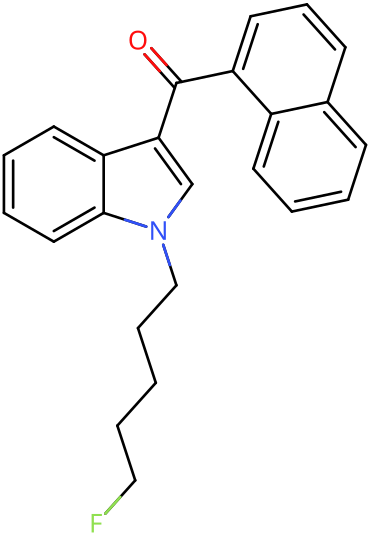
AM-2201 Stats & Data
FCCCCCn1cc(C(=O)c2cccc3ccccc23)c2ccccc12ALQFAGFPQCBPED-UHFFFAOYSA-NReceptor Profile
Receptor Actions
Measured Affinities
Guide to PHARMACOLOGYMeasured binding and functional data for AM2201, curated by the IUPHAR/BPS Guide to PHARMACOLOGY. Each row cites the paper it came from. Lower concentrations mean tighter binding — a value in the sub-nanomolar range indicates a very potent interaction.
| Target | Action | Measure | Value | Concentration | Species | Source |
|---|---|---|---|---|---|---|
| CB1 receptor Cnr1 | Agonist | pKi | 9 | 1 nM | Rat | — |
| CB2 receptor Cnr2 | Agonist | pKi | 8.59 | 2.57 nM | Mouse | — |
| CB1 receptor CNR1 | Agonist | pEC50 | 7.42 | 38.02 nM | Human | PMID 25921407 |
| CB2 receptor CNR2 | Agonist | pEC50 | 7.23 | 58.88 nM | Human | PMID 25921407 |
Reading this. pKi, pEC50 and pIC50 are negative log molar values, so a higher number means a tighter interaction; the concentration column converts them for you. Values from non-human species are laboratory measurements and do not translate directly to human effect. Receptor affinity is not a dose — it describes what a molecule binds, not how much of it is safe to take.
Receptor data from the IUPHAR/BPS Guide to PHARMACOLOGY (v2026.2), licensed CC BY-SA 4.0. Matched to this substance by InChIKey.
Effect Profile
Curated + 18 ReportsModerate visuals with mild auditory effects and body load
Tolerance & Pharmacokinetics
drugs.wikiTolerance Decay
Model is heuristic from user reports: tolerance builds within days of heavy use and decays over weeks. Cross-tolerance with THC is partial; with other full-agonist SCRAs it is stronger.
Cross-Tolerances
Experience Report Analysis
ErowidDemographics
Gender Distribution
Age Distribution
Reports Over Time
Effect Analysis
ErowidEffects aggregated from 18 experience reports (18 single-substance Erowid)
Effect Sentiment Distribution
Confidence Distribution
Each bar is the share of reports mentioning the effect; its whisker, and the band on the rows below, is the 95% interval: where the share could plausibly be with other reports of the same kind.
Too few reports for bars: these effects come from 18 single-substance Erowid reports, and a bar is drawn only from 20 reports or more. With fewer, a percentage cannot tell a common effect from a rare one. Counts are shown instead. Why 20?
Positive Effects 3
Adverse Effects 6
Show 6 neutral or unclassified mentions
Also reported in combinations. In the 11 AM-2201 reports where another drug was taken too, 5 mention hospital, emergency services or an overdose, 1 a seizure and 1 psychosis (too few reports for percentages). In the 18 single-substance reports: 7, 3 and 1. These are not in the figures above: they cannot be put down to AM-2201 alone, and a mention is not always something that happened to the writer.
Real-World Dose Distribution
ErowidFrom 5 of 9 recorded dose entries: those that state a weight (mg, g or µg), in routes with at least five of them. Values above Q3 + 3×IQR, far above what people typically take, are left out; they can include real heavy doses and overdoses, not only mistakes.
Smoked (n=5)
Form / Preparation
Most common forms and preparations, as a share of the 16 reports that give one
Too few reports for bars: these forms come from 16 reports, and a bar is drawn only from 20 reports or more. With fewer, a percentage cannot tell a common effect from a rare one. Counts are shown instead. Why 20?
- Powder / Crystals 13 of 16
- Plant Material 2 of 16
Redose Patterns
Redosing behavior across 18 reports
Too few reports for a chart: redosing is known from 18 reports, and a split is drawn only from 20 reports or more. Counts are shown instead. Why 20?
- Single dose 17 of 18
- Redosed 1 of 18
Harm Reduction
drugs.wikiAM-2201 is an extremely potent full agonist at CB1/CB2 receptors; microgram-level errors are clinically relevant. Volumetric dosing (dissolving a weighed amount into a measured volume) greatly lowers overdose risk compared with sprinkling powder or using uneven herbal blends. Herbal/incense products often contain highly variable amounts per gram; uneven distribution produces ‘hot hits’ and overdose clusters. Fast onset/short duration (especially inhaled) strongly promotes compulsive redosing; pre-portion doses and impose a waiting period to reduce escalation. Acute toxicity can include severe anxiety/agitation, hypertension, tachyarrhythmia, hyperthermia, hyperemesis, seizures, and in some cases acute kidney injury; seek urgent care for chest pain, persistent vomiting, confusion, seizures, or dark urine. Avoid hot environments and vigorous exertion during intoxication due to hyperthermia/rhabdomyolysis risk; sip fluids but do not overhydrate. Do not mix with stimulants or tramadol; both raise seizure and cardiovascular risks. Depressants (alcohol, opioids, benzodiazepines) increase sedation and aspiration risk; polydrug fatalities are well-documented with potent SCRAs. Adulteration/mislabelling is common: some ‘cannabis’ vapes and herbal products have contained potent SCRAs, occasionally far stronger than AM-2201; use trusted sources, prefer lab-verified materials, and avoid unknown cartridges. If dependent, a gradual taper or transition to lower-potency cannabinoids (with support) is safer than abrupt stop; expect days of sleep and mood disturbance. Do not drive or operate machinery for several hours after effects resolve; psychomotor impairment and rebound anxiety persist beyond the peak.
References
Data Sources
Cited References
- TripSit: Wiki – AM-2201
- Ginsburg BC et al., Seizure liability of AM-2201 in mice, Neuropharmacology 2012
- Seely KA et al., Synthetic cannabinoid acute toxicity, Clin Toxicol 2012
- Miliano C et al., Abuse potential of synthetic cannabinoids, Curr Addict Rep 2017
- Wai MS et al., Adverse health effects of synthetic cannabinoids, Forensic Sci Int 2017
Additional references
- PubChem – AM2201
- TripSit – main site (volumetric dosing tool, combo app links)
- TripSit wiki – Cannabinoid E-liquid (solvent choice, PG/VG mixing)
- EMCDDA Council Decision on MDMB-CHMICA (context: high potency & variability; AM-2201 controlled under 1971 Convention)
- EMCDDA European Drug Report 2024 – Highlights (adulteration of cannabis products with SCRAs)
- StatPearls – Cannabinoid Toxicity (synthetic cannabinoids: seizures, hyperthermia, rhabdomyolysis, renal failure)
- Erowid – AM-2201 Difficult Experiences (severe adverse events)
- Erowid – AM-2201 Bad Trips (psychosis-like reactions, panic)
- Erowid Crew Blog – NYC K2 warning (withdrawal, unpredictability)
- Drugs-Forum – CDC MMWR summary: Acute Kidney Injury associated with synthetic cannabinoids (2012)
- Isomer Design – AM-2201 entry (synonyms/identifiers)
- TripSit wiki – Sources for Laboratory Analysis (drug checking services)
- Bluelight – ‘Spice’ user discussion (short duration, narrow safety window, seizure anecdotes)