
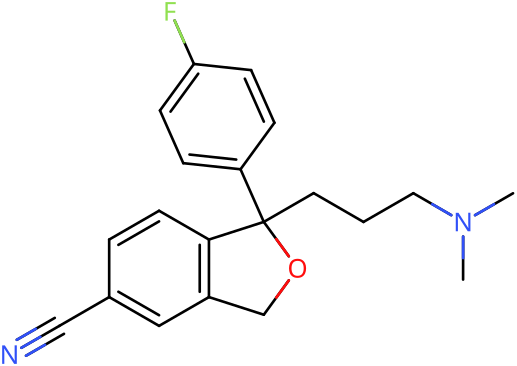
Citalopram Stats & Data
N#Cc1ccc2c(COC2(CCCN(C)C)c2ccc(F)cc2)c1WSEQXVZVJXJVFP-UHFFFAOYSA-NPharmacology
DrugBankDescription
Citalopram belongs to a class of antidepressant agents known as selective _serotonin-reuptake inhibitors_ (SSRIs) and is widely used to treat the symptoms of depression. Its chemical structure is unrelated to that of other SSRIs or of tricyclic, tetracyclic, or other prescribed antidepressants . Citalopram is also known as _Celexa_, and available in tablet and solution forms . This drug was initially approved by the FDA in 1998 .
Mechanism of Action
The mechanism of action of citalopram results from its inhibition of CNS neuronal reuptake of serotonin (5-HT) . The molecular target for citalopram is the serotonin transporter (solute carrier family 6 member 4, _SLC6A4_), inhibiting its serotonin reuptake in the synaptic cleft . Citalopram binds with significantly less affinity to histamine, acetylcholine, and norepinephrine receptors than tricyclic antidepressant drugs . This drug has no or neglible affinity for _5-HT1A_, _5-HT2A_, _dopamine D_1 and _D2_, _α1-_, _α2_-, and_ β adrenergic_, _histamine H1_, _gamma-aminobutyric acid_ (GABA), _muscarinic_, _cholinergic_, and _benzodiazepine_ receptors. Antagonism of _muscarinic_, _histaminergic_, and _adrenergic receptors_ is thought to be associated with several anticholinergic, sedative, and cardiovascular effects of other psychotropic drugs .
Pharmacodynamics
Citalopram belongs to a class of antidepressants known as selective serotonin reuptake inhibitors (SSRIs). It has been found to relieve or manage symptoms of depression, anxiety, eating disorders and obsessive-compulsive disorder among other mood disorders. The antidepressant, anti-anxiety, and other actions of citalopram are linked to its inhibition of CNS central uptake of serotonin . Serotonergic abnormalities have been reported in patients with mood disorders. Behavioral and neuropsychological of effects of serotonin include the regulation of mood, perception, reward, anger, aggression, appetite, memory, sexuality, and attention, as examples. The onset of action for depression is approximately 1 to 4 weeks. The complete response may take 8-12 weeks after initiation of citalopram . <i>In vitro</i> studies demonstrate that citalopram is a strong and selective inhibitor of neuronal serotonin reuptake and has weak effects on norepinephrine and dopamine central reuptake. The chronic administration of citalopram has been shown to downregulate central norepinephrine receptors, similar to other drugs effective in the treatment of major depressive disorder. Citalopram does not inhibit monoamine oxidase .
Metabolism
Citalopram is metabolized mainly in the liver via <i>N</i>-demethylation to its main metabolite, _demethylcitalopram_ by CYP2C19 and CYP3A4 . Other metabolites include _didemethylcitalopram_ via CYP2D6 metabolism, and _citalopram <i>N</i>-oxide_ via monoamine oxidase enzymes and aldehyde oxidase. It is a deaminated propionic acid derivative . After a single dose of citalopram, peak blood concentrations occur at approximately 4 hours . This drug in is found mainly unchanged in the plasma as citalopram. Cytochrome P450 (CYP) 3A4 and 2C19 isozymes appear to be heavily involved in producing _demethylcitalopram_. Demethylcitalopram appears to be further <i>N</i>-demethylated by CYP2D6 to didemethylcitalopram. Citalopram metabolites exert little pharmacologic activity in comparison to the parent drug and are not likely to contribute to the clinical effect of citalopram .
Absorption
Rapidly and well absorbed from the GI tract. Peak plasma concentrations occur within 4 hours of a single orally administered dose. Bioavailability is 80% following oral administration. Food does not affect absorption .
Indication
For the treatment of depression, as indicated by the FDA label . Off-label indications include but are not limited to: treatment of sexual dysfunction, post-stroke behavioural changes, ethanol abuse, obsessive-compulsive disorder (OCD) in children, and diabetic neuropathy , , , , , , , .
Protein Binding
Citalopram, dimethylcitalopram, and didemethylcitalopram are 80% bound to plasma proteins .
Elimination
12-23% of an oral dose of citalopram is found unchanged in the urine, while 10% of the dose is found in the faeces .
Volume of Distribution
12 L/kg Citalopram is highly lipophilic and likely widely distributed throughout the body, including the blood-brain-barrier. However, its metabolite, _demethylcitalopram_ does not penetrate the blood-brain-barrier well .
Clearance
The systemic clearance of citalopram is 330 mL/min, with approximately 20% renal clearance .
Measured Affinities
Guide to PHARMACOLOGYMeasured binding and functional data for citalopram, curated by the IUPHAR/BPS Guide to PHARMACOLOGY. Each row cites the paper it came from. Lower concentrations mean tighter binding — a value in the sub-nanomolar range indicates a very potent interaction.
| Target | Action | Measure | Value | Concentration | Species | Source |
|---|---|---|---|---|---|---|
| SERT SLC6A4 | Inhibition | pKi | 8.36 | 4.37 nM | Human | PMID 18487050 |
| NET SLC6A2 | Inhibition | pKi | 3 | 1,000,000 nM | Human | PMID 23168018 |
Reading this. pKi, pEC50 and pIC50 are negative log molar values, so a higher number means a tighter interaction; the concentration column converts them for you. Values from non-human species are laboratory measurements and do not translate directly to human effect. Receptor affinity is not a dose — it describes what a molecule binds, not how much of it is safe to take.
Receptor data from the IUPHAR/BPS Guide to PHARMACOLOGY (v2026.2), licensed CC BY-SA 4.0. Matched to this substance by InChIKey.
Symptoms most often accompanying citalopram overdose, alone or in combination with other drugs and/or alcohol, included dizziness, sweating, nausea, vomiting, tremor, somnolence, and sinus tachycardia. In more rare cases, observed symptoms included amnesia, confusion, coma, convulsions, hyperventilation, cyanosis, rhabdomyolysis, and ECG changes (including QTc prolongation, nodal rhythm, ventricular arrhythmia, and very rare cases of torsade de pointes). Studies reveal that citalopram toxicity is not common, even at doses up to 100 mg. However, there is a chance of developing serotonin hyperactivity at therapeutic doses, primarily if using another serotonergic medication concomitantly.
Carcinogenicity
No indication of carcinogenicity to humans (not listed by IARC).
Toxicity (DrugBank)
**Oral (Human) LD**: 56 mg/kg **Intraperitoneal (Mouse) LD50**: 179 mg/kg **Acute toxicity** Symptoms of toxicity include dizziness, sweating, nausea, vomiting, tremor, somnolence, and sinus tachycardia. Rarely, symptoms included amnesia, confusion, coma, convulsions, hyperventilation, cyanosis, rhabdomyolysis, and ECG changes (including QTc prolongation, nodal rhythm, ventricular arrhythmia, and extremely rare cases of cardiac torsade de pointes) may occur. Acute renal failure has been a rare occurrence . In cases of overdose, establish and maintain the airway to ensure adequate ventilation and oxygen delivery. Due to the large volume of distribution of citalopram, forced diuresis, dialysis, hemoperfusion, and exchange transfusion are unlikely to be of benefit. Gastric evacuation by lavage and use of activated charcoal should be considered. Careful observation and cardiac and vital sign monitoring are advised, in addition to supportive care. With the large volume of distribution of citalopram, forced diuresis, dialysis, hemoperfusion, and exchange transfusion are unlikely to be of benefit . **Pregnancy** This drug is categorized as pregnancy category C. In animal reproduction studies, citalopram has been shown to have adverse effects on embryo/fetal and postnatal development, which includes teratogenic effects when given at doses higher than human therapeutic doses.
Tolerance & Pharmacokinetics
drugs.wikiTolerance Decay
Experience Report Analysis
ErowidDemographics
Gender Distribution
Age Distribution
Reports Over Time
Effect Analysis
ErowidEffects aggregated from 17 experience reports (17 single-substance Erowid)
Effect Sentiment Distribution
Confidence Distribution
Each bar is the share of reports mentioning the effect; its whisker, and the band on the rows below, is the 95% interval: where the share could plausibly be with other reports of the same kind.
Too few reports for bars: these effects come from 17 single-substance Erowid reports, and a bar is drawn only from 20 reports or more. With fewer, a percentage cannot tell a common effect from a rare one. Counts are shown instead. Why 20?
Positive Effects 3
Adverse Effects 3
Show 3 neutral or unclassified mentions
Also reported in combinations. In the 41 Citalopram reports where another drug was taken too, 8 (19.5%) mention hospital, emergency services or an overdose, 3 (7.3%) a seizure and 2 (4.9%) psychosis. In the 17 single-substance reports: 2, 1 and 1. These are not in the figures above: they cannot be put down to Citalopram alone, and a mention is not always something that happened to the writer.
Dosage Distribution
Dose distribution from experience reports, one dose per report (the first listed). Doses above Q3 + 3×IQR, far above what people typically take, are left out of the median and range and listed under each route: most are real heavy doses or overdoses, not mistakes.
3 reports gave a dose above the typical range (240–340 mg), so they are not in the figures above. 1 of them mentions hospital, emergency services or an overdose. Listing a dose here does not mean it is safe.
1 dose more than 50 times the median may be a typing or unit error and is not in the figures either: check the report.
Real-World Dose Distribution
ErowidFrom 96 of 100 recorded dose entries: those that state a weight (mg, g or µg), in routes with at least five of them. Values above Q3 + 3×IQR, far above what people typically take, are left out; they can include real heavy doses and overdoses, not only mistakes.
Oral (n=91)
Common Combinations
Most co-occurring substances, as a share of all 58 reports filed under Citalopram; whiskers are 95% intervals
Form / Preparation
Most common forms and preparations, as a share of the 12 reports that give one
Too few reports for bars: these forms come from 12 reports, and a bar is drawn only from 20 reports or more. With fewer, a percentage cannot tell a common effect from a rare one. Counts are shown instead. Why 20?
- Pill / Tablet 12 of 12
Body-Weight Dosing
Dose per kg of body weight, one dose per report (the first listed), from reports giving a weight of 30–250 kg. Doses above Q3 + 3×IQR, far above what people typically take, are left out of the median and range and listed under each route.
3 reports gave a dose above the typical range (3.857–4.41 mg/kg), so they are not in the figures above. 1 of them mentions hospital, emergency services or an overdose. Listing a dose here does not mean it is safe.
1 dose more than 50 times the median may be a typing or unit error and is not in the figures either: check the report.
Show the reports
- 4.41 mg/kg · mentions hospital, emergency services or an overdose
- 3.896 mg/kg · another drug taken too
- 3.857 mg/kg
Possibly a typing or unit error:
- 25.735 mg/kg · mentions hospital, emergency services or an overdose
Redose Patterns
Redosing behavior across 57 reports