
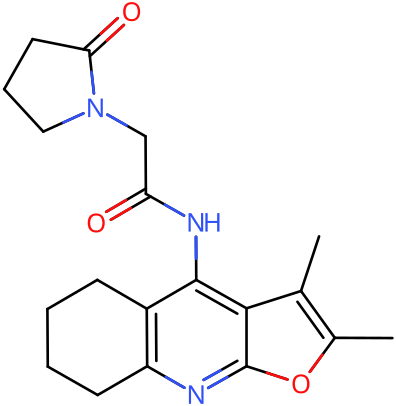
Coluracetam Stats & Data
O=C1CCCN1CC(=O)Nc1c2CCCCc2nc2oc(C)c(C)c12PSPGQHXMUKWNDI-UHFFFAOYSA-NReceptor Profile
Receptor Actions
Toxicity
PsychonautWikiThe toxicity and long-term health effects of recreational coluracetam use do not seem to have been studied in any scientific context and the exact toxic dosage is unknown. This is because coluracetam has very little history of human use. Anecdotal evidence from people who have tried coluracetam within the community suggests that there do not seem to be any negative health effects attributed to simply trying this drug at low to moderate doses by itself and using it sparingly (but nothing can be completely guaranteed). It is strongly recommended that one use harm reduction practices when using this substance.
Effect Profile
CuratedStrong focus and stimulation with low euphoria and anxiety/jitters
Tolerance & Pharmacokinetics
drugs.wikiTolerance Decay
Tolerance patterns are based on community reports (no controlled human data). Many users report diminishing returns with daily use and prefer spacing doses to a few days per week. Cross‑tolerance between racetams is plausible but unquantified.
Cross-Tolerances
Experience Report Analysis
ErowidDemographics
Gender Distribution
Too few reports for a chart: gender is known from 1 report, and a split is drawn only from 20 reports or more. Counts are shown instead. Why 20?
- Not Specified 1 of 1
Age Distribution
Reports Over Time
Legal Status
| Country | Status | Notes |
|---|---|---|
| Australia | Coluracetam is a schedule 4 substance in Australia under the Poisons Standard (February 2020). | A schedule 4 substance is classified as "Prescription Only Medicine, or Prescription Animal Remedy – Substances, the use or supply of which should be by or on the order of persons permitted by State or Territory legislation to prescribe and should be available from a pharmacist on prescription." |
Harm Reduction
drugs.wikiColuracetam (MKC-231) is an experimental racetam-class compound with no approved medical indications; DrugBank lists it as an experimental small-molecule, and there is no established human safety dossier—treat cautiously and avoid daily long-term use without medical oversight. In animals with cholinergic damage, MKC-231 enhances high‑affinity choline uptake (HACU)—the rate‑limiting step in acetylcholine synthesis—by increasing CHT1 transporter availability at synaptic membranes; this mechanistic action underlies its nootropic interest but also implies additive effects with other cholinergic agents. Preclinical work shows procognitive effects after repeated dosing even when the drug is no longer detectable in brain at 24 h, which suggests short residence time with downstream transporter regulation; do not assume prolonged presence or redose prematurely. Human pharmacokinetics are not published; duration and onset figures come from community reports and aggregator timelines—expect variability and begin at the low end of dose ranges. Sublingual administration produces a faster onset and greater potency per mg than oral; because typical effective doses are in the single‑digit milligram range, use a calibrated milligram scale and avoid eyeballing powders—several users describe unpleasant visual/photophobic episodes after overdoing sublingual doses. Visual “HD/bright color” effects and mild photophobia have been reported anecdotally; avoid driving or hazardous tasks until you understand your response. Headache is commonly reported; while many users co‑dose dietary choline, remember that acetylcholine synthesis is constrained by choline transport capacity, so stacking multiple cholinergics (AChE inhibitors, high‑dose choline donors, nicotine) can tip into nausea, sweating, tremor or anxiety—back off and separate agents if this occurs. Because market products are unregulated, potency and purity vary; favor vendors with third‑party analyses and start with single‑agent trials before any stacks (other racetams, stimulants, or GABAergics). Many users report rapid tolerance or shifting effects with frequent use; spacing doses (e.g., 2–3 non‑consecutive days per week) is a common harm‑reduction practice. If you take prescription cholinergic therapies (e.g., for dementia or myasthenia) or have conditions sensitive to cholinergic tone, consult your clinician before any use; evidence in pregnancy/breastfeeding is absent—avoid.
References
Cited References
- Bessho et al. (1996) - Effect on water maze learning deficits
- Braintropic - Coluracetam Overview
- Murai et al. (1994) - MKC-231 ameliorates working memory deficits
- NootropicsExpert - Coluracetam Review
- Shirayama et al. (2007) - MKC-231 antagonizes phencyclidine-induced deficits
- Takashina et al. (2008) - MKC-231 mode of action in choline uptake
- Reddit: r/Nootropics – How do you dose Coluracetam? (2014)
- Bluelight: Coluracetam user thread (2013)
- Reddit: r/Nootropics – Long-term tolerance report (2015)
- SelfDecode – Coluracetam interactions
Additional references
- DrugBank – Coluracetam (DB21278) identification/experimental status
- PubChem – Coluracetam compound record (CID 214346)
- MKC‑231 improves HACU and ACh release in cholinergically lesioned rats (AF64A)
- MKC‑231 Mode of Action: increases CHT1 trafficking and HACU Vmax
- MKC‑231 repeated dosing: procognitive effects persist; not detected in brain at 24 h
- Basic Neurochemistry – ACh synthesis limited by high‑affinity choline uptake
- Bluelight community thread – Coluracetam experiences (dose/effects variability)
- Reddit r/Nootropics – User reports of visual brightness/photophobia and sublingual sensitivity
- SubstanceSearch – Coluracetam timeline summary (onset/duration)
- Reddit r/Nootropics – First‑hand sublingual dosing reports and variable responses