
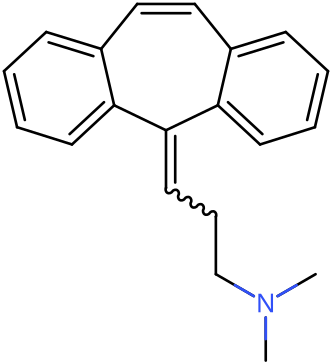
Cyclobenzaprine Stats & Data
JURKNVYFZMSNLP-UHFFFAOYSA-NPharmacology
DrugBankDescription
Cyclobenzaprine, a centrally-acting muscle relaxant, was first synthesized in 1961 and has been available for human use since 1977. It was initially studied for use as antidepressant given its structural similarity to tricyclic antidepressants - it differs from Amitriptyline by only a single double bond. Since its approval, it has remained relatively popular as an adjunctive, short-term treatment for acute skeletal muscle spasms secondary to musculoskeletal injury.
Mechanism of Action
The exact mechanism of action of cyclobenzaprine has not been fully elucidated in humans, and much of the information available regarding its mechanism has been ascertained from early animal studies. There is some evidence that cyclobenzaprine exerts its effects at the supraspinal level, specifically within the locus coeruleus of the brainstem, with little-to-no action at neuromuscular junctions or directly on skeletal musculature. Action on the brainstem is thought to result in diminished activity of efferent alpha and gamma motor neurons, likely mediated by inhibition of coeruleus-spinal or reticulospinal pathways, and ultimately depressed spinal cord interneuron activity. More recently it has been suggested that inhibition of descending serotonergic pathways in the spinal cord via action on 5-HT2 receptors may contribute to cyclobenzaprine’s observed effects.
Pharmacodynamics
Cyclobenzaprine is a skeletal muscle relaxant that works on areas of the brainstem to reduce skeletal muscle spasm, though its exact pharmacodynamic behaviour is currently unclear. Despite its long half-life, it is relatively short-acting with a typical duration of action of 4-6 hours. Cyclobenzaprine has been reported to contribute to the development of serotonin syndrome when used in combination with other serotonergic medications. Symptoms of serotonin syndrome may include autonomic instability, changes to mental status, neuromuscular abnormalities, or gastrointestinal symptoms - treatment with cyclobenzaprine should be discontinued immediately if any of these reactions occur during therapy.
Metabolism
Cyclobenzaprine is extensively metabolized in the liver via both oxidative and conjugative pathways. Oxidative metabolism, mainly N-demethylation, is catalyzed primarily by CYP3A4 and CYP1A2 (with CYP2D6 implicated to a lesser extent) and is responsible for the major metabolite desmethylcyclobenzaprine. Cyclobenzaprine also undergoes N-glucuronidation in the liver catalyzed by UGT1A4 and UGT2B10, and has been shown to undergo enterohepatic circulation.
Absorption
The oral bioavailability of cyclobenzaprine has been estimated to be between 0.33 and 0.55. Cmax is between 5-35 ng/mL and is achieved after 4 hours (Tmax). AUC over an 8 hour dosing interval was reported to be approximately 177 ng.hr/mL.
Indication
Cyclobenzaprine is indicated as a short-term (2-3 weeks) adjunct therapy, along with rest and physical therapy, for relief of muscle spasm associated with acute, painful musculoskeletal conditions. It has not been found effective in the treatment of spasticity originating from cerebral or spinal cord disease, or spasticity in children with cerebral palsy. Cyclobenzaprine is also occasionally used off-label for reducing pain and sleep disturbances in patients with fibromyalgia.
Half-life
The effective half-life of cyclobenzaprine in young healthy subjects is approximately 18 hours. These values are extended in the elderly and those with hepatic insufficiency, with a mean effective half-life of 33.4 hours and 46.2 hours in these groups, respectively.
Protein Binding
Cyclobenzaprine is approximately 93% protein bound in plasma. It has been identified as specifically having a high affinity for human serum albumin.
Elimination
After administration of a radio-labeled dose of cyclobenzaprine, 38-51% of radioactivity was excreted in the urine while 14-15% was excreted in the feces. Cyclobenzaprine is highly metabolized, with only approximately 1% of this same radio-labeled dose recovered in the urine as unchanged drug. Metabolites excreted in the urine are likely water-soluble glucuronide conjugates.
Volume of Distribution
The volume of distribution of cyclobenzaprine is approximately 146 L. The combination of high plasma clearance despite a relatively long half-life observed with cyclobenzaprine is suggestive of extensive tissue distribution.
Clearance
The approximate plasma clearance of cyclobenzaprine is 0.7 L/min.
Manifestations of toxicity may develop rapidly after a cyclobenzaprine overdose, and rarely, death may occur. The most common toxic effects associated with cyclobenzaprine overdose are drowsiness and tachycardia; less frequent manifestations include tremor, agitation, coma, ataxia, hypertension, slurred speech, confusion, dizziness, nausea, vomiting, and hallucinations. Cyclobenzaprine is structurally and pharmacologically related to tricyclic antidepressants. Among the most dreaded toxicities linked with cyclical antidepressants, overdoses affect fast-acting sodium channels in the cardiac conduction system.
Toxicity (DrugBank)
The oral LD50 of cyclobenzaprine in mice and rats is 338 mg/kg and 425 mg/kg, respectively. Signs of overdose may develop rapidly after ingestion and commonly include significant drowsiness and tachycardia, with less common manifestations including tremor, agitation, ataxia, GI upset, and other CNS effects such as confusion and hallucinations. Potentially critical manifestations, though rare, include cardiac arrest or dysrhythmias, severe hypotension, seizures, and neuroleptic malignant syndrome. As the management of cyclobenzaprine overdose is complex and ever-changing, it is recommended that a poison control center be consulted prior to treatment. Typical management involves gastrointestinal decontamination, close cardiac monitoring, and monitoring for signs of CNS or respiratory depression. As cyclobenzaprine exists in relatively low concentrations in plasma, monitoring of drug plasma levels should not guide management and dialysis is likely of no value.
Tolerance & Pharmacokinetics
drugs.wikiTolerance Decay
Tolerance to daytime sedation can develop over several days of repeated use. Given sparse formal data, these values are approximate and based on class inferences and user reports rather than controlled studies.
Cross-Tolerances
Experience Report Analysis
ErowidDemographics
Gender Distribution
Age Distribution
Reports Over Time
Effect Analysis
ErowidEffects aggregated from 35 experience reports (35 single-substance Erowid)
Effect Sentiment Distribution
Confidence Distribution
Each bar is the share of reports mentioning the effect; its whisker, and the band on the rows below, is the 95% interval: where the share could plausibly be with other reports of the same kind.
Positive Effects 3
Adverse Effects 1
Show 1 neutral or unclassified mention
Also reported in combinations. In the 27 Cyclobenzaprine reports where another drug was taken too, 2 (7.4%) mention hospital, emergency services or an overdose, 1 (3.7%) a seizure and 0 (0.0%) psychosis. In the 35 single-substance reports: 2.9%, 0.0% and 0.0%. These are not in the figures above: they cannot be put down to Cyclobenzaprine alone, and a mention is not always something that happened to the writer.
Dose-Response Correlation
How effect frequency changes across dose levels. Whiskers, and the numbers' hover text, give each figure's 95% interval.
Not drawn, too few reports (a dose tier needs 20): Oral Heavy (n=13). Why 20?
Dosage Distribution
Dose distribution from experience reports, one dose per report (the first listed). Doses above Q3 + 3×IQR, far above what people typically take, are left out of the median and range and listed under each route: most are real heavy doses or overdoses, not mistakes.
Real-World Dose Distribution
ErowidFrom 97 of 101 recorded dose entries: those that state a weight (mg, g or µg), in routes with at least five of them. Values above Q3 + 3×IQR, far above what people typically take, are left out; they can include real heavy doses and overdoses, not only mistakes.
Oral (n=83)
Insufflated (n=7)
Common Combinations
Most co-occurring substances, as a share of all 62 reports filed under Cyclobenzaprine; whiskers are 95% intervals
Form / Preparation
Most common forms and preparations, as a share of the 49 reports that give one; whiskers are 95% intervals
Body-Weight Dosing
Dose per kg of body weight, one dose per report (the first listed), from reports giving a weight of 30–250 kg. Doses above Q3 + 3×IQR, far above what people typically take, are left out of the median and range and listed under each route.
2 reports gave a dose above the typical range (3.15–8.475 mg/kg), so they are not in the figures above. Listing a dose here does not mean it is safe.
Show the reports
Redose Patterns
Redosing behavior across 52 reports
Harm Reduction
drugs.wikiCyclobenzaprine has a long effective half-life (about 18 hours IR; ~32 hours ER) and effects can persist into the next day, so plan for next‑day drowsiness and do not drive or operate machinery until fully alert. It is intended for short‑term use (generally ≤ 2–3 weeks) alongside rest and physical therapy; prolonged use lacks strong evidence and increases adverse effects. It is contraindicated in hyperthyroidism, during the acute recovery phase of myocardial infarction, and in patients with arrhythmias, heart block/conduction disturbances, or heart failure. Combining with serotonergic drugs (e.g., SSRIs/SNRIs/MAOIs) has produced case‑reported serotonin syndrome; discontinue and seek care if agitation, hyperreflexia, clonus, or autonomic instability occur. Additive CNS depression occurs with alcohol, opioids, benzodiazepines, and Z‑hypnotics; avoid mixing or use minimal doses with extended spacing if medically unavoidable. Potent anticholinergic properties can cause dry mouth, blurred vision, constipation, urinary retention, confusion, and at high doses anticholinergic delirium; avoid dehydration and hot environments and monitor for urinary retention, especially in males with BPH. Overdose shares tricyclic‑like cardiotoxicity (QRS widening, arrhythmias) and seizure risk; emergent care should include ECG monitoring and serum alkalinization with sodium bicarbonate when QRS is prolonged. Extended‑release capsules must not be chewed or crushed; if swallowing is difficult, contents may be sprinkled on applesauce and swallowed without chewing, then rinse the mouth to avoid retained granules. Hepatic impairment and older age substantially prolong half‑life and raise exposure, warranting lower starting doses (e.g., 5 mg) or avoidance in moderate–severe hepatic disease. Although euphoria is occasionally reported anecdotally at high doses, sedation, dysphoria, and delirium are more common outcomes; deliberate recreational escalation is therefore high‑risk and not recommended.