
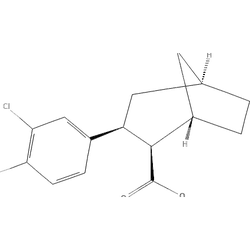
Dichloropane Stats & Data
O-401
Rti-111
PubChem
MW314.2
FormulaC15H17Cl2NO2
LogP3.4
IUPACmethyl (1R,2S,3S,5S)-3-(3,4-dichlorophenyl)-8-azabicyclo[3.2.1]octane-2-carboxylate
SMILES
COC(=O)C1C2CCC(N2)CC1C3=CC(=C(C=C3)Cl)ClInChIKey
JFUNLJPTPCQLIR-PJQZNRQZSA-N
Chemical Class
Phenyltropane
Psychoactive Class
Stimulant
Receptor Profile
Receptor Actions
Inhibitors
Serotonin-norepinephrine-dopamine reuptake inhibitor (SNDRI)
Other
blocks dopamine transporter (DAT IC50: 0.79 nM)
blocks serotonin transporter (SERT IC50: 3.13 nM)
blocks norepinephrine transporter (NET IC50: 18 nM)
Toxicity
PsychonautWikiThe toxicity and long-term health effects of recreational dichloropane use has not been studied in any scientific context and the exact toxic dosage is unknown. This is because dichloropane has very little history of human usage. In terms of neurotoxicity (as defined by the damage or death of cells in the brain in response to over-excitation or reactive oxidation caused by drugs), it is reasonable to assume that like other stimulants which work principally through reuptake inhibition (e.g. cocaine), dichloropane should not exhibit these effects unlike certain other substances such as methamphetamine, which have suspected mechanisms of direct neurotoxicity.
Effect Profile
Curated
Stimulant
5.2
Moderate focus and stimulation with strong anxiety/jitters, mild euphoria
Stimulation / Energy×3
6
Euphoria / Mood Lift×2
5
Focus / Productivity×2
7
Anxiety / Jitters×1
10
Tolerance & Pharmacokinetics
drugs.wikiTolerance Decay
Full tolerance
1d
Half tolerance
10d
Baseline
~18d
Legal Status
| Country | Status | Notes |
|---|---|---|
| Germany | Dichloropane is not a controlled substance under the BtMG ( Narcotics Act ) or the NpSG ( New Psychoactive Substances Act ). | Technically it would fall under the definition of a medicine by §2 AMG ( Medicines Act ) because it induces a pharmacological effect. By a decision of the European Court of Justice, this definition was declared ineffective because it was not compatible with EU law. Dichloropane can be considered unregulated. |
| Switzerland | Dichloropane is a controlled substance specifically named under Verzeichnis E. | |
| United States | Dichloropane may be considered to be an analogue of cocaine under the Federal Analogue Act. | The Federal Analogue Act, 21 U.S.C. § 813, is a section of the United States Controlled Substances Act, allowing any chemical "substantially similar" to an illegal drug (in Schedule I or II) to be treated as if it were also in Schedule I or II, but only if it is intended for human consumption. |
References
Cited References
- Bluelight: RTI-111 (Dichloropane) Dosage Info Discussion
- Bluelight: RTI-111 (Dichloropane) Experience Reports
- Carroll et al. 2005: Synthesis and Monoamine Transporter Binding Properties
- Ranaldi et al. 2000: Reinforcing and Discriminative Stimulus Effects in Rhesus Monkeys
- TripSit: Drug Combinations Wiki
- TripSit: RTI-111 Factsheet